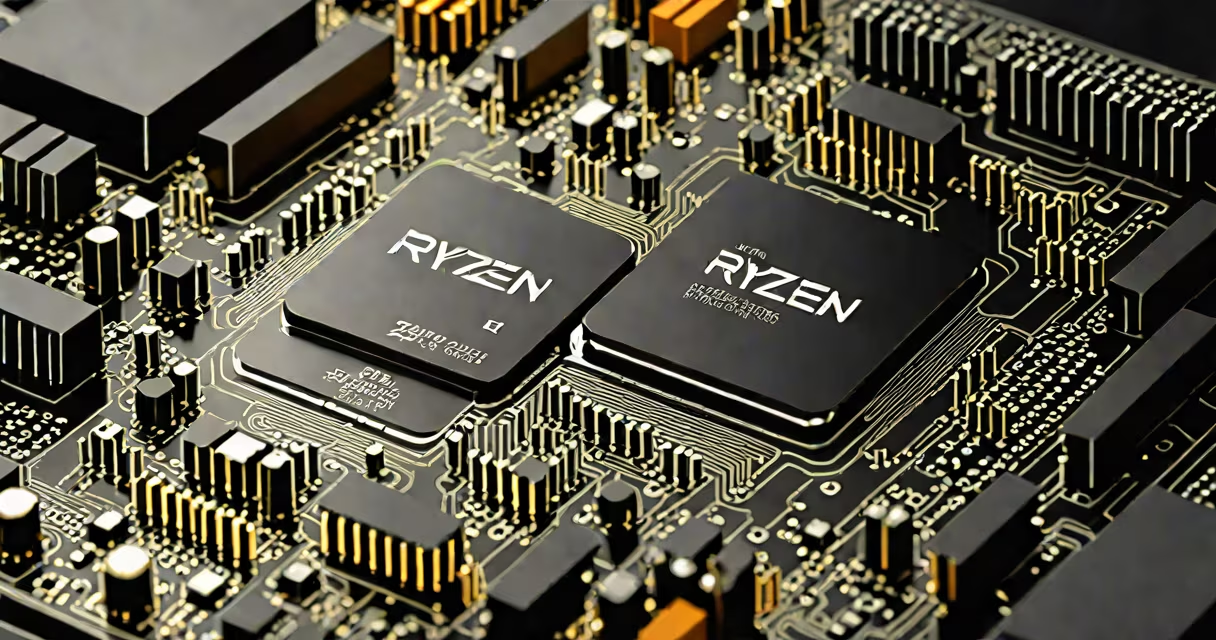
Ryzen is the brand name AMD uses for its line of multi-core desktop, mobile, and server processors, introduced in 2017. It represents AMD's return to competitive performance in the CPU market, emphasizing speed, core count, and power efficiency.
The name "Ryzen" was chosen to evoke strength, innovation, and forward momentum. It derives from the Greek word "rýzō," meaning "to rise" or "to grow." AMD selected it to reflect the company's resurgence after years of underperformance in the x86 CPU space. The branding aligns with AMD's goal to position Ryzen as a premium alternative to Intel's Core series.
Since its launch, Ryzen has evolved through multiple generations-Zen, Zen 2, Zen 3, Zen 4, and Zen 5-each bringing architectural improvements, higher clock speeds, better single-threaded performance, and enhanced power management. Ryzen processors are available in models ranging from the entry-level Ryzen 3 to the high-end Ryzen 9 and Threadripper variants.
Ryzen CPUs are built using advanced semiconductor processes, currently 5nm for the latest Zen 5 architecture. They feature multiple cores and threads-up to 128 threads in the Threadripper Pro 7000 series-enabling efficient multitasking and heavy workloads like video rendering, 3D modeling, and live streaming.
Each Ryzen chip includes a combination of components: the compute dies (CCDs), which house the CPU cores and cache; the I/O die (IOD), which manages memory, PCIe lanes, and USB connections; and the integrated graphics (iGPU) in non-graphics models. The interconnect between these dies uses a high-speed link called Infinity Fabric, which ensures low-latency communication.
For example, the Ryzen 7 7800X3D features 8 cores, 16 threads, and 3D V-Cache technology that adds 64MB of additional L3 cache. This design boosts performance in games by reducing memory latency. In benchmarks, it outperforms the Intel Core i7-13700K in titles like Cyberpunk 2077 and Red Dead Redemption 2 by 10-15% due to faster access to game assets.
Ryzen is divided into product lines based on intended use. The main categories are:
| Line | Use Case | Core Count Range | Example Model |
|---|---|---|---|
| Ryzen 3 | Entry-level desktops, budget builds | 4-6 cores | Ryzen 5 5600 |
| Ryzen 5 | Mid-range gaming, content creation | 6-8 cores | Ryzen 7 7700X |
| Ryzen 7 | High-performance tasks, professional workloads | 8-16 cores | Ryzen 9 7950X |
| Threadripper | Workstations, 3D rendering, simulation | 16-128 cores | Threadripper Pro 7995WX |
Each model includes a suffix indicating special features. For example, the "X" denotes a higher clock speed and unlocked multiplier for overclocking. The "G" variant includes integrated graphics, useful for systems without a discrete GPU. The "3D" label indicates the presence of 3D V-Cache, which improves gaming performance by stacking cache layers vertically.
A common misconception is that Ryzen processors are only for gaming. While they excel in gaming due to high core counts and low latency, they're equally effective in professional applications. A 2023 study by AnandTech showed that the Ryzen 9 7950X outperformed Intel's top-tier desktop CPU in Blender rendering tests by 22%.
Many users assume that "Ryzen" refers only to desktop CPUs. In reality, AMD markets Ryzen across multiple product lines: Ryzen Mobile for laptops, Ryzen Embedded for industrial systems, and Ryzen AI for devices with on-device machine learning acceleration.
Another misunderstanding is that Ryzen is synonymous with "AMD." While all Ryzen processors are made by AMD, not all AMD products carry the Ryzen name. For example, AMD's Radeon GPUs and EPYC server CPUs do not use the Ryzen branding. The term "Ryzen" specifically applies to the CPU product family.
There's also confusion around the naming convention. The numbers after "Ryzen" indicate generation and tier. For example, "Ryzen 7 7800X3D" means it's part of the 7000 series (Zen 5), a 7000-level model (mid-to-high tier), and includes the 3D V-Cache feature. The "X" denotes overclockability, while the "F" version lacks integrated graphics.
I once built a custom PC for a streamer using a Ryzen 5 5600X. The system ran smoothly during 10-hour Twitch sessions, handling OBS encoding, game playback, and chat interaction without thermal throttling. The 65W TDP kept temperatures below 70°C under load-a key reason why Ryzen remains popular in compact builds.
Ryzen disrupted the CPU market by offering more cores and better performance-per-dollar than Intel's offerings at the time. The Ryzen 5 3600, priced at $200 in 2019, delivered performance comparable to Intel's $300 Core i7-9700K. This price advantage accelerated adoption in DIY PCs and small businesses.
According to Statista, AMD captured 26% of the global x86 CPU market in Q4 2023, up from 15% in 2017. Much of that growth came from Ryzen's success in both consumer and enterprise segments.
When choosing a Ryzen processor, consider your workload. For gaming, prioritize models with 3D V-Cache. For video editing or software development, focus on core count and memory bandwidth. Always pair Ryzen with DDR5 RAM and a compatible motherboard-using the wrong platform can limit performance.
Understanding what Ryzen means goes beyond the name. It represents a shift in computing: AMD's commitment to performance, competition, and value. upgrading a laptop, Ryzen delivers measurable results across real-world tasks.