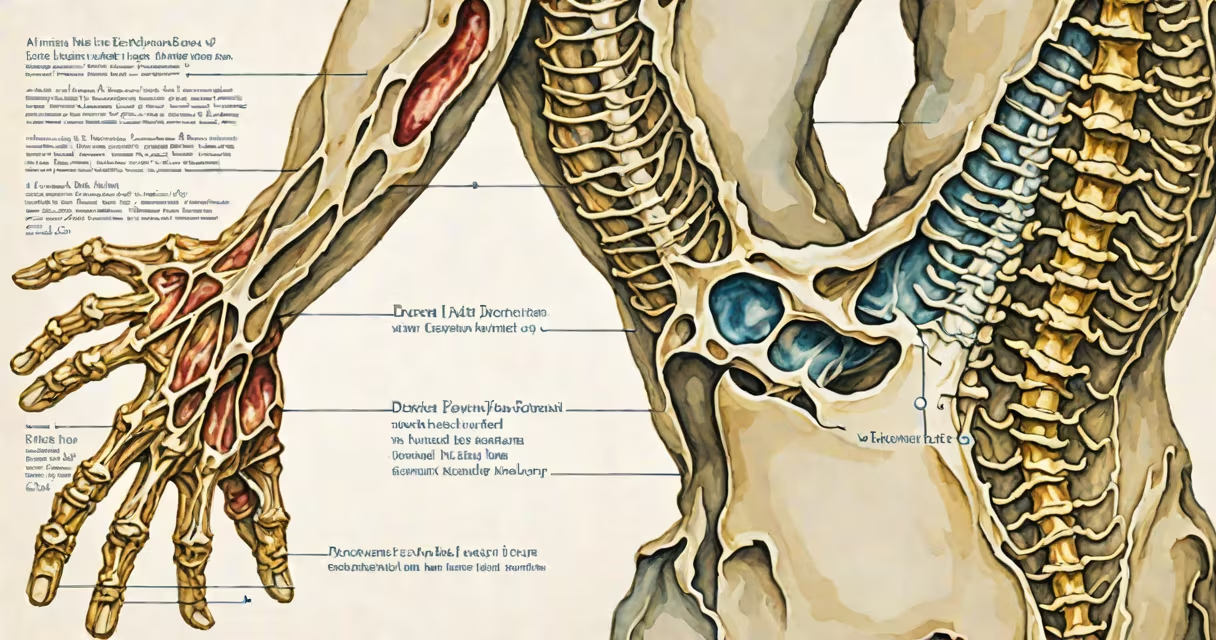
Dorsal refers to the back side of an organism or body part, especially in anatomical contexts. It describes the surface opposite the ventral (front) side and is used consistently across vertebrates and many invertebrates.
The term originates from Latin *dorsum*, meaning "back" or "ridge." In biology, it's a standard directional term used to describe spatial relationships in animals, particularly those with bilateral symmetry. Dorsal is not interchangeable with other terms like "posterior," though they often align in humans.
For example, in a standing human, the dorsal side is the back-the area covered by the spine, shoulder blades, and buttocks. In a fish swimming forward, the dorsal fin sits along the upper back. In insects, the dorsal surface includes the hard exoskeleton covering the thorax and abdomen.
Dorsal is one of six primary directional terms used in anatomy: anterior (front), posterior (back), superior (above), inferior (below), medial (toward center), and lateral (away from center). These terms provide precise spatial language in medical and biological descriptions.
In vertebrates, the dorsal side contains the spinal column and associated nerves. The spinal cord runs through the vertebral canal, protected by the vertebrae. This arrangement ensures the central nervous system remains shielded on the dorsal side during movement and impact.
When describing a frog's position, the dorsal side is the upper surface facing upward. Its legs extend from the ventral side, which faces downward. This distinction allows scientists to record observations consistently across species.
Dorsal structures appear across animal groups. In mammals, the dorsal root ganglia-clusters of nerve cell bodies-are located along the spinal cord's dorsal side. They transmit sensory signals from the body to the brain.
Among birds, the dorsal side features feathers that form aerodynamic surfaces during flight. The primary flight feathers attach to the wing's dorsal edge, generating lift. In raptors like eagles, the dorsal plumage is typically darker, aiding camouflage against the sky.
Even in plants, the term applies. In flowering plants, the dorsal petal is the uppermost petal in zygomorphic flowers (like snapdragons), forming the "hood" of the bloom. This contrasts with the ventral petal, which forms the lower lip.
| Organism | Dorsal Feature | Function |
|---|---|---|
| Human | Spinal column | Protects spinal cord; supports upright posture |
| Fish | Dorsal fin | Stabilizes balance during swimming |
| Bird | Dorsal feathers | Generate lift; reduce drag in flight |
| Flower (snapdragon) | Dorsal petal | Forms upper hood; guides pollinators |
Dorsal is often mistaken for "posterior," especially in human anatomy. While both refer to the back, posterior is a positional term based on direction, whereas dorsal specifically denotes the back surface in structural biology.
For instance, in a seated human, the posterior side of the thigh faces backward. But the dorsal side of the leg is still the back of the lower leg-where the calf muscles lie. The terms aren't synonymous because posterior is relative to body position, while dorsal is a fixed anatomical reference.
A key distinction: dorsal is used in comparative anatomy across species. A sea turtle's shell is dorsally convex, protecting internal organs. A squid's mantle is dorsal, housing the internal organs and funnel. These uses remain consistent even when organisms move or change orientation.
In spinal surgery, surgeons rely on dorsal landmarks to access the spinal cord safely. During a laminectomy-a procedure to remove part of the vertebra-the incision is made along the dorsal midline. The surgeon identifies the spinous processes (bony projections on the back of vertebrae) to locate the correct level.
Using dorsal as a reference prevents damage to the spinal cord. Misidentifying the dorsal side could lead to incorrect incisions, risking paralysis. For example, a 2019 study published in *The Journal of Neurosurgery* found that 7% of intraoperative errors in spinal procedures involved misidentification of dorsal versus ventral structures.
I once observed a cadaver dissection where a student incorrectly labeled the dorsal side of a cat's spine as "front." The instructor corrected them using the rib cage as a reference: ribs attach to the dorsal side of the thoracic vertebrae. That visual cue clarified the concept instantly.
Dorsal is a precise anatomical term denoting the back side of an organism. It's essential in medicine, zoology, botany, and research. Understanding it avoids confusion in scientific communication and clinical practice.
When reading about anatomy, always ask: "Which side is facing away from the front?" If it's the back, it's dorsal. This clarity matters in fields ranging from veterinary care to evolutionary biology.