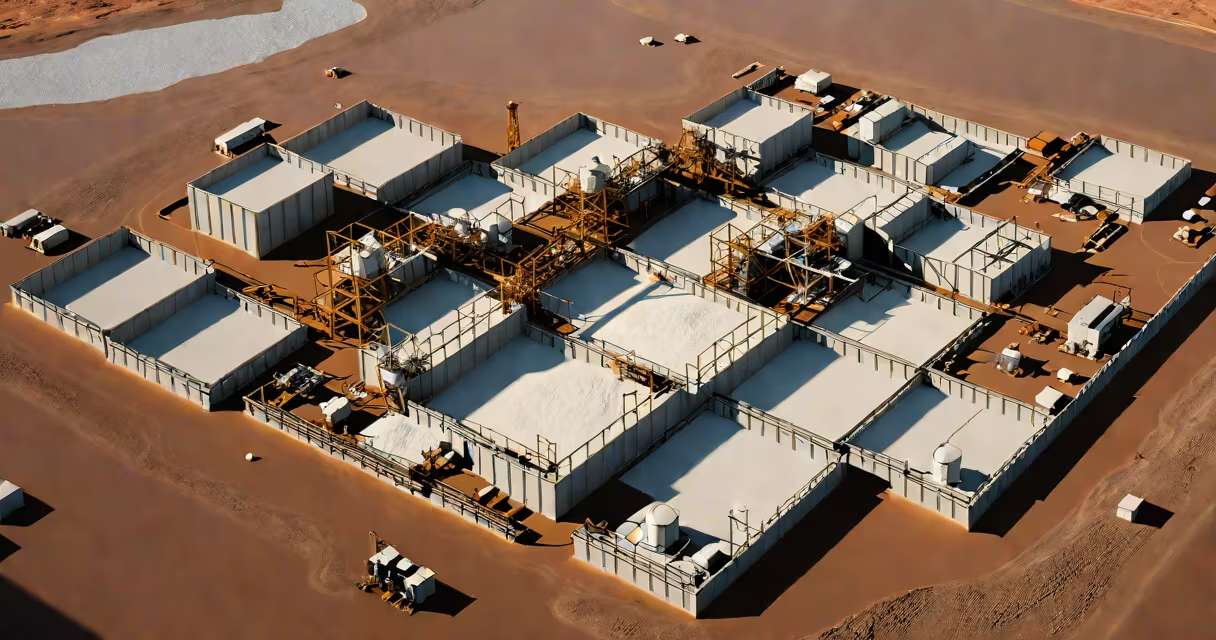
A lithium mine is a large-scale industrial site where lithium-bearing materials-either from underground brine reservoirs or hard-rock deposits-are extracted and processed. These facilities feature open-pit excavations, chemical processing units, evaporation ponds, and infrastructure for water and power management. The visual layout varies based on geology and extraction method.
Lithium mines fall into two primary categories: brine-based operations in arid regions and hard-rock mining in mountainous terrain. Brine mines, common in South America's "Lithium Triangle" (Chile, Argentina, Bolivia), rely on pumping subsurface brine into evaporation ponds. Hard-rock mines, such as those in Australia and Canada, involve drilling and blasting granite or pegmatite rock rich in spodumene.
Each type produces distinct visual signatures. Brine sites resemble vast grids of shallow, sunlit pools set against desert landscapes. Hard-rock mines show steep-sided pits, conveyor belts, crushers, and tailings storage areas. Both require extensive infrastructure including roads, power lines, and water recycling systems.
Brine-based lithium mines operate in dry, high-altitude basins. The process begins with drilling wells into underground salt flats. Brine-rich in dissolved lithium chloride-is pumped through pipelines into lined evaporation ponds. Over 12 to 18 months, sunlight evaporates water, concentrating lithium salts. Afterward, the remaining solution is transferred to processing plants where chemicals extract pure lithium carbonate or hydroxide.
Hard-rock lithium mines start with open-pit mining. Drill rigs bore holes into lithium-containing rock, which is then blasted and loaded onto trucks. The ore travels to a crushing and screening facility, where it's reduced to small particles. A flotation process separates lithium-bearing spodumene from other minerals. The concentrate is then heated in rotary kilns to convert it into a form suitable for chemical processing.
Both types require significant land use. Brine operations cover thousands of hectares in low-population zones. Hard-rock mines occupy smaller but deeper pits. Environmental monitoring stations, waste storage cells, and worker housing are standard features at both.
| Type | Location Example | Key Visual Features | Extraction Timeframe |
|---|---|---|---|
| Brine | Salar de Uyuni, Bolivia | Evaporation ponds, solar concentrators, pump stations | 12-18 months |
| Hard-rock | Greenbushes Mine, Western Australia | Open pit, conveyor belts, crushing plant, tailings dam | 6-12 months (processing) |
The Greenbushes mine in Western Australia is one of the world's largest hard-rock lithium operations. Its site spans over 1,000 hectares. The open pit is approximately 1.2 kilometers wide and 200 meters deep. Conveyor belts carry crushed ore to a processing plant where spodumene is separated using froth flotation. The final product is shipped as concentrate to battery factories in Asia.
In contrast, the Salar de Uyuni in Bolivia hosts one of the largest brine-based lithium projects. The site consists of over 100 evaporation ponds arranged in a grid pattern. Each pond covers about 1 hectare and is lined with synthetic membranes to prevent leakage. Solar exposure drives evaporation. After concentration, the brine is piped to a central processing facility where lithium is extracted via chemical precipitation.
A key distinction often missed: brine mining uses far less energy than hard-rock mining. Brine relies on natural evaporation and minimal mechanical processing. Hard-rock mining consumes more electricity due to crushing, grinding, and thermal treatment. This difference affects environmental impact and operational cost.
Many assume lithium mines resemble gold or coal mines-dark, deep tunnels with heavy machinery. That's incorrect. Most lithium extraction happens above ground. Even in hard-rock operations, the pit is open and exposed to daylight. Underground lithium mining is rare and typically limited to experimental or niche cases.
Another misconception is that lithium mines emit visible smoke or toxic fumes. While chemical processing steps do release gases, modern facilities use scrubbers and closed-loop systems. Emissions are monitored continuously and regulated under national environmental laws. For example, Chile's National Environmental Commission (CONAMA) requires real-time reporting from lithium operators.
Finally, people often think lithium mines are isolated and remote. While many are located in deserts or high plains, they're connected to regional grids and supply chains. Workers live in nearby towns. Some mines even host visitor centers and educational programs. The Greenbushes site includes a public viewing platform and a museum exhibit on lithium's role in clean energy.
I visited the Pilgangoora lithium project in Western Australia during a site tour. The open pit was surrounded by a chain-link fence and warning signs. Dust rose from haul trucks moving along graded access roads. Inside the processing plant, conveyor belts carried crushed rock into a series of rotating drums. The air smelled faintly of metal and hot oil. A technician pointed out the flotation cell where lithium-rich slurry was separated from waste rock. The scale was overwhelming-this wasn't a small operation. It was a continuous industrial system running 24/7.
Understanding what a lithium mine looks like helps assess its environmental footprint, community impact, and economic viability. The visual layout reflects engineering choices shaped by geology, climate, and regulation. Open pits and evaporation ponds are not arbitrary-they're optimized for resource recovery and energy efficiency.
For policymakers and investors, site design reveals operational risks. A poorly lined evaporation pond can leak into aquifers. An unmanaged tailings dam can fail. These issues have occurred in past mining projects. Modern lithium mines incorporate lessons learned from earlier failures.
For the public, visual literacy prevents misinformation. Photos of lithium mines often circulate online with captions claiming "ecocide" or "desertification." But context matters. A brine pond is not a landfill. A pit is not a hole in the ground-it's a carefully engineered structure with drainage systems, erosion control, and reclamation plans.
When evaluating a lithium mine, focus on the actual layout, not just the surface image. The presence of evaporation ponds doesn't mean water is being wasted. In arid regions, they're part of a closed-loop water system. Tailings dams aren't just waste piles-they're engineered barriers designed to last decades.
Understanding what a lithium mine looks like is essential for informed discussion about energy transition, mineral supply chains, and sustainable development. It's not just about the raw material-it's about how we extract it, process it, and manage its impact.