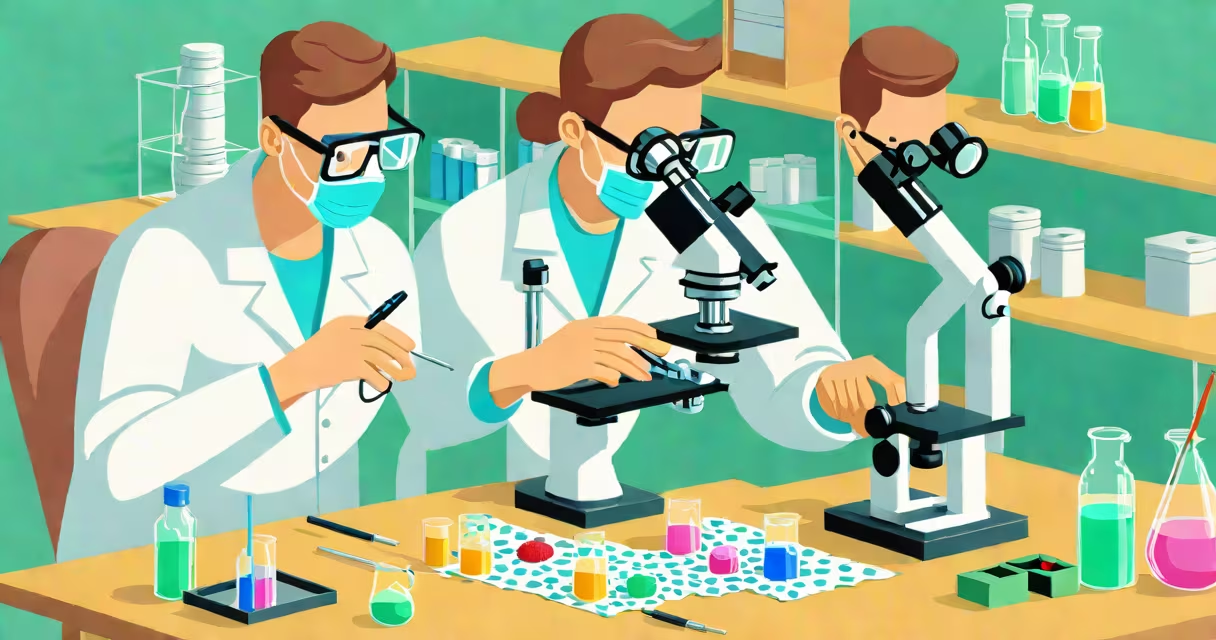
A chemical technologist conducts laboratory analyses to identify the composition, structure, and properties of chemical substances. They apply standardized procedures to test materials for purity, stability, and consistency across pharmaceuticals, environmental samples, food products, and industrial chemicals.
These professionals operate instruments such as gas chromatographs, mass spectrometers, and infrared spectrophotometers. Their results support quality assurance, regulatory compliance, and product development. They document findings accurately and often collaborate with chemists and engineers to refine processes.
Chemical technologists typically hold an associate's or bachelor's degree in chemistry, chemical technology, or a related field. Certification from organizations like the American Society for Quality (ASQ) can improve credibility, especially in regulated environments like FDA-approved labs.
They follow established protocols to prepare samples, calibrate equipment, run tests, and interpret data. Each step must be traceable and reproducible to meet audit standards. For example, in a pharmaceutical lab, a chemical technologist may verify that a batch of insulin contains the correct concentration of active ingredient and no contaminants.
Testing often involves multiple stages. A sample might first undergo filtration, then be diluted, and finally analyzed via high-performance liquid chromatography (HPLC). The technologist records retention times, peak areas, and baseline drifts to determine whether results fall within acceptable limits.
When deviations occur, they investigate potential causes-equipment malfunction, human error, or contamination-and report discrepancies. In some cases, they adjust procedures or recommend retesting to ensure reliability.
Chemical technologists perform routine and specialized tasks depending on their industry. In environmental labs, they measure pollutants like lead or PCBs in water samples. In food manufacturing, they test for allergens, pesticides, or microbial growth.
| Industry | Common Tests | Key Instruments |
|---|---|---|
| Pharmaceuticals | Purity of drug compounds, degradation analysis | HPLC, UV-Vis spectrophotometer |
| Food & Beverage | Microbial counts, nutrient content | PCR machines, atomic absorption spectrometer |
| Environmental | Heavy metal levels, pH balance | Ion chromatograph, pH meter |
| Manufacturing | Material strength, thermal stability | Differential scanning calorimeter (DSC) |
Each instrument requires calibration and maintenance. Technologists must understand the underlying principles-not just how to press "start." For instance, knowing that a mass spectrometer ionizes molecules using electron impact helps troubleshoot poor resolution or unexpected peaks.
Chemical technologists are essential in labs that produce or regulate consumer goods. Without them, companies couldn't validate safety claims or pass inspections. The U.S. Bureau of Labor Statistics reports that employment in analytical chemistry roles grew 6% between 2021 and 2031-faster than average-for the sector.
In a real-world scenario, a chemical technologist working for a cosmetics company tested a new moisturizer batch for preservative effectiveness. Using a microbiological assay, they exposed the product to bacteria and fungi over 28 days. After detecting no microbial growth, they confirmed the formulation met shelf-life standards. This result allowed the product to proceed to market.
Another non-obvious role: they often serve as the first line of defense against counterfeit materials. In one case, a technologist identified synthetic melamine in infant formula by analyzing nitrogen content through elemental analysis. The discrepancy led to a recall and strengthened supply chain monitoring.
Many confuse chemical technologists with chemists. While both work with chemicals, chemists design experiments and develop new compounds. Technologists execute tested methods and generate data. A chemist might create a new polymer; a chemical technologist measures its melting point and tensile strength.
Also, unlike general lab assistants, chemical technologists have formal training in analytical techniques. They don't just mix solutions-they understand the reaction kinetics behind them. For example, preparing a titration solution requires knowledge of molarity, stoichiometry, and endpoint indicators.
Some assume all lab work is automated. But even with advanced robotics, human oversight remains critical. A technologist must recognize anomalies-like a sudden spike in absorbance that suggests instrument drift or cross-contamination.
I once observed a chemical technologist in a wastewater treatment facility recalibrating a dissolved oxygen sensor. The device had been giving inconsistent readings during a compliance audit. After checking the calibration curve and cleaning the membrane, the technician restored accuracy. That single fix prevented a violation notice and avoided $20,000 in fines.
Emerging trends include integration of AI-driven data analysis tools. Some labs now use machine learning models to flag outliers in large datasets. However, the technologist still verifies flagged results manually-AI cannot replace domain expertise or hands-on validation.
Understanding what a chemical technologist does reveals a field grounded in precision, accountability, and real-world impact. Their work helps everyday products-from medicines to cleaning agents-are safe, effective, and compliant with regulations.