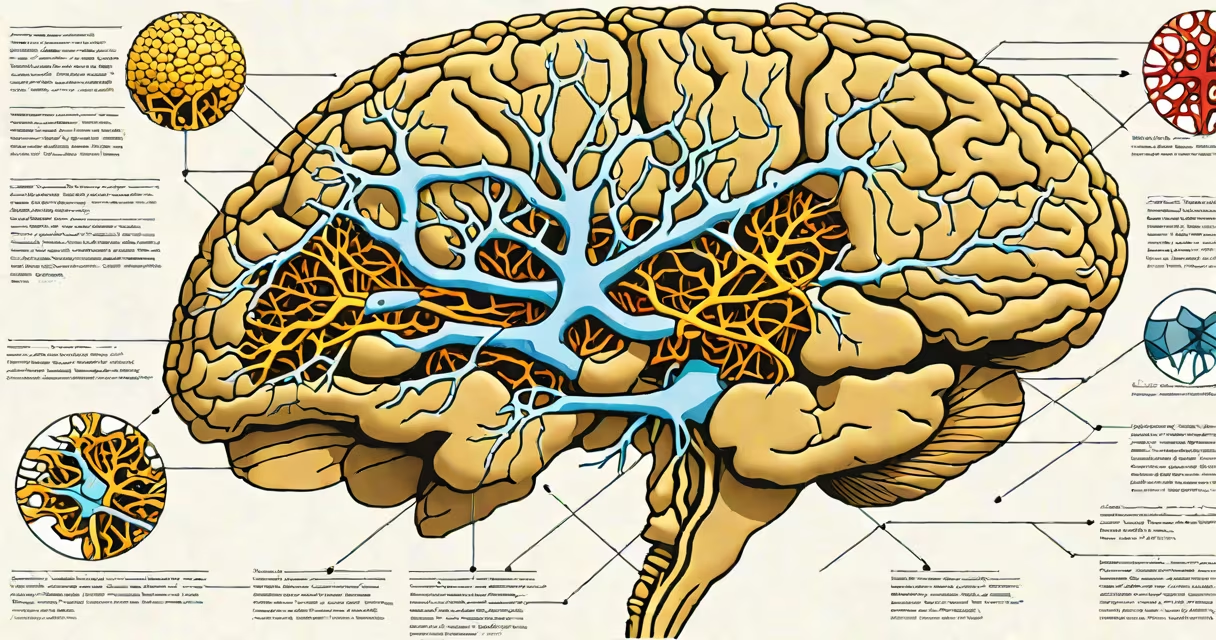
Neurons are specialized cells in the brain that transmit information using electrical impulses and chemical signals. They form vast networks that enable perception, thought, memory, and voluntary movement.
Each neuron receives input through dendrites, processes it in the cell body, and sends output via the axon to other neurons, muscles, or glands. This process happens millions of times per second across the brain's 86 billion neurons.
Neurons communicate at junctions called synapses, where neurotransmitters like dopamine and serotonin cross a tiny gap to influence the next cell. This system allows the brain to adapt, learn, and maintain internal balance.
When a neuron fires, an electrical impulse called an action potential travels down its axon. This impulse is generated when ion channels open in response to incoming signals, causing a rapid shift in voltage across the cell membrane.
The action potential reaches the axon terminal, triggering the release of neurotransmitters into the synaptic cleft-the space between neurons. These chemicals bind to receptors on the receiving neuron, either exciting or inhibiting its activity.
For example, when you touch a hot stove, sensory neurons in your hand send signals to the spinal cord and brain. Motor neurons then activate muscles to pull your hand away-all within 100 milliseconds.
There are three main types of neurons, each serving distinct functions in the nervous system:
| Type | Function | Location | Example |
|---|---|---|---|
| Sensory neurons | Carry signals from senses to the central nervous system | Spinal cord, peripheral nerves | Touch receptors in skin detect pressure |
| Motor neurons | Send commands from brain to muscles and organs | Spinal cord, brainstem | Control leg movement during walking |
| Interneurons | Process information between neurons in the brain and spinal cord | Brain, spinal cord | Integrate visual and auditory cues during conversation |
Interneurons make up about 99% of neurons in the human brain. They handle complex processing such as decision-making, emotional regulation, and long-term memory formation.
A single neuron can connect to thousands of others. The cerebral cortex alone contains over 100 trillion synaptic connections, enabling high-level cognitive functions.
Neurons are essential for all brain functions. Damage to specific neuron populations leads to measurable deficits:
Research shows that even mild traumatic brain injury can reduce neuronal connectivity in the frontal lobes, affecting attention and impulse control.
Neuroplasticity-the brain's ability to reorganize itself-relies on neurons forming new connections. After a stroke, surviving neurons can take over lost functions through synaptic rewiring, especially with rehabilitation.
Many people assume neurons fire randomly or that each neuron controls a single behavior. In reality, neural circuits work in coordinated patterns.
For instance, the decision to move your arm involves hundreds of neurons firing in sequence across the motor cortex, cerebellum, and spinal cord-not one neuron acting alone.
Another misconception is that we only use 10% of our brains. fMRI studies show that nearly all brain regions are active during normal daily tasks, even while resting.
Neurons don't operate independently. A single thought-like recognizing a friend's face-activates distributed networks across the occipital lobe (visual processing), temporal lobe (memory), and prefrontal cortex (identity recognition).
Consider learning to play piano. Initially, movements are clumsy because the brain lacks precise neural pathways. With practice, repeated activation strengthens specific synaptic connections.
After 10 hours of deliberate practice, fMRI scans show increased gray matter density in the motor cortex and enhanced synchronization between left and right hemispheres. This reflects structural changes in neurons and their connections.
These changes are due to long-term potentiation (LTP)-a process where frequent stimulation makes synapses more efficient. LTP is the biological basis of learning and memory.
Without neurons, the brain cannot process sensory input, regulate bodily functions, or generate consciousness. They are the fundamental units of neural computation.
During a routine EEG test, doctors measure electrical activity from neurons firing in sync. Abnormal patterns-such as spikes or slow waves-can indicate epilepsy or encephalopathy.
I once observed a live neuron culture under a microscope during a neuroscience lab. Individual cells extended thin filaments that reached out and connected with neighbors over 24 hours. The network formed spontaneously, mimicking early brain development. Seeing that emergence of structure confirmed how changing and responsive neurons are.
Neurons differ from glial cells, which support and insulate them but do not transmit signals. Glial cells outnumber neurons 10 to 1 in the brain, yet they don't carry information.
Neurons also rely on blood flow to deliver oxygen and glucose. A single neuron consumes about 10 times more energy than a typical cell, making metabolic health important for proper function.
Understanding neurons helps explain why mental states aren't separate from biology. Thoughts, emotions, and behaviors emerge from neural activity. You are not your brain-but your brain is the physical substrate of who you are.
Neurons are not passive wires. They integrate inputs, filter noise, and adapt over time. Their collective activity gives rise to everything the mind experiences.
When you read this sentence, over 100,000 neurons in your visual cortex fired in coordination to interpret the shapes on the screen. Your brain didn't just see letters-it decoded meaning through neural networks shaped by years of language exposure.
What do neurons do in the brain? They process information, store memories, regulate physiology, and generate conscious experience. Without them, there would be no thought, no emotion, no self.