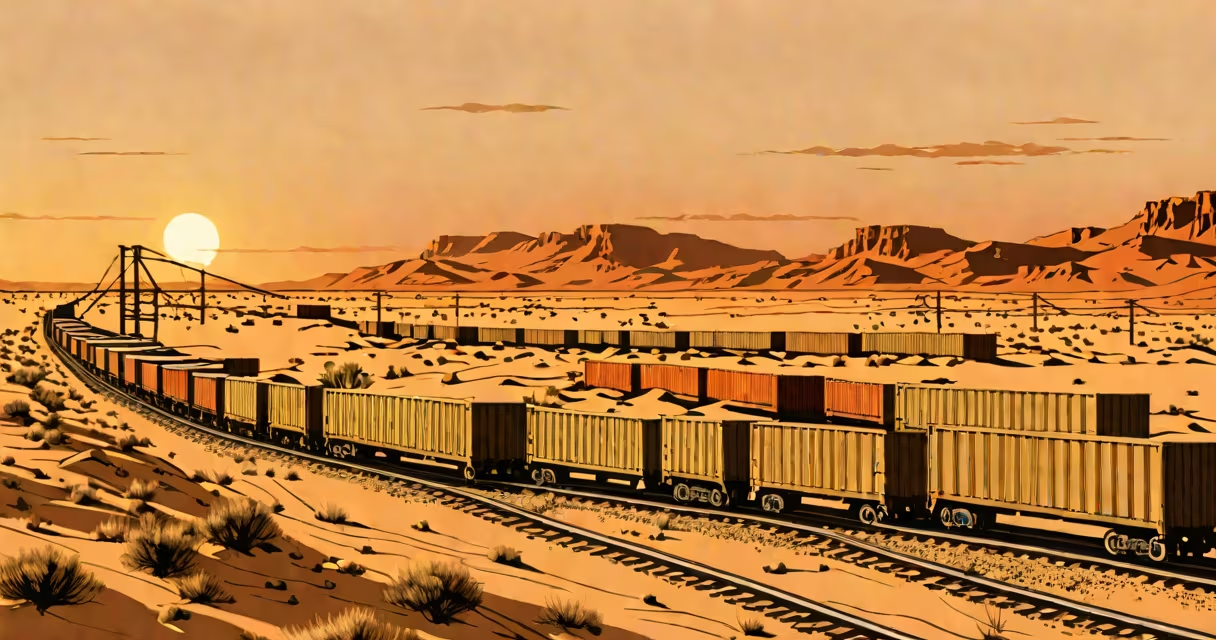
Freight trains transport raw materials, manufactured goods, and consumer products across continents using standardized rail cars. They move millions of tons of cargo annually, linking ports, factories, and distribution centers without relying on highways.
Modern freight rail systems move many goods in specialized railcars designed for safety, efficiency, and load capacity. The most common cargo includes intermodal containers, bulk commodities like coal and grain, and unitized freight such as automobiles and steel coils. These trains operate under strict federal regulations and are engineered to handle heavy loads over long distances with minimal fuel consumption compared to trucks.
According to the Association of American Railroads (AAR), U.S. freight railroads moved 16.7 billion ton-miles of freight in 2023-equivalent to transporting nearly 1.2 million fully loaded 53-foot trailers in a single year. This volume underscores the scale of rail's role in national supply chains.
Freight trains rely on a network of dedicated tracks, signaling systems, and locomotive crews trained to manage complex schedules. Each train consists of multiple railcars connected by couplers and equipped with braking systems that engage automatically during emergencies. Locomotives provide power, while the weight distribution across the train reduces wear on both track and rolling stock.
Trains travel at speeds between 40 and 70 mph depending on terrain and route. On flat, high-capacity corridors like the Union Pacific's mainline through the Midwest, speeds can exceed 60 mph. In mountainous regions or urban zones, speeds drop below 40 mph due to gradients and safety protocols.
A key advantage of rail freight is energy efficiency. The AAR reports that moving a ton of freight one mile by rail uses 3.5 times less fuel than trucking. This efficiency translates into lower greenhouse gas emissions per ton-mile-about 75% less than diesel-powered trucks.
Freight trains use different car types based on cargo shape, weight, and handling requirements. The most common categories include:
| Type | Carries | Common Load Example | Capacity |
|---|---|---|---|
| Intermodal container car | Standard shipping containers | Consumer electronics, clothing, appliances | Two 20-ft or one 40-ft container |
| Flatcar | Heavy machinery, vehicles, oversized cargo | Steel beams, wind turbine blades, military tanks | Up to 100,000 lbs |
| Hopper car | Bulk dry goods | Grain, cement, animal feed | 90,000-120,000 lbs |
| Boxcar | Protected, enclosed cargo | Automobile parts, furniture, electronics | 50,000-70,000 lbs |
| Refrigerated car (reefer) | Perishable goods | Frozen meat, fresh produce, pharmaceuticals | 40,000-60,000 lbs |
Intermodal cars dominate long-haul routes. They carry standard 20- and 40-foot ISO containers stacked two high. These containers are sealed, weatherproof, and designed for transfer between ships, trains, and trucks without reloading.
One non-obvious fact: many freight trains don't carry their cargo in isolation. A single train may have a mix of car types-say, a string of hopper cars carrying wheat followed by boxcars with auto parts and then a flatcar with a decommissioned fighter jet fuselage. This mixed-load model maximizes asset utilization and reduces empty return trips.
Freight trains run on over 140,000 miles of track in the United States alone, primarily owned and maintained by Class I railroads like BNSF, Union Pacific, CSX, and Norfolk Southern. These companies operate regional networks that connect major industrial hubs.
Key corridors include the Chicago-to-Los Angeles route, which handles 30% of all intermodal traffic in the West, and the East Coast corridor from New York to Atlanta, used heavily for moving consumer goods from port cities like Savannah and Baltimore inland.
Why choose rail over truck? For long-distance hauls-especially over 500 miles-rail offers lower cost per ton-mile. A 2022 study by the Federal Railroad Administration found that rail transport costs $0.85 per ton-mile versus $1.50 for trucking on average. This makes rail ideal for bulk and low-value-high-volume shipments.
Many assume freight trains only move raw materials like coal or ore. While those still make up a significant portion-coal accounted for 11% of U.S. rail tonnage in 2023-most rail freight today involves finished goods and intermodal containers.
Another misconception is that rail is obsolete. In reality, rail accounts for 40% of all freight movement in the U.S. by ton-miles, despite representing only 2% of total freight miles traveled. This shows rail's efficiency in moving large volumes over distance.
Some believe freight trains carry only "heavy" or "industrial" cargo. But rail also transports perishables via refrigerated cars, medical supplies, and even live animals. In 2023, over 1.4 million cattle were shipped by rail from Texas to processing plants in Nebraska.
During a trip through the Rocky Mountains in 2021, I observed a westbound freight train carrying 120 intermodal containers from Los Angeles to Denver. The train had 110 cars, including 60 container flats, 30 boxcars, and 20 hopper cars. The entire process took 38 hours-faster than a truck would take due to fewer stops and continuous routing.
While both transport goods, freight trains and freight trucks differ in capacity, speed, and operational scope. Trains move larger payloads over longer distances with lower emissions per ton-mile. Trucks offer door-to-door delivery flexibility and faster turnaround times.
For example, a single freight train can carry 100 containers-equivalent to 100 tractor-trailers. But a truck can deliver directly to a warehouse. The choice depends on geography, time sensitivity, and cost.
When planning logistics, shippers often combine both modes. A shipment from Shanghai to Chicago might go by ship to Los Angeles, then by rail to the Midwest, and finally by truck to the final destination. This multimodal system leverages the strengths of each mode.
Understanding what freight trains carry helps explain how global supply chains function. From the steel used in skyscrapers to the coffee beans in your morning cup, rail freight moves essential goods across continents every day.