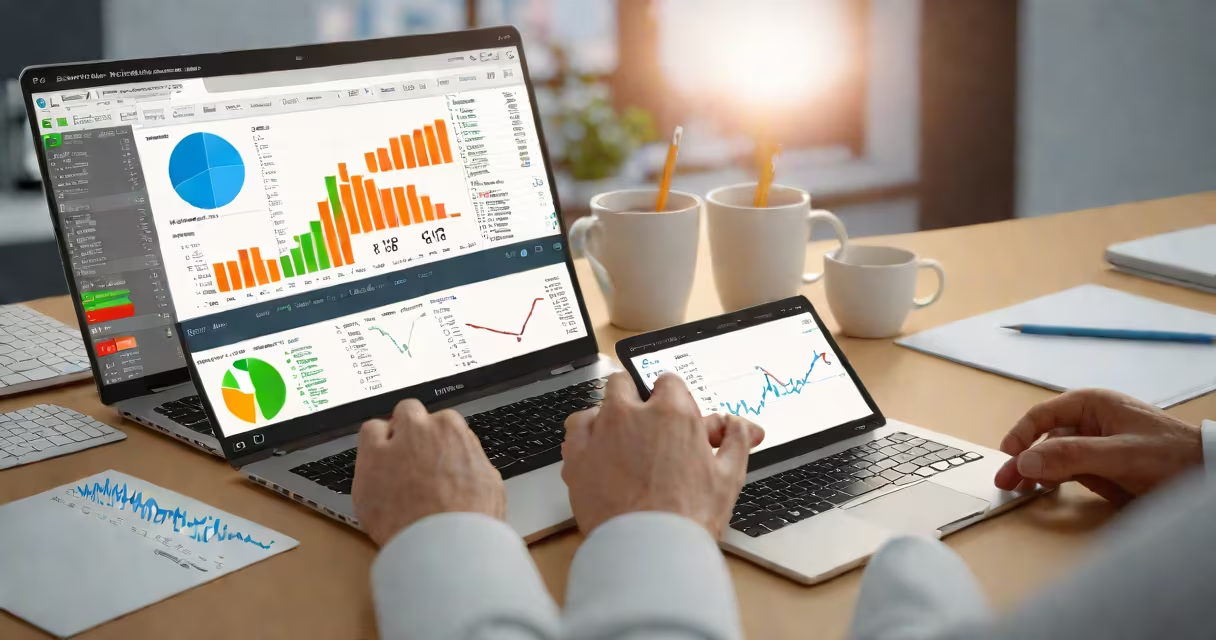
Accounting information consists of organized financial data collected from business transactions, used to measure performance, ensure regulatory compliance, and support management decisions. This data includes income, expenses, assets, liabilities, and equity reported through standardized formats like balance sheets and income statements.
These records are generated through consistent processes-journal entries, ledgers, and periodic reconciliations-ensuring reliability. Public companies must follow Generally Accepted Accounting Principles (GAAP) in the U.S., while international firms often apply International Financial Reporting Standards (IFRS). Without accurate accounting information, organizations cannot verify financial health or meet legal obligations.
For example, a small retail business records daily sales via point-of-sale systems. That data flows into accounting software, categorizes costs (rent, inventory, wages), and generates monthly reports. These reports show net profit, cash flow, and asset values-critical inputs for tax filings, loan applications, and budget planning.
Accounting information begins with transaction capture. Every sale, payment, or purchase triggers a journal entry. These entries are posted to ledgers-digital or physical records grouped by account type (e.g., accounts receivable, depreciation expense).
At month-end, accountants compile these entries into formal financial statements. The income statement shows revenue minus expenses to calculate net income. The balance sheet displays assets, liabilities, and owner's equity at a specific date. The cash flow statement tracks actual cash movements, distinguishing between operating, investing, and financing activities.
These documents are validated through audits. Internal auditors check for errors or fraud. External auditors, hired independently, verify that the numbers comply with GAAP or IFRS. According to the American Institute of CPAs (AICPA), 92% of publicly traded U.S. companies undergo annual external audits to maintain investor confidence.
Accounting information varies by purpose and audience. Internal users-managers and executives-rely on detailed, timely reports. External users-investors, lenders, regulators-need summarized, standardized disclosures.
| Type | Primary Users | Frequency | Example |
|---|---|---|---|
| Financial Statements | Investors, creditors | Quarterly, annually | Income statement, balance sheet |
| Management Reports | Department heads, CEOs | Daily, weekly, monthly | Profitability by product line, departmental budgets |
| Tax Records | IRS, state agencies | Annually, quarterly | Form 1120 for corporations, Schedule C for sole proprietors |
| Payroll Data | HR, employees | Bi-weekly, monthly | Net pay, tax withholdings, benefits deductions |
Internal systems such as ERP platforms (e.g., SAP, Oracle NetSuite) automate much of this work. They integrate data from sales, procurement, HR, and banking systems into a single source of truth. For instance, when a customer pays an invoice, the system updates accounts receivable, reduces outstanding balances, and posts the transaction to the general ledger-all within seconds.
Many confuse accounting information with raw data. A receipt from a vendor is data. When that receipt is categorized under "office supplies" and recorded in the general ledger, it becomes accounting information. The transformation from data to information requires classification, timing, and context.
Another error is assuming accounting information reflects real-time cash position. A company may report $500,000 in revenue for Q1, but if customers haven't paid yet, the cash hasn't arrived. Accrual accounting recognizes revenue when earned-not when cash is received. This difference ensures accurate performance measurement, even when payments lag.
A lesser-known fact: accounting information is not always neutral. The choice of accounting method-like FIFO vs. LIFO for inventory-can alter reported profits. During inflation, FIFO shows higher profits because older, lower-cost goods are sold first. LIFO results in lower taxable income. The SEC mandates disclosure of such choices so users understand their impact.
Consider a bakery that sells $12,000 in goods monthly. Its accounting system tracks $6,000 in ingredient costs, $2,000 in rent, $1,500 in labor, and $500 in utilities. After posting all entries, the system generates a monthly income statement showing $2,000 in net profit.
When the owner considers expanding to a second location, this accounting information reveals key insights. The current store operates at a 16.7% profit margin ($2,000 ÷ $12,000). If expansion costs $30,000 upfront and requires hiring two new staff members, the owner uses the existing data to project breakeven in 18 months. Without this information, the decision would rely on guesswork.
I once reviewed the books for a local café during a renovation. The owner had been recording cash sales manually, leading to discrepancies. After switching to cloud-based accounting software, we identified $1,800 in unrecorded sales over three months. Correcting the data improved tax accuracy and revealed a 12% increase in actual profitability.
Accurate accounting information supports legal compliance, investor trust, and strategic planning. The Securities and Exchange Commission (SEC) requires public companies to file quarterly 10-Q reports and annual 10-Ks. These filings contain audited accounting information that investors use to assess risk and growth potential.
Without reliable accounting information, businesses face penalties, loss of creditworthiness, and failure. A 2022 study by the Association of Certified Fraud Examiners (ACFE) found that organizations with weak internal controls lost an average of $1.6 million annually to fraud-often stemming from poor recordkeeping.
What are the accounting information? They are structured, verified financial records derived from business activity. These records serve as the foundation for accountability, transparency, and informed decision-making across all levels of an organization.