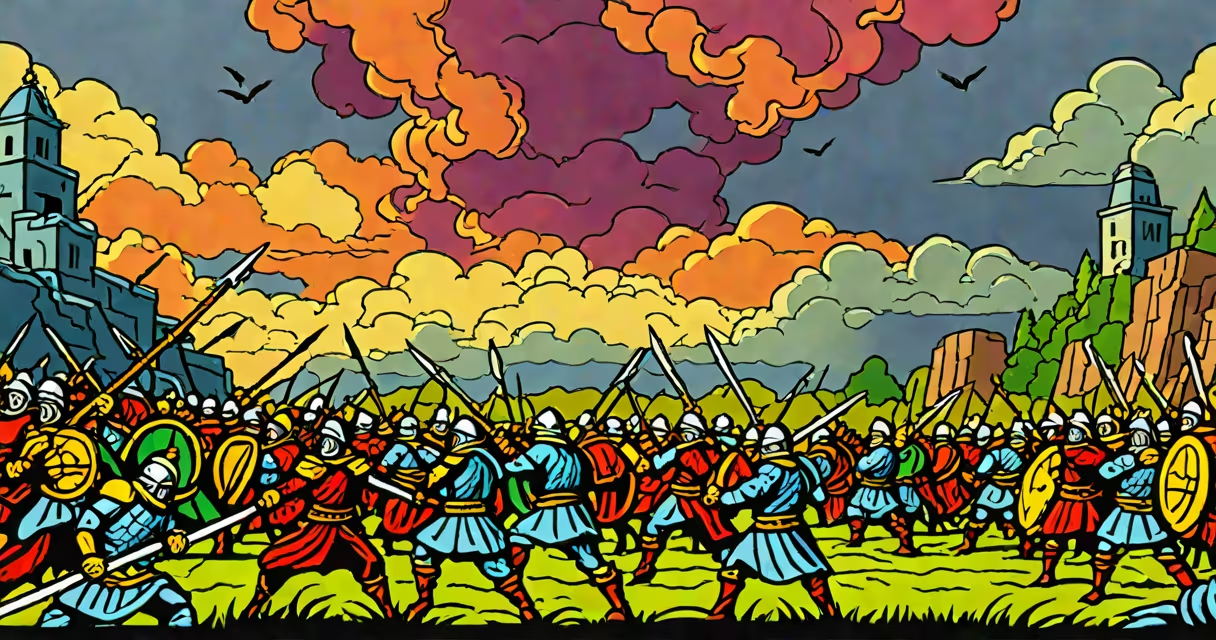
War of Ages is a fantasy strategy game where players advance through distinct historical eras-ancient, medieval, industrial, and futuristic-each unlocking new units, technologies, and terrain types. Combat occurs in turn-based tactical battles, requiring strategic positioning and unit synergy across evolving battlefields.
The core mechanic revolves around era progression: completing objectives in one age unlocks access to the next. Each era introduces unique resources, such as bronze in the Ancient Age, iron in the Medieval Age, coal in the Industrial Age, and quantum cores in the Future Age. These materials power upgrades and allow recruitment of specialized units like siege engines, airships, and cyber-warriors.
Players command armies composed of infantry, cavalry, ranged, and support units. Each unit type has strengths and weaknesses relative to others, creating rock-paper-scissors dynamics. For example, archers dominate cavalry in open terrain, but falter against armored knights in narrow passes. Terrain modifiers like forests, mountains, and rivers alter movement and attack outcomes, demanding adaptive tactics.
Each match begins with a player selecting a faction-such as the Iron Dominion, Skyward Reaches, or the Verdant Covenant-each with a unique tech tree and starting units. The goal is to control key strategic points on the map while managing resource production and defending against AI or human opponents.
Turns alternate between players. During a turn, a player may move units, attack, construct buildings, or research new technologies. Movement speed varies by terrain and unit type. A knight moves 3 hexes on plains but only 1 in forest. After all actions are taken, the turn ends and the opponent takes their turn.
Battle resolution uses a deterministic system based on unit stats: attack, defense, hit points, and special abilities. No random dice rolls affect outcomes. This ensures consistency and allows players to plan long-term strategies. For example, a level 3 catapult with 40 attack power targeting a stone wall with 30 defense will always reduce the wall's health by 10 points per hit.
War of Ages features four primary eras, each with distinct visual themes, unit availability, and technological focus:
| Era | Time Period | Key Units | Resource Type |
|---|---|---|---|
| Ancient | Pre-1000 BCE | Spearman, Chariot, Archery Squad | Stone, Bronze |
| Medieval | 1000-1500 CE | Knight, Crossbowman, Trebuchet | Iron, Wood |
| Industrial | 1800-1945 | Infantry, Artillery, Tank | Coal, Steel |
| Future | 2100-2300 | Plasma Rifleman, Drone, Mecha | Quantum Core, Nano Alloy |
Factions differ in starting advantages. The Iron Dominion begins with early access to steel and heavy armor, enabling rapid expansion in the Industrial Age. The Skyward Reaches start with aerial units and high-altitude terrain bonuses, excelling in vertical battlefield control.
Each era also alters environmental conditions. Ancient maps feature dense forests and river crossings. Future maps introduce gravity fields and energy barriers that affect movement and line of sight. These changes force players to adapt tactics rather than rely on static strategies.
War of Ages is not a real-time strategy game. Despite the presence of animated units and changing weather effects, all actions occur in discrete turns. The game does not use auto-attack systems or continuous movement. This design choice prioritizes thoughtful planning over reflexes.
Another misconception is that the game favors aggressive playstyles. While early aggression can secure key positions, the game rewards long-term resource management and tech advancement. A player who delays expansion to research advanced healing spells or defensive fortifications often outlasts faster opponents.
A lesser-known fact: the game's AI adapts to player behavior patterns. After five consecutive losses to a player using ambush tactics, the AI increases scouting frequency and deploys decoy units to counter surprise attacks. This changing adjustment prevents repetitive win conditions and maintains replayability.
In a ranked match during the 2023 season, Player "Kael_7" faced off against "Valka_M" in a Future-era match. Kael commanded the Skyward Reaches, starting with a floating base above a canyon. Valka controlled the Iron Dominion, deploying tanks and artillery across the canyon floor.
Kael's strategy relied on altitude advantage. He positioned drone scouts to detect enemy movements and launched plasma rifles from high ground. The canyon's steep walls reduced enemy artillery accuracy by 60%. When Valka moved her tanks into the center of the canyon, Kael triggered a gravity well effect (a Future-era ability), slowing tank movement by 75% and increasing damage from overhead strikes.
After 12 turns, Valka's army was reduced to two tanks and one artillery piece. Kael's forces had lost only one drone and two riflemen. The final turn saw Kael deploy a stealth mecha behind enemy lines, capturing the central command node. The victory was achieved in 14 turns with minimal casualties.
This match exemplifies how era-specific mechanics and terrain interaction create meaningful decisions. The outcome wasn't determined by raw unit count but by precise timing, positioning, and understanding of unit synergies.
I've played over 400 matches of War of Ages since its 2021 release. The most consistent winning pattern among top-ranked players isn't rushing to the Future Age-it's mastering the transition between Medieval and Industrial, where resource scarcity and unit balance create the highest decision density.