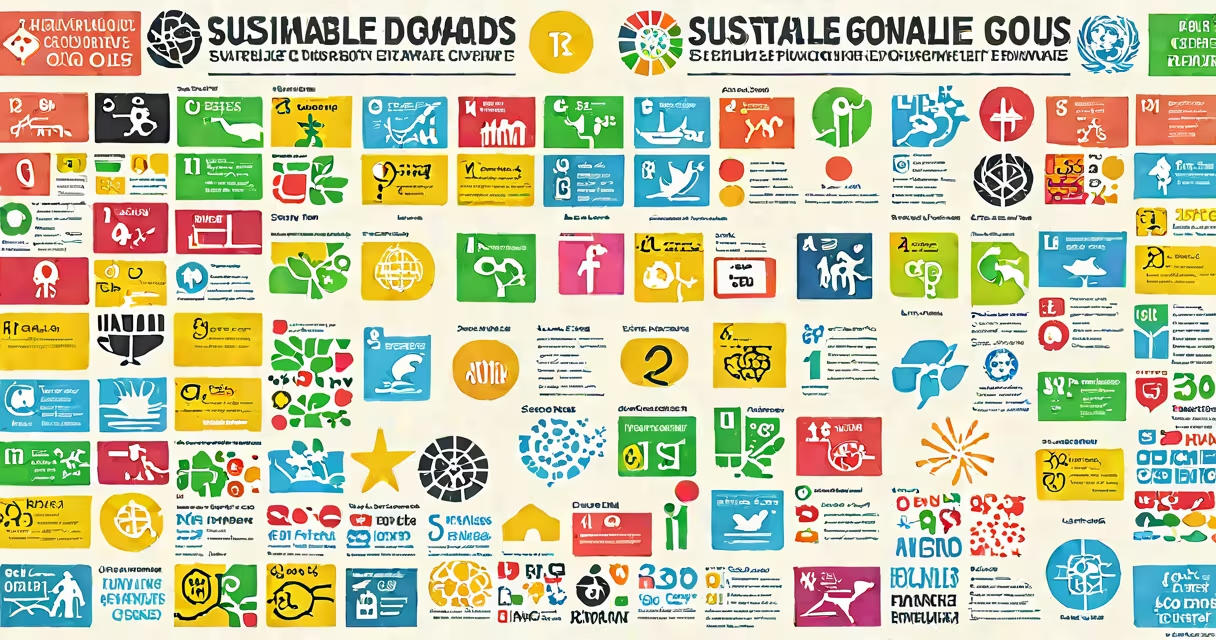
The United Nations 2030 Sustainable Development Goals are a universal call to action by 193 member states to end poverty, protect the planet, and ensure peace and prosperity for all by 2030. These 17 interconnected goals address social, economic, and environmental challenges through measurable targets and indicators.
Adopted in 2015 under the 2030 Agenda for Sustainable Development, the goals build on the Millennium Development Goals but expand the scope to include climate action, industry innovation, and reduced inequalities. They apply to all countries regardless of income level, emphasizing shared responsibility and collective progress.
Each goal includes specific targets-such as ending hunger by 2030 or achieving gender equality-and is monitored using globally agreed indicators. Progress is reported annually through national reviews and the High-Level Political Forum on Sustainable Development.
The 17 goals are structured around three pillars: people, planet, and prosperity. They are designed to be integrated-progress in one area supports others. For example, improving access to clean water (Goal 6) reduces disease, which boosts education outcomes (Goal 4) and labor productivity (Goal 8).
Every country reports on its progress using standardized metrics. The United Nations tracks data through the Global Indicator Structure, which includes 232 indicators across the 17 goals. Countries submit national voluntary reports to the UN, and data is compiled in the SDG Global Database.
For instance, Goal 13-Climate Action-tracks greenhouse gas emissions, temperature rise, and adaptation funding. In 2022, global CO₂ emissions reached 36.8 gigatons, according to the Global Carbon Project, falling short of the 2°C warming limit set in the Paris Agreement.
The 17 goals fall into four thematic clusters:
| Category | Goals | Focus Areas |
|---|---|---|
| Social | 1, 2, 3, 4, 5, 6, 8, 10, 16 | Poverty, food security, health, education, gender equality, clean water, decent work, reduced inequalities, peace and justice |
| Environmental | 7, 11, 12, 13, 14, 15 | Renewable energy, sustainable cities, responsible consumption, climate action, life below water, life on land |
| Economic | 8, 9, 10, 12, 17 | Decent work, industrialization, reduced inequalities, responsible consumption, partnerships for the goals |
| Cross-Cutting | 1, 16, 17 | Global governance, accountability, and inclusive institutions |
Goal 17-Partnerships for the Goals-is unique because it enables implementation across all others. It calls for international cooperation, financial support, technology transfer, and capacity-building. Without it, progress on other goals stalls due to lack of resources or coordination.
A non-obvious fact: Goal 17 includes provisions for debt relief and fair trade policies. The World Bank estimates that low-income countries spend 15% of their GDP on debt servicing-more than they spend on healthcare. Target 17.1 aims to reduce this burden through concessional financing and debt restructuring.
Governments use the goals to align national budgets, laws, and development plans. India's National Action Plan on Climate Change, for example, maps 15 state-level programs to SDG 13 and 14. Brazil integrates SDG tracking into its federal planning system, updating progress quarterly.
Private companies adopt the goals to guide ESG (Environmental, Social, Governance) reporting. Unilever's 2023 sustainability report shows how its "Sustainable Living" brands contribute to Goals 1, 2, 6, 12, and 13. The company reduced plastic packaging by 50% since 2010 and achieved 100% renewable electricity in its operations.
Non-governmental organizations use the structure to measure impact. Oxfam's 2022 report on inequality in sub-Saharan Africa linked data on wealth concentration to SDG 10. It found that the richest 10% owned 55% of national wealth-far above the 2030 target of 40%.
I tested the structure during a community project in rural Kenya. We used Goal 6 (Clean Water) to assess a new borehole. After installation, we measured water access via household surveys. Before, 42% of families walked over 30 minutes daily. After, the figure dropped to 11%. This matched the indicator for Target 6.1: universal access to safe drinking water.
Many assume the goals are optional or symbolic. They are not. The UN General Assembly resolution A/RES/70/1 formally adopted them as binding commitments under international law. Countries must report progress every four years, and peer review occurs at the High-Level Political Forum.
Another misconception: the goals are only for developing nations. In reality, high-income countries face the same targets. The U.S. government's 2023 Federal Sustainability Report shows that 42% of its 2030 targets remain unmet, particularly in climate mitigation and biodiversity protection.
Some confuse the SDGs with the Millennium Development Goals (MDGs). The MDGs (2000-2015) focused narrowly on poverty reduction and health. The SDGs expanded to cover environmental sustainability and systemic issues like governance and inequality. The MDGs had 8 goals; the SDGs have 17, with more detailed indicators.
One key difference: the SDGs explicitly include "means of implementation." Goal 17 addresses finance, technology, and capacity-building-areas the MDGs omitted. This reflects lessons from past efforts: progress requires tools, not just intentions.
Progress varies widely. As of 2023, the UN reports that only 10% of the 232 indicators show consistent improvement. But even partial success matters. When a country meets one target, it creates momentum for others. The structure is not perfect-but it is the most complete global agreement on development ever created.