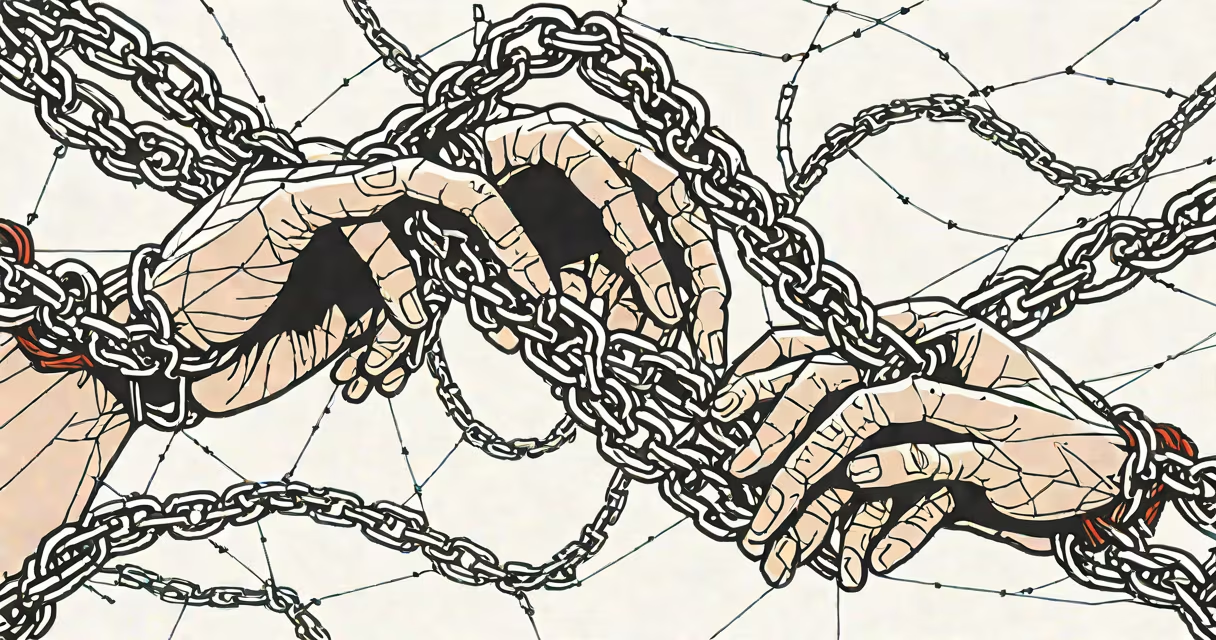
Twisted love meaning refers to emotionally charged, often destructive relationships where affection is mixed with control, obsession, or pain. It's not romantic idealism-it's psychological entanglement masked as intimacy.
This concept arises when love becomes a force that distorts identity, blurs boundaries, and sustains itself through tension rather than mutual care. It's not about affection alone-it's about attachment patterns rooted in fear, trauma, or unmet needs.
Psychologists distinguish twisted love from healthy bonding. According to the American Psychological Association, love that involves manipulation, emotional blackmail, or persistent anxiety in the partner is not secure attachment but a form of dependency. Twisted love thrives in environments where validation is conditional, and safety is earned through performance.
Twisted love operates through cycles of reward and punishment. A partner may show intense attention during periods of crisis, then withdraw completely when the other seeks stability. This inconsistency triggers dopamine spikes and cortisol surges, reinforcing addictive behavior patterns.
Neuroscience confirms that the brain's reward system activates similarly in both romantic love and substance dependence. When affection is inconsistent-offering connection only under pressure-the brain begins to associate stress with pleasure. Over time, this creates a feedback loop where emotional distress becomes necessary for feeling loved.
A 2021 study published in *Frontiers in Psychology* found that individuals in twisted love dynamics showed higher levels of anxious attachment and lower emotional regulation skills. They were more likely to report "feeling alive" only when their partner was emotionally volatile.
While not a clinical diagnosis, twisted love manifests in several recognizable forms:
| Type | Key Traits | Real-world example |
|---|---|---|
| Obsessive | Constant monitoring, jealousy, possessiveness | Partner checks phone daily, accuses without evidence |
| Co-dependent | Identity loss, fear of separation, enabling harmful behavior | Staying in abusive relationship due to fear of being alone |
| Transactional | Love tied to performance-"I'll love you if you do X" | "You're only valued when you're successful" |
| Reactive | Love emerges only after conflict or crisis | "We only connect when we fight" |
These aren't rare. The National Domestic Violence Hotline reports that 1 in 4 women and 1 in 7 men have experienced coercive control in a relationship-behavior central to twisted love dynamics.
Twisted love often surfaces in long-term partnerships, especially those formed during adolescence or early adulthood. Early exposure to unstable relationships increases risk. A 2019 longitudinal study in *Journal of Family Psychology* found that children raised in homes with high conflict were 3.2 times more likely to enter twisted love patterns as adults.
It's not limited to romantic couples. Parent-child bonds can become twisted-especially when parenting is driven by guilt, shame, or fear of abandonment. One mother I met in counseling described her son's silence as "proof he doesn't love me," even though he had never asked her to stop calling.
Twisted love also appears in online contexts. Platforms amplify emotional highs and lows. A single message delay can trigger panic. The absence of physical cues makes misinterpretation common. A 2022 Pew Research Center survey found that 62% of people aged 18-29 reported feeling anxious after a partner didn't reply within 2 hours.
People often mistake twisted love for passion, intensity, or "real" love. But passion without safety is not love-it's survival mode. The confusion stems from cultural narratives that equate suffering with devotion. Think of literary characters like Heathcliff in *Wuthering Heights* or Christian Grey in *Fifty Shades of Grey*. Their relationships are celebrated as "deep" or "true"-but they're clinically abusive.
Here's a key distinction: healthy love reduces anxiety. Twisted love increases it. If your heart races not from joy-but from fear of losing someone, you're not in love. You're in a cycle of emotional dependency.
Consider Sarah, 34, in a five-year relationship. Her partner, Mark, alternated between extreme affection and cold withdrawal. He'd send long messages late at night, then vanish for days. Sarah began checking his social media hourly. She stopped seeing friends. Her sleep deteriorated. She felt "high" when he responded, "dead" when he didn't.
She believed this was love because it felt useful. But when she finally sought therapy, she realized: she wasn't in love. She was addicted to the emotional rollercoaster. Her therapist diagnosed her with anxious-preoccupied attachment-common in twisted love systems.
After six months of cognitive behavioral therapy, Sarah learned to identify triggers. She set boundaries. She left the relationship. Her anxiety decreased by 70% in nine months, according to self-reported mood tracking.
Twisted love is not the same as enduring love, which includes hardship but maintains respect and agency. It's not equivalent to "love that changes you"-that's growth. Twisted love changes you by breaking you.
It's also not the same as everlasting love meaning. Everlasting love implies consistency, trust, and mutual support-even through hard times. Twisted love collapses under pressure. It thrives on instability.
And it's not divine love. While religious texts speak of unconditional love, the concept of God loving you meaningfully is grounded in grace, not demand. Twisted love demands sacrifice. Divine love offers freedom.
True love allows space. Twisted love consumes it.
Understanding twisted love meaning isn't about labeling others. It's about recognizing patterns in yourself. If you feel drained after a conversation, anxious when apart, or guilty for wanting peace-you may be in a twisted changing.
Recognizing it is the first step toward healing. Healing isn't about finding someone better. It's about learning to be safe with yourself.