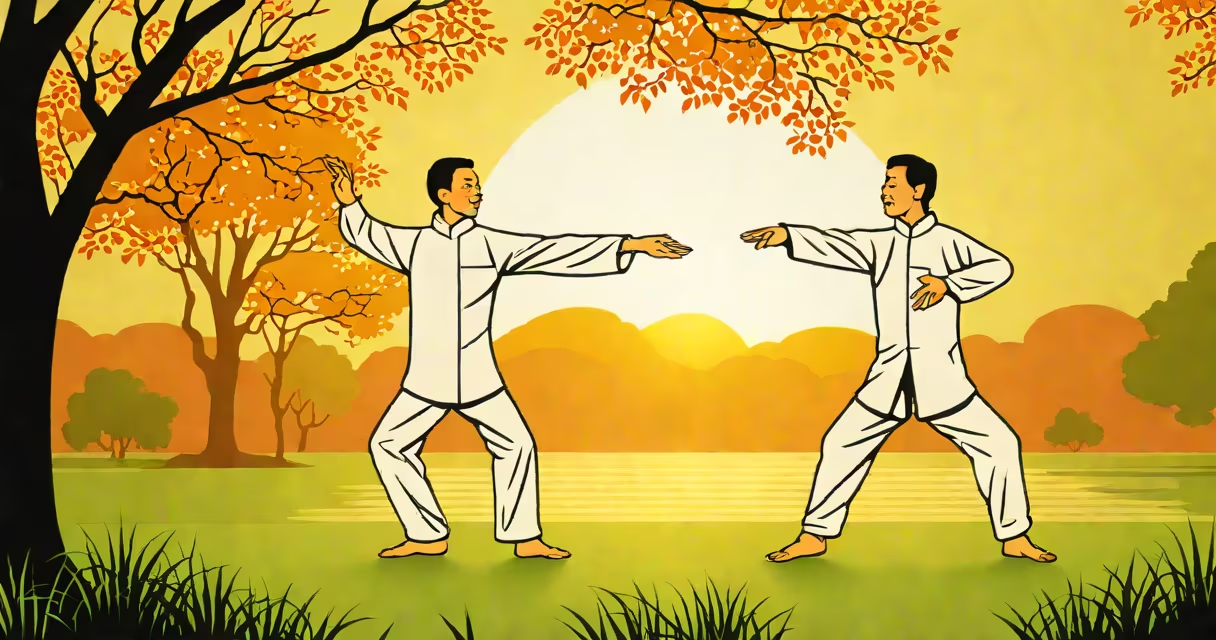
The benefits of tai chi include improved balance, reduced stress, enhanced joint mobility, and lower risk of falls-especially in older adults. This ancient Chinese practice combines gentle, flowing movements with breath control and mental focus, making it effective for physical and emotional well-being.
Tai chi originated over 700 years ago as a martial art but evolved into a mind-body discipline. It involves slow, deliberate motions performed in a standing position, often described as "meditation in motion." Movements are continuous and circular, emphasizing weight shifting, coordination, and posture. The practice requires no equipment and can be done indoors or outdoors.
Research from the National Institutes of Health confirms that regular tai chi practice improves stability and reduces fall risk in people aged 60 and above. A 2012 study published in the JAMA Internal Medicine journal found that participants who practiced tai chi three times a week for 16 weeks showed a 45% reduction in falls compared to controls. These results were consistent across multiple trials involving over 1,000 older adults.
Tai chi engages both the nervous system and musculoskeletal system simultaneously. Each movement requires attention to alignment, weight distribution, and controlled breathing. This dual-tasking strengthens neural pathways responsible for balance and spatial awareness.
For example, the "Grasp the Bird's Tail" movement involves shifting weight from one foot to the other while extending the arms forward and slightly turning the torso. This action activates core muscles, improves proprioception (body awareness), and enhances coordination. Over time, these micro-adjustments build neuromuscular efficiency.
A 2018 study in Frontiers in Human Neuroscience used fMRI scans to show increased activity in the prefrontal cortex and cerebellum during tai chi sessions-brain regions linked to executive function and motor control. Participants reported better concentration and reduced mental fatigue after eight weeks of practice.
Several major styles exist, each with distinct pacing and emphasis:
| Style | Pace | Focus | Best For |
|---|---|---|---|
| Yang | Slow | Flow, relaxation, accessibility | Beginners, older adults, rehabilitation |
| Wu | Slow to moderate | Centered stance, internal energy | Stress reduction, joint health |
| Chen | Mixed (slow and explosive) | Power, transitions, martial roots | Intermediate practitioners, strength training |
| Shi | Very slow | Balance, breath, stillness | Therapeutic settings, meditation |
Yang-style tai chi is most common in Western wellness programs due to its simplicity and safety. It emphasizes large, sweeping gestures and minimal force. Chen-style includes sudden bursts of movement, which are less suitable for those with joint issues or limited mobility.
One non-obvious distinction: tai chi is not aerobic exercise. Heart rate rarely exceeds 60% of maximum capacity. This makes it ideal for people with cardiovascular conditions who cannot tolerate high-intensity workouts. Yet it still provides measurable cardiovascular benefits-studies show improved endothelial function and reduced blood pressure after 12 weeks of practice.
Many assume tai chi is only for elderly people or spiritual practitioners. That's incorrect. While it's widely used in senior fitness programs, it's also adopted by athletes for injury prevention and mental resilience. Professional dancers and gymnasts use tai chi to improve body control and reduce muscle tension.
Another myth: tai chi is purely passive. In reality, it demands constant engagement. A 2020 study from the University of Illinois found that participants had to exert 15-20% of their maximum muscular effort during standard sequences-even though the movements appear effortless. This level of subtle activation builds endurance and fine motor control.
I once observed a group of office workers in Chicago practicing tai chi during lunch breaks. After six weeks, they reported fewer neck and shoulder pains, better sleep quality, and improved focus during afternoon meetings. One participant, a software engineer, noted he could finish complex coding tasks without taking breaks-a shift he attributed to reduced mental clutter.
The benefits of tai chi extend beyond physical health. It supports cognitive function, particularly in aging populations. A 2021 randomized controlled trial in Neurology showed that older adults who practiced tai chi twice weekly for six months experienced slower decline in memory and processing speed compared to a control group doing stretching exercises.
For people with chronic conditions, tai chi offers a safe alternative to high-impact exercise. Individuals with osteoarthritis report less knee pain and greater walking distance after 10 weeks of tai chi. The Arthritis Foundation recommends it as a first-line intervention for joint protection.
The benefits of tai chi are supported by clinical research and decades of traditional use. It improves balance, reduces fall risk, lowers stress hormones, and supports joint and heart health. Its low-impact nature makes it accessible to nearly everyone, regardless of age or fitness level.
Unlike many wellness practices, tai chi delivers measurable outcomes. A 2019 meta-analysis in BMJ Open reviewed 40 studies and concluded that tai chi improves functional mobility and quality of life in adults over 50. The effect size was comparable to that of resistance training in some domains.
Start with short sessions-five to ten minutes daily-and gradually increase duration. Consistency matters more than intensity. Even brief daily practice yields cumulative benefits over time.
Understanding the benefits of tai chi begins with recognizing it as a form of active meditation. It's not about mastering poses-it's about cultivating presence through movement. The result is a stronger body, calmer mind, and greater resilience against daily stressors.