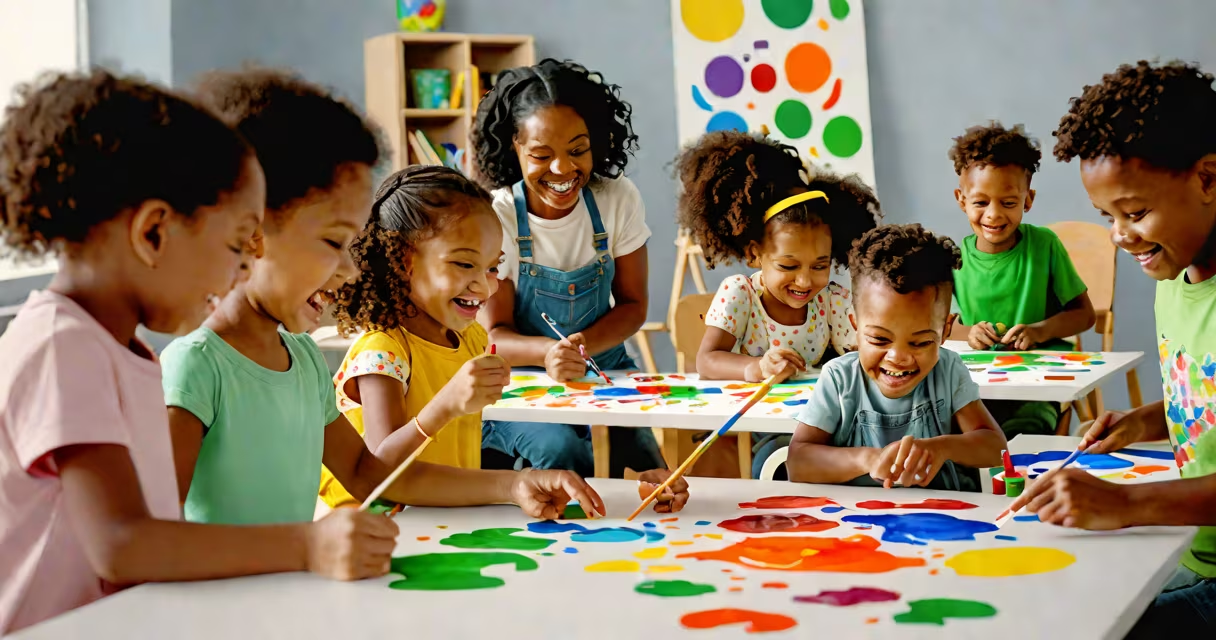
Teaching preschool art involves guiding children aged 3 to 5 through structured, sensory-based creative activities that build motor skills, emotional expression, and cognitive development. These sessions prioritize process over product, encouraging exploration rather than perfection.
Art in preschool settings is not about producing museum-worthy pieces. It's about letting children interact with materials-paint, clay, scissors, glue-using their hands and senses. A typical session might involve rolling playdough into snakes, dipping sponges in paint, or tearing paper to make collages. The goal isn't a finished artwork; it's the act of doing.
According to the National Association for the Education of Young Children (NAEYC), art experiences support language development, problem-solving, and self-regulation. Children describe what they're making, negotiate space with peers, and manage frustration when glue doesn't stick. These moments build foundational skills beyond creativity.
Each activity follows a simple structure: introduce the material, demonstrate a basic technique, then allow free exploration. Teachers don't show children how to "make a butterfly" or "draw a house." Instead, they ask open-ended questions: "What happens when you mix blue and yellow?" or "Can you make something that moves?"
Materials are chosen for safety and accessibility. Non-toxic, washable paints, large brushes, and tearable paper reduce barriers to participation. A child with limited mobility can still participate using adaptive tools like foam brushes or Velcro-adhered paint pads.
During circle time, teachers might display a few examples-not to compare, but to spark conversation. "I see someone used red in the middle," they might say. This reinforces observation and verbalization without pressure to replicate.
Preschool art is categorized by sensory modality and developmental focus. The most effective programs rotate between tactile, visual, and kinesthetic tasks to engage different parts of the brain.
| Type | Examples | Developmental Focus |
|---|---|---|
| Tactile | Playdough sculpting, sand tray work, finger painting | Motor control, sensory integration |
| Visual | Color mixing, collage-making, nature drawing | Pattern recognition, color theory basics |
| Kinesthetic | Dance with scarves, movement-based painting, rhythm instruments | Body awareness, coordination |
A 4-year-old named Mateo once spent 20 minutes pressing his hand into wet clay, then lifting it slowly to reveal a print. He didn't want to make a "handprint monster"-he wanted to feel the resistance of the material. His teacher didn't correct him. She simply said, "That's heavy. Can you press harder?" That moment wasn't about art-it was about agency.
Teaching preschool art is standard practice in licensed early childhood centers, public pre-K programs, and private Montessori schools. It appears in daily routines, often scheduled during quiet times after lunch or before nap.
Research from the American Psychological Association shows that children who engage in regular art activities score higher on measures of executive function-planning, attention, and task-switching. In one study, children who participated in weekly art sessions showed 15% greater improvement in sustained attention compared to peers in non-art curricula.
Classrooms use art to assess developmental milestones. A teacher might notice a child consistently uses only one hand during painting, signaling a need for occupational therapy referral. Or a child who avoids eye contact while working may be struggling with social engagement. Art becomes a diagnostic tool, not just a fun activity.
Many assume teaching preschool art means copying templates or following step-by-step instructions. This is incorrect. The NAEYC explicitly warns against "art projects" that result in identical outcomes. When every child makes the same paper plate turkey, the focus shifts from expression to compliance.
Another misconception is that art requires expensive supplies. A successful program can run on recycled materials-cardboard tubes, bottle caps, old fabric scraps. One classroom in rural Iowa used only household items and reported higher engagement than a neighboring school with a $2,000 art budget.
There's also confusion between art and craft. Craft implies a final product-like a paper snowflake or a decorated cup. Art prioritizes the process. A child coloring inside lines is practicing control. A child smearing red across a page is expressing emotion. Both are valid-but only the latter counts as teaching preschool art.
At Willow Creek Early Learning Center in Portland, Oregon, a typical week includes:
Teachers document each session with photos and brief notes. They avoid labeling work ("This is a dog"). Instead, they record: "Lila used blue and green in swirls. Said it was 'the ocean when it's angry.'" This preserves the child's narrative.
I once observed a teacher pause when a child dropped a paintbrush and began crying. She didn't hand him another. She knelt and said, "The brush fell. What do you want to do?" He picked up a sponge and continued painting. The moment wasn't about art-it was about resilience. Teaching preschool art includes managing emotional responses, not just materials.
The core difference between teaching preschool art and other creative activities lies in evaluation. In traditional art classes, work is judged on realism, neatness, or technical skill. In preschool art, the outcome is irrelevant. A child's scribble is as valid as a detailed field.
When a parent asks, "Does my child have talent?" the answer isn't yes or no. Talent isn't measured until later. The real metric is engagement. Did the child stay focused for 10 minutes? Did they try new materials? Did they speak about their work?
One study published in the journal *Early Childhood Research Quarterly* found that children who were praised for effort-"You kept trying!"-showed greater persistence in future art tasks than those praised for results-"That's beautiful!" The former builds intrinsic motivation.
For educators, success isn't a wall covered in masterpieces. It's a room full of children who say, "I did it myself."