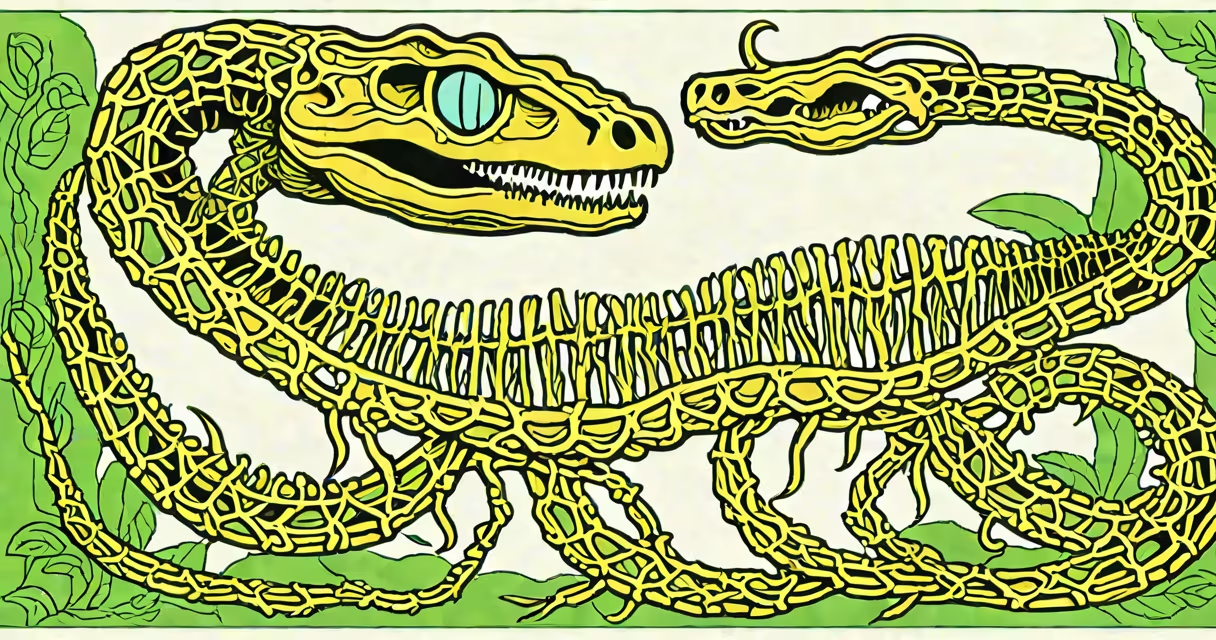
A snake skeleton diagram is a visual representation of the internal bony structure of a snake, highlighting its highly modified vertebral column, ribs, and vestigial limb bones. Unlike mammals, snakes lack limbs, but their skeletons contain hundreds of vertebrae that enable extreme flexibility and locomotion.
Snakes evolved from lizards around 100 million years ago, and their skeletons reflect adaptations to a limbless, elongated body. The skeleton consists primarily of vertebrae-over 200 in many species-each bearing a pair of ribs. This arrangement allows for undulating movement through muscle contractions along the spine. The skull is loosely connected to the vertebrae, enabling snakes to swallow prey much larger than their head size.
These diagrams are used in biology education, veterinary science, and paleontology to study evolutionary changes in vertebrates. They show how snakes lost most limb structures while enhancing spinal mobility, a key adaptation for burrowing, climbing, and hunting in diverse environments.
The core of a snake's movement lies in its axial skeleton-the series of vertebrae running from the neck to the tail. Each vertebra has a central body, neural arch, and zygapophyses (articulating joints) that allow precise bending. Snakes have no sternum (breastbone), which increases flexibility and enables them to twist through narrow spaces.
Ribs extend from nearly every vertebra and attach to the abdominal wall. These ribs provide structural support and anchor muscles used in locomotion. Some species, like boas and pythons, retain tiny pelvic bones and remnants of hindlimb bones-vestigial structures that serve no functional purpose but confirm their evolutionary ancestry from four-limbed ancestors.
For example, the ball python (*Python regius*) has a skeleton with approximately 230 vertebrae and over 300 ribs. Its skull features a kinetic joint between the upper and lower jaw bones, allowing it to dislocate its jaw during feeding. A detailed snake skeleton diagram illustrates this complex arrangement, showing how individual bones interlock and move relative to one another.
Snake skeletons consist of three main bone groups: axial (spine and ribs), appendicular (limb-related), and cranial (skull). The axial skeleton dominates, making up over 90% of the total bone count.
| Bone Type | Number in Average Snake | Function | Example Species |
|---|---|---|---|
| Vertebrae | 200-300+ | Support, flexibility, muscle attachment | Boa constrictor |
| Ribs | 300-500+ | Protect organs, aid in breathing | King cobra |
| Pelvic bones | 2-4 | Vestigial; no function in movement | Pythons, boas |
| Hindlimb remnants | 0-2 | Non-functional; only seen in imaging | Green anaconda |
While most snakes have no functional limbs, some species exhibit rare genetic traits that produce small external hindlimbs. The *Python regius* occasionally displays tiny claw-like structures on its ventral side, remnants of ancestral legs. These are not used for walking but may play a role in mating behavior.
Scientists use CT scans and 3D modeling to reconstruct accurate snake skeleton diagrams. For instance, research published in Nature Communications (2021) analyzed fossilized snake specimens from the Cretaceous period and confirmed that early snakes had more complete limb structures than modern ones, supporting the theory that limb loss occurred gradually over millions of years.
Many assume snakes have no bones because they appear soft and flexible. This is false. All snakes are vertebrates with a complete internal skeleton. Their bones are lightweight and highly flexible, allowing extreme bending-but they still exist.
Another misconception is that all snake bones are identical. In reality, different regions of the spine have distinct shapes. Cervical vertebrae near the head are smaller and more mobile, while caudal vertebrae in the tail are shorter and adapted for anchoring tail muscles. The atlas vertebra (first cervical) often has a unique saddle-shaped joint that allows the head to pivot sideways.
Some illustrations incorrectly show snakes with a single long rib connecting the entire body. Actual anatomy reveals that each rib is paired and attached to a separate vertebra. This detail is important for understanding how snakes breathe-rib movement expands and contracts the chest cavity during respiration.
Snake skeleton diagrams are essential tools in comparative anatomy courses. They illustrate evolutionary trade-offs: reduced limbs for increased agility and concealment. Students compare snake skeletons to those of lizards and mammals to understand homologous structures-bones that share a common origin but differ in function.
For example, the snake's hyoid bone (supporting the tongue and mouth) is derived from gill arches in fish ancestors. This connection highlights deep evolutionary history. Diagrams help students trace how bones adapted over time, such as the transformation of forelimb bones into pelvic spurs in certain species.
I once observed a high school biology class using a printed snake skeleton diagram to simulate feeding mechanics. Pupils manipulated cutouts of jaws and vertebrae to demonstrate how a snake swallows prey whole. The activity revealed how poorly understood concepts like jaw dislocation and spinal flexion become tangible when visualized.
When studying a snake skeleton diagram, always verify the species and scale. Diagrams of large constrictors like the reticulated python differ from those of small colubrids due to size and structural variation. Accurate labeling prevents confusion between similar bones like the quadrate (jaw joint) and the articular (lower jaw bone).
A snake skeleton diagram is not just a static image-it's a map of adaptation. It reveals how evolution reshaped a body plan to thrive without limbs, relying instead on thousands of interlocking bones to achieve speed, stealth, and survival.