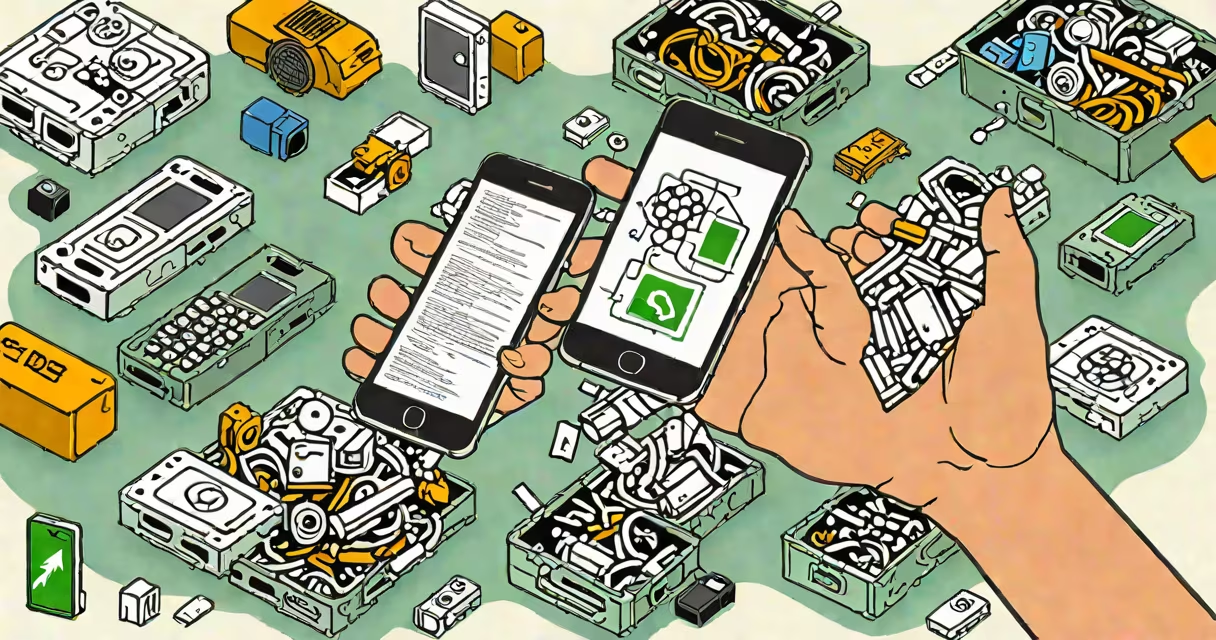
recycling cell phones for money means turning in old or broken smartphones to companies that pay for them based on condition, model, and market demand. These payments come from reselling parts, refurbishing units, or extracting valuable materials like gold and lithium.
Companies buy used phones from individuals, often offering instant quotes online. The buyer assesses the device's condition-screen damage, battery health, storage capacity-and assigns a value. Payment methods include gift cards, direct deposits, or prepaid debit cards. This process reduces electronic waste and gives consumers a financial return.
According to the Environmental Protection Agency (EPA), only 15% of e-waste is recycled properly in the U.S., leaving millions of discarded phones in landfills. Recycling cell phones for money helps divert devices from waste streams and supports sustainable resource recovery.
When you recycle a phone for money, the process begins with a device evaluation. You enter your phone's make, model, storage size, and condition into a tool like Apple's Trade-In Calculator or Gazelle's online form. The system returns a quote based on current market prices.
If you accept the offer, you ship the device using a prepaid label. Upon receipt, the company verifies the device's condition against your description. If it matches, they issue payment within 48 hours. If discrepancies exist-like hidden cracks or water damage-the offer may be revised or declined.
For example, a 2020 iPhone 11 with 64GB storage and no visible damage might fetch $220. A similar model with a cracked screen could drop to $100. Devices with failed batteries or missing components receive lower offers or are rejected outright.
Several models exist for recycling cell phones for money. The most common are direct trade-in services, retailer buyback programs, and nonprofit collection initiatives.
| Program Type | How It Pays | Best For | Example |
|---|---|---|---|
| Online Trade-In Platforms | Cash via check, PayPal, or gift card | High-value devices in good condition | Gazelle, Decluttr, Swappa |
| Retailer Buybacks | Store credit or gift card | Customers upgrading at a store | Best Buy, Verizon, Walmart |
| Carrier Trade-Ins | Discount on new device or partial cash | Subscribers switching plans | AT&T, T-Mobile, Metro by T-Mobile cell phones |
| Nonprofit Collection | No direct payment, but tax deduction for donations | Devices with minor defects or outdated models | Cell Phones for Soldiers, World Computer Exchange |
Trade-in platforms like Gazelle and Decluttr offer the highest average payouts. A 2021 Samsung Galaxy S21 with 128GB storage and minimal wear fetched $310 on Gazelle in early 2023. Best Buy's in-store program offered $150 for the same device, plus a $50 discount on a new purchase.
Carrier programs such as those from Metro by T-Mobile cell phones often provide discounts rather than cash. However, they reduce the cost of new devices. For example, trading in a working iPhone 12 on a Metro plan could lower the price of a new phone by $300.
Many people assume recycling cell phones for money is only for high-end models. That's incorrect. Even older or damaged phones have value. A 2016 iPhone 6 with a broken home button still sold for $15 on eBay in 2023 due to demand for replacement parts.
Another myth is that all recycling centers extract precious metals. While some do, most focus on reuse. The EPA reports that only 1% of U.S. e-waste undergoes formal metal recovery. Most phones are either refurbished or disassembled for parts.
A key distinction: recycling for money is not the same as donating. Donations may qualify for tax deductions, but they don't pay cash. Conversely, selling a phone for scrap value doesn't guarantee a profit-it may cost more to ship than you earn.
In January 2023, I traded in my 2019 Google Pixel 3a with 64GB storage and a scratched front glass. I used the Trade-In app on Gazelle's website. After entering the serial number and uploading photos, I received a quote of $125.
I accepted the offer, printed the prepaid shipping label, and dropped the phone in a FedEx box. Within 48 hours, Gazelle confirmed receipt and verified the damage. I received $125 via PayPal the next day.
The phone was later refurbished and sold for $280. The difference covered Gazelle's processing costs and generated a profit. My device didn't go to landfill-it was reused, and I got paid for it.
Every recycled phone prevents 30 pounds of CO2 emissions annually, according to the United Nations Environment Programme (UNEP). Reusing a single smartphone saves enough energy to power a desktop computer for 10 days.
When you recycle cell phones for money, you're not just getting cash-you're supporting circular economy principles. Devices stay in use longer, reducing mining for raw materials like cobalt and rare earth elements.
For context, the average American owns 2.5 smartphones. If just 20% of those were recycled for money, the U.S. could recover over $1 billion in value annually and prevent 1.2 million tons of e-waste.
While the payout varies, the act itself reduces environmental harm. As of 2023, over 1.5 billion phones were discarded globally. Only 17% were formally recycled. Recycling cell phones for money closes part of that gap.
Understanding how recycling cell phones for money works helps you make informed choices. Whether you choose a platform like Gazelle, a carrier deal, or a local drop-off, you gain value from devices others discard.