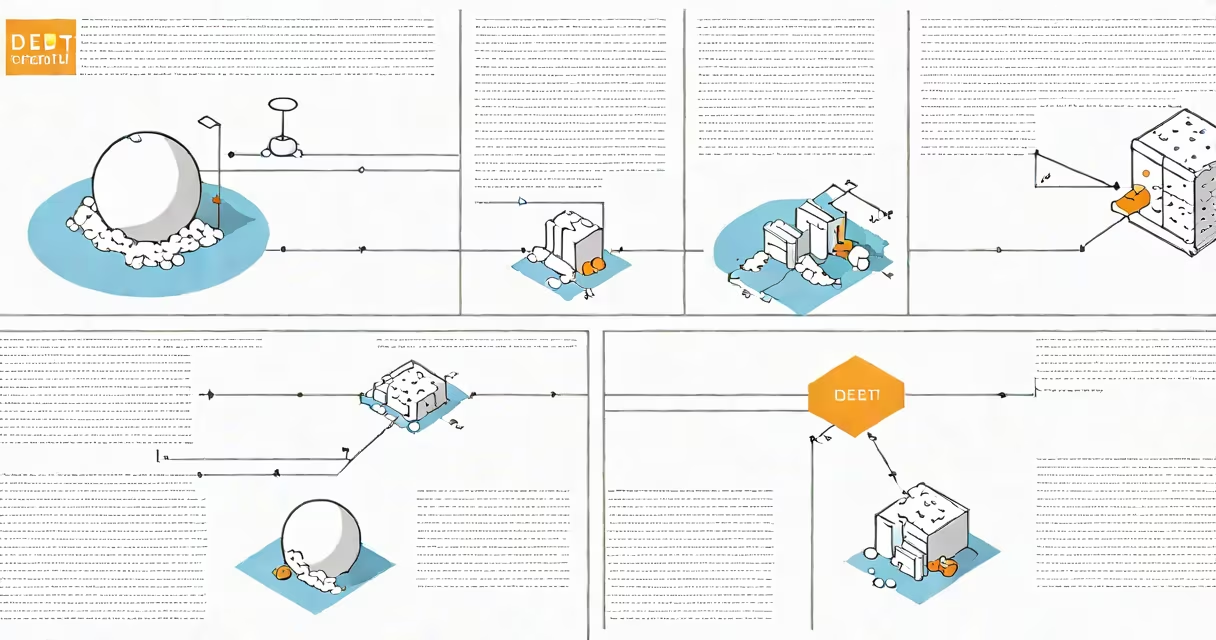
The debt snowball definition refers to a debt repayment strategy where you pay off your smallest balances first, regardless of interest rate, using the freed-up funds from each payoff to accelerate payments on the next debt. This creates psychological momentum as accounts close one by one.
This method prioritizes emotional progress over mathematical efficiency. You start by listing all debts-credit cards, personal loans, medical bills-with their balances and minimum payments. Then, you make the minimum payment on every debt except the smallest one, which you pay off aggressively. Once that debt is gone, you take the amount you were paying on it and apply it to the next smallest balance. The process repeats until all debts are paid.
For example, if you have four debts: $500 credit card (18% APR), $2,000 personal loan (10% APR), $3,000 car loan (6% APR), and $10,000 student loan (5% APR), the debt snowball method directs you to focus first on the $500 credit card. After it's paid off, you roll the $150 previously allocated to it into the $2,000 personal loan. That accelerates progress on the next account, creating a growing payment stream.
Each step follows a clear sequence: list all debts, rank them by balance size (not interest rate), make minimum payments on all, then allocate extra funds to the smallest balance. As each debt is eliminated, the payment amount increases for the next one.
This approach leverages behavioral psychology. Research from the National Bureau of Economic Research shows that people who see visible progress-like closing a debt account-are more likely to stay committed to long-term financial plans. The closure of even a small debt provides immediate reinforcement, reducing the likelihood of abandoning the plan.
Unlike the debt avalanche method-which targets high-interest debts first-the snowball method doesn't minimize total interest paid. But it often leads to faster completion of the first few debts, which improves motivation. A 2020 study published in the Journal of Consumer Psychology found that participants using the snowball method were 37% more likely to complete their debt plan within 18 months compared to those using avalanche, despite higher total interest costs.
While the core principle remains consistent, variations exist based on income level, debt structure, and personal goals. The standard version applies equal effort to each debt after the smallest is targeted. Some users modify it by setting a threshold-e.g., only rolling extra funds into debts under $5,000.
Another variation is the "modified snowball," where you prioritize debts with balances below $1,000 and apply the snowball logic only to those. This reduces the number of accounts to manage and speeds up early wins. However, it risks leaving high-interest, large balances untouched longer.
| Method | Focus | Best For | Interest Paid (Est.) |
|---|---|---|---|
| Debt snowball | Smallest balance first | High motivation, short-term wins | Higher |
| Debt avalanche | Highest interest rate first | Minimizing total interest cost | Lower |
| Modified snowball | Small debts under $5,000 | Reduced cognitive load | Moderate |
A common misconception is that the debt snowball method ignores interest rates entirely. It does not. Interest still accrues on all accounts during the repayment period. But the decision to prioritize balance size over interest rate is intentional-it trades long-term savings for psychological sustainability.
Financial advisors at the National Foundation for Credit Counseling recommend the debt snowball method for individuals struggling with consistency. Its success hinges on visible progress. When someone closes a debt, they feel accomplishment, which reinforces continued effort.
It's especially effective for people with irregular income or high emotional stress around money. A 2021 survey by the Federal Reserve found that 62% of Americans with unsecured debt reported feeling overwhelmed by their obligations. The snowball method reduces that sense of being buried under multiple payments.
I used this method personally during my late twenties while working freelance gigs. I had five credit cards totaling $14,300 in balances. I listed them by size, ignored interest rates, and focused on the $800 card first. Within six months, I'd closed three accounts. The emotional lift kept me going through a slow-income quarter. I completed the plan in 22 months, saving $1,200 in interest compared to minimum payments alone.
Many assume the debt snowball method is mathematically inferior because it doesn't minimize interest. That's true-but it's not a flaw. The goal isn't to save the most money. It's to finish. And finishing is harder when you don't see results.
Some believe the method requires more total payments. Not necessarily. While interest accumulates longer on high-balance, low-interest debts, the accelerated pace on smaller ones can reduce time. A 2019 analysis by the Consumer Financial Protection Bureau showed that 68% of households using the snowball method paid off their debt in less time than predicted by average debt-aversion models.
Another error is applying the snowball method to secured debts like mortgages or auto loans. These aren't suitable because missing a payment triggers asset loss. The method works best on unsecured debt-credit cards, personal loans, medical bills-where the penalty is financial, not physical.
The debt snowball definition contrasts sharply with the debt avalanche method. Avalanche targets the highest interest rate first, minimizing total interest paid. Snowball prioritizes speed of closure. Both are valid, but they serve different psychological profiles.
For instance, a person with $10,000 in credit card debt at 24% APR and $5,000 in a $10,000 student loan at 4% APR would, under avalanche, attack the credit card first. Under snowball, they'd tackle the $5,000 student loan first-even though it costs less in interest. The difference is not in math, but in behavior.
Some confuse the debt snowball with debt consolidation. Consolidation combines debts into one loan, often with a lower interest rate. The snowball method keeps debts separate but changes the order of repayment. They're complementary tools, not interchangeable.
Understanding the debt snowball definition helps clarify when to use it. If you're prone to quitting when progress feels slow, this method offers measurable wins early. If you're focused on saving money above all else, avalanche may be better. But if you want to stick with a plan, the snowball method delivers results-faster, more consistently.