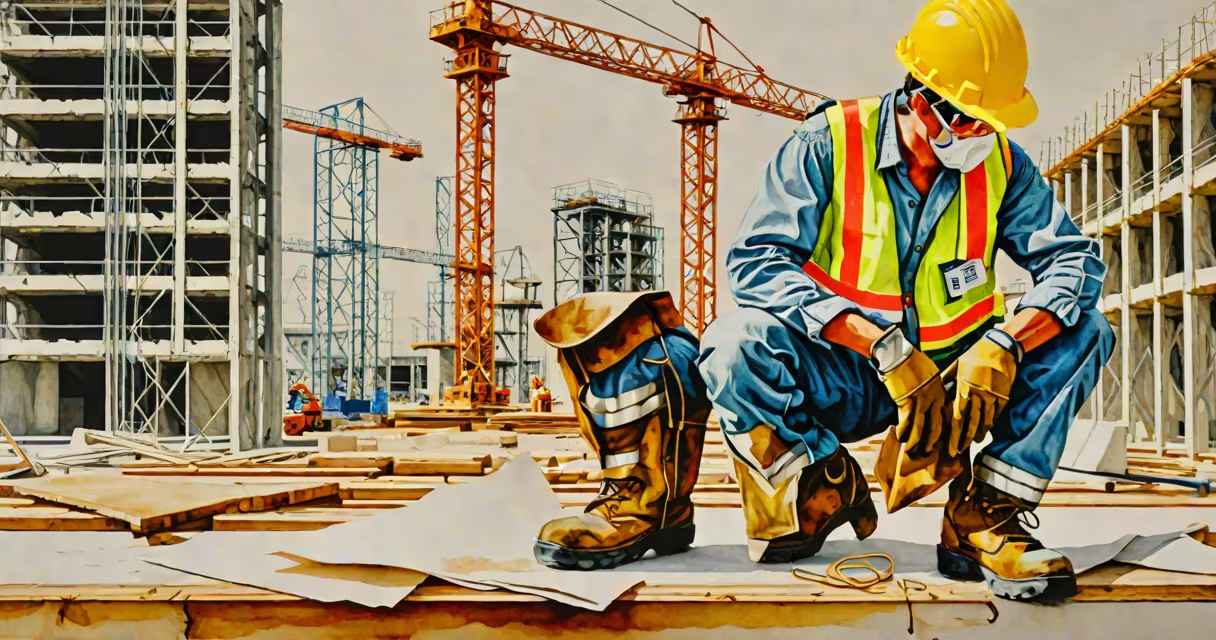
The ppe osha definition refers to the U.S. Occupational Safety and Health Administration's formal criteria for personal protective equipment-items like gloves, helmets, goggles, and respirators that reduce exposure to workplace hazards. OSHA mandates that employers assess job tasks, identify physical, chemical, biological, or mechanical risks, and supply appropriate ppe based on those findings.
OSHA defines ppe as "equipment worn to minimize exposure to hazards." This includes head protection, eye and face protection, hearing protection, respiratory protection, hand protection, foot protection, and full-body protection. The agency requires that ppe be selected based on the specific hazard-such as falling objects, flying debris, noise levels above 85 dBA, or exposure to bloodborne pathogens-and that it fits properly and is maintained in good condition.
Employers must train workers on when and how to use ppe correctly. Failure to comply with the ppe osha definition can result in citations and fines under OSHA's General Duty Clause and specific standards like 29 CFR 1910.132, which governs ppe selection and use. The standard applies across industries including construction, manufacturing, healthcare, and laboratories.
When a hazard is identified-say, a worker handling corrosive chemicals-the employer must conduct a hazard assessment. Based on the results, they choose ppe that meets ANSI/ISEA standards for chemical resistance, such as nitrile gloves rated for specific substances. The equipment must be inspected before each use and replaced when damaged or degraded.
For example, a warehouse employee operating a forklift near high-voltage areas must wear insulated gloves and boots. OSHA's 29 CFR 1910.137 covers electrical safety and specifies that ppe must be tested and rated for the voltage level involved. A worker using a grinder without eye protection violates the ppe osha definition because impact-resistant goggles are required.
Employers cannot require employees to pay for ppe unless it's for non-hazardous tasks, such as everyday work shoes. OSHA's 29 CFR 1910.132(f) states that employers must provide all necessary ppe at no cost to the worker. This rule prevents financial barriers to safety compliance.
OSHA categorizes ppe by function and the type of hazard it mitigates. The following table outlines common categories, their applications, and relevant OSHA regulations:
| Type | Hazard Type | OSHA Standard | Example Use Case |
|---|---|---|---|
| Head Protection | Falling objects, impact | 29 CFR 1910.135 | Construction worker under scaffolding |
| Eye/Face Protection | Debris, splashes, radiation | 29 CFR 1910.133 | Welder using a face shield |
| Respiratory Protection | Particulates, gases, vapors | 29 CFR 1910.134 | Asbestos abatement worker using N95 mask |
| Hand Protection | Cuts, burns, chemicals | 29 CFR 1910.138 | Lab technician handling hydrochloric acid |
| Foot Protection | Crush, puncture, slips | 29 CFR 1910.136 | Factory worker on a production floor |
Each category requires specific performance standards. For instance, eye protection must meet ANSI Z87.1-2020 for impact resistance. Respirators must be approved by NIOSH and fit-tested annually. These standards ensure consistency and reliability across workplaces.
Many employers assume that providing ppe fulfills their obligation under the ppe osha definition. But OSHA emphasizes that mere possession isn't enough-workers must be trained, equipment must be maintained, and proper use must be enforced. A 2021 OSHA inspection report found that 43% of ppe-related violations stemmed from improper training, not lack of gear.
Another misconception is that ppe is only needed in high-risk jobs. OSHA clarifies that even low-hazard environments-like offices with paper-cut risks-require basic protections. A single incident involving a sharp piece of paper can lead to a laceration requiring medical treatment. Employers must assess all tasks, regardless of perceived risk level.
A lesser-known fact: OSHA allows employers to substitute ppe with engineering controls when feasible. For example, installing machine guards reduces the need for hand protection. This principle is outlined in 29 CFR 1910.147, which prioritizes hazard elimination over reliance on ppe. However, ppe remains the last line of defense when engineering controls aren't sufficient.
In 2022, a roofing contractor in Texas was cited for violating the ppe osha definition after a worker fell from a ladder while installing shingles. The investigation revealed that the company had supplied fall arrest harnesses but failed to train employees on how to secure them properly. The worker's use wasn't attached to a secure anchor point, leading to injury.
OSHA issued a citation under 29 CFR 1910.140, which requires fall protection systems to be inspected and used correctly. The company paid $12,000 in penalties and implemented mandatory training. This case illustrates that the ppe osha definition isn't just about supplying gear-it demands correct usage, maintenance, and education.
I once observed a hospital's infection control team during a pandemic surge. They enforced strict ppe protocols: N95 masks, face shields, gowns, and gloves. Workers were trained weekly on donning and doffing procedures. When a nurse removed her mask too early, the team stopped the procedure and retrained her. This adherence to the ppe osha definition prevented multiple exposures.
Some confuse ppe with administrative controls or engineering solutions. PPE is a barrier between the worker and the hazard. Engineering controls-like ventilation systems or machine guards-eliminate or reduce the hazard at the source. Administrative controls involve scheduling, rotation, or signage.
For example, in a chemical plant, fume hoods (engineering control) reduce airborne exposure. Limiting time in high-noise zones (administrative control) reduces hearing damage risk. PPE-like earplugs-is supplemental. OSHA's hierarchy of controls places ppe at the bottom of the priority list, meaning it should only be used when higher-level controls fail.
Failure to distinguish between these layers leads to overreliance on ppe. A 2020 study published in the Journal of Occupational and Environmental Hygiene found that workplaces relying solely on ppe reported 3.2 times more injuries than those using layered controls. This underscores that the ppe osha definition is part of a larger safety structure.
Under the ppe osha definition, employers must document hazard assessments, select appropriate gear, train staff, and maintain records. OSHA inspectors review these documents during audits. The standard applies to all employers covered under the Occupational Safety and Health Act of 1970.