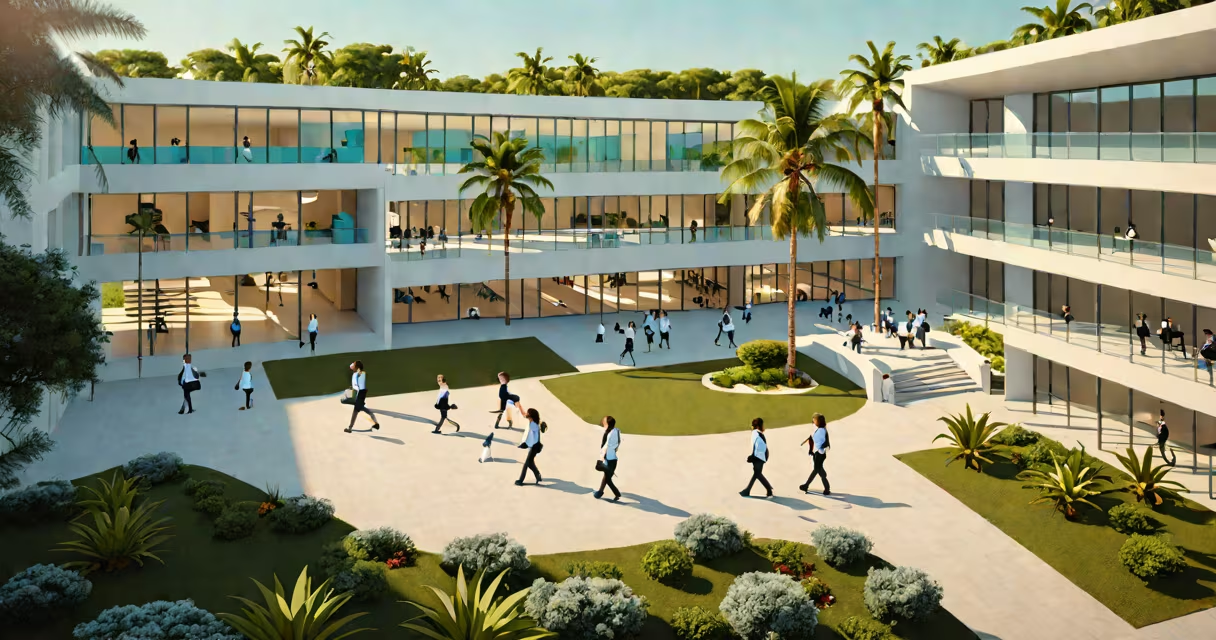
Nord Anglia International School is a network of private international schools offering a globally recognized curriculum with a focus on academic rigor, bilingual instruction, and character development. The schools operate under the Nord Anglia Education group, which manages institutions in over 30 countries, emphasizing high standards, teacher training, and access to global resources.
Each Nord Anglia International School follows the International Baccalaureate (IB) structure, including the Primary Years Programme (PYP), Middle Years Programme (MYP), and Diploma Programme (DP), ensuring alignment with global educational benchmarks. Students engage in inquiry-based learning, interdisciplinary projects, and assessments designed to develop critical thinking and problem-solving skills.
The network integrates global experiences through partnerships with institutions like the Juilliard School for performing arts and the Massachusetts Institute of Technology (MIT) for science and innovation programs. These collaborations provide students with unique opportunities to participate in global challenges, virtual labs, and performance workshops, enriching their classroom experience beyond local curricula.
Nord Anglia International Schools follow a structured academic calendar aligned with the IB's international standards. All schools deliver the IB curriculum across three stages: PYP for ages 3-12, MYP for ages 11-16, and DP for ages 16-18. This progression ensures continuity and depth in learning, preparing students for higher education worldwide.
Instruction is delivered in English, with many campuses offering additional language streams such as French, Mandarin, or Arabic. For example, Nord Anglia International School in Shanghai offers a dual-language program where core subjects are taught in both English and Mandarin, supporting biliteracy from an early age.
Assessments are standardized across the network. IB exams are externally marked by the International Baccalaureate Organization, ensuring consistency in grading. Students take external exams at the end of the DP, with results used by universities globally for admissions.
Nord Anglia Education operates schools in major cities across Asia, Europe, the Middle East, and North America. Each school maintains the same academic standards, teaching methodologies, and extracurricular frameworks, though localized adaptations may occur based on cultural context and national regulations.
| Location | Program Offered | Language of Instruction | IB Level |
|---|---|---|---|
| London, UK | PYP, MYP, DP | English | All three |
| Dubai, UAE | MYP, DP | English, Arabic (bilingual) | MYP & DP |
| Shanghai, China | PYP, MYP, DP | English, Mandarin | All three |
| Geneva, Switzerland | PYP, MYP, DP | English, French | All three |
Some schools offer specialized pathways. For instance, Nord Anglia International School in Singapore includes a STEM-focused track within the MYP, integrating project-based learning with industry mentors from tech firms like Google and Siemens.
One frequent misunderstanding is that Nord Anglia International School is a single institution. In reality, it is a global network of independently governed schools operating under shared standards and branding. Each school is licensed, accredited, and regulated by local education authorities, meaning they are not centrally controlled but adhere to Nord Anglia's quality structure.
Another misconception is that the IB curriculum is inherently difficult. While the IB demands high levels of engagement and independent work, research from the International Baccalaureate Organization shows that IB graduates have higher university completion rates than non-IB peers. A 2022 study published in the Journal of Research in International Education found that IB students were 15% more likely to graduate from university within four years compared to peers in national curricula.
A lesser-known fact: Nord Anglia schools use a proprietary platform called "Nord Anglia Education Connect" to standardize lesson planning, track student progress, and share best practices among teachers worldwide. This system enables consistent pedagogical approaches even across geographically distant campuses.
In 2023, a student from Nord Anglia International School in Barcelona completed the IB Diploma with scores of 6 in Mathematics, 7 in English Literature, and 6 in Chemistry. She was accepted into the University of Cambridge to study Natural Sciences, citing her IB experience as essential preparation for the rigors of undergraduate study.
Her success stemmed from the school's integration of formative assessment cycles, personalized feedback, and access to MIT's online science modules. During her DP year, she participated in a climate modeling challenge hosted by MIT, using real-world datasets to analyze carbon emissions trends. This project contributed to her Extended Essay and helped her secure a scholarship based on academic merit.
She also took part in the Nord Anglia Global Citizenship Program, organizing a school-wide recycling initiative that reduced waste by 40% over one academic year. The program emphasizes leadership, empathy, and civic responsibility, aligning with the IB's mission to develop well-rounded individuals.
Nord Anglia International School is not a charter school, nor is it a homeschooling provider. It is a private, fee-paying institution with full accreditation from national and international bodies, including the Council of International Schools (CIS) and the New England Association of Schools and Colleges (NEASC).
It differs from other international schools that may follow national curricula (like the British A-Level system or American AP courses). While some schools offer multiple pathways, Nord Anglia exclusively uses the IB structure, which prioritizes complete development over rote memorization.
For comparison, French International School focuses on the French national curriculum and offers the French Baccalaureate, while Nord Anglia emphasizes the IB and global mobility. Parents choosing between them often weigh language immersion versus international accreditation.
I visited a Grade 10 MYP class at Nord Anglia International School in Vienna during a unit on sustainable urban design. The teacher used a real-world challenge: redesigning a local park to reduce flood risk and increase biodiversity. Students worked in teams, collected soil samples, analyzed rainfall data, and presented proposals to city planners.
What stood out was the smooth integration of math, science, and social studies. One group used statistical models to predict runoff patterns, another interviewed local residents about green space preferences. The teacher facilitated discussion but did not dominate instruction. The atmosphere was collaborative, with students asking questions, debating trade-offs, and revising plans based on peer feedback.
This approach reflects the school's philosophy: learning is not passive. Students are expected to apply knowledge in authentic contexts, a sign of the IB's inquiry model.
Nord Anglia International School provides a globally consistent, academically rigorous education rooted in the IB structure. With a focus on bilingualism, global citizenship, and experiential learning, it prepares students for success in university and beyond. Its network-wide standards ensure quality, while local adaptations maintain cultural relevance. For families seeking a balanced, forward-thinking education, Nord Anglia International School offers a proven pathway to lifelong achievement.