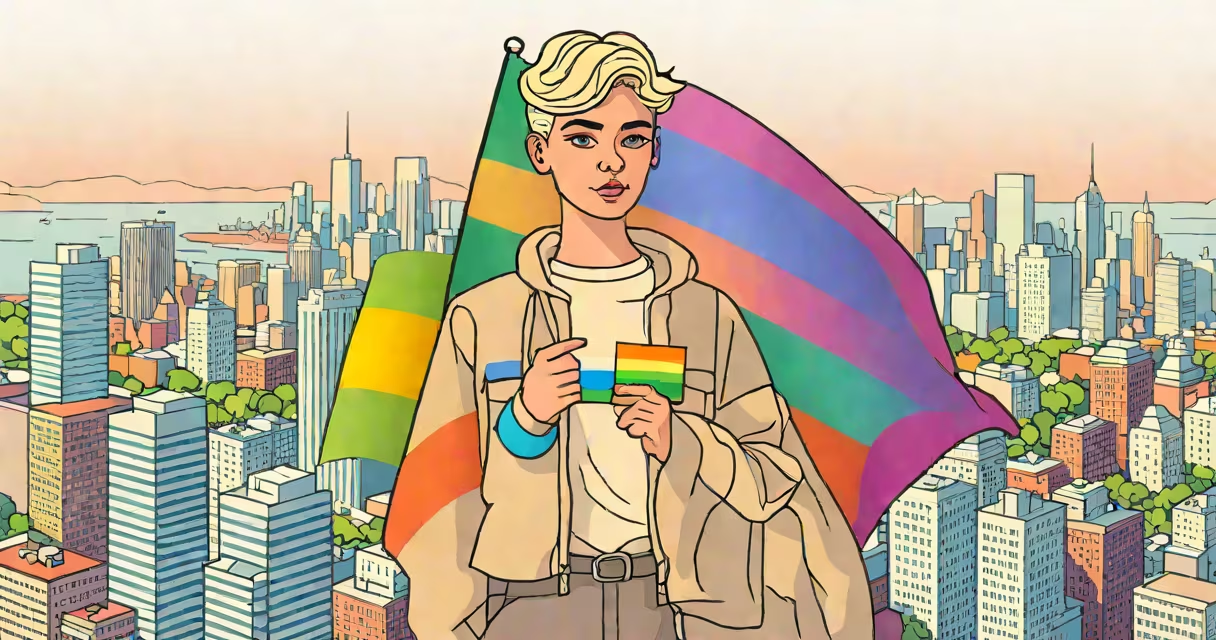
A non binary demiboy is someone whose gender identity is partially male, but not fully man or woman. This identity exists within the broader non binary spectrum and reflects a personal experience of gender that is not entirely aligned with traditional male or female categories.
Gender identity is internal and personal. A non binary demiboy may feel a strong connection to masculinity in certain aspects-such as emotional expression, appearance, or social roles-but does not identify as a man. The term "demiboy" specifically indicates a partial identification with boyhood or maleness, while still acknowledging that their full identity extends beyond binary labels.
This identity is distinct from being transgender or cisgender. A non binary demiboy may experience gender dysphoria related to societal expectations of masculinity, or they may feel discomfort with assigned sex at birth. However, their experience is not defined solely by medical or psychological criteria. Instead, it's rooted in lived perception and self-understanding.
Identity formation is not linear. For a non binary demiboy, gender may feel like a mix of masculine traits and non binary presence. They might express themselves through clothing, pronouns, or behaviors associated with boys or men, but also incorporate elements that feel more fluid or undefined.
Pronoun usage varies widely. Some non binary demiboy individuals use he/him, others use they/them, and some blend multiple sets. A person might say, "I use he/him most days, but sometimes I want to be called they/them." This flexibility reflects the changing nature of identity rather than inconsistency.
One individual I met at a community event described their experience: "I grew up feeling like I was supposed to be a boy, but I never fit the mold. I liked girls' clothes, but I also loved sports and loud voices. Now I call myself a demiboy-I'm not a man, but I'm not just 'non binary' either." Their story illustrates how demiboy identity fills a gap between rigid categories.
There is no single way to be a non binary demiboy. Identities exist along a spectrum of expression, self-perception, and social alignment. Some people emphasize the "partial" aspect-feeling male in specific contexts but not universally. Others focus on the non binary foundation, seeing demiboy as part of a larger gender exploration.
| Identity Type | Key Features | Common Pronouns |
|---|---|---|
| Demiboy with strong male association | Feels male in emotional or behavioral ways; may prefer male-presenting clothing | he/him, they/them |
| Demiboy with low male association | Identifies as partially male but rarely expresses masculinity; may feel disconnected from male culture | they/them, xe/xir |
| Demiboy with evolving identity | Fluid over time; may shift between identifying as demiboy and other non binary labels | varies |
These types are not mutually exclusive. A person may move between them over time. The key is consistency with self-identification, not adherence to a fixed model.
The term "non binary demiboy" is used primarily in LGBTQ+ communities, online forums, and mental health settings. It provides a language for people who don't fit neatly into man or woman but still relate to some aspects of male identity.
Using this label helps reduce isolation. According to the National Center for Transgender Equality, 35% of transgender and non binary people report feeling misunderstood by healthcare providers. Clear terminology like "non binary demiboy" improves communication and access to affirming care.
It's also used in education and workplace diversity training. When policies recognize non binary identities-including demiboy-organizations create safer spaces for gender-diverse individuals. For example, a university in Oregon updated its student registration system to include "demiboy" as a gender option in 2022, allowing students to select from 12 gender identifiers.
"Non binary demiboy" is often mistaken for being a form of transgender man. This is incorrect. While some transgender men may have similar experiences, a non binary demiboy does not necessarily desire or plan to transition medically or socially to live as a man. Their identity is not about becoming something else-it's about being who they are.
Another frequent error is assuming that demiboy means "almost a boy." This misreads the term. "Demiboy" doesn't imply deficiency or incompleteness. It describes a valid, complete identity that exists between or beyond binary categories. As the American Psychological Association notes, "Gender identity is not a scale of completeness, but a spectrum of authentic experience."
A less obvious point: not all non binary demiboy individuals experience gender dysphoria. Dysphoria is a clinical term describing distress due to mismatch between gender identity and assigned sex at birth. But many non binary demiboy people do not feel dysphoric. Their experience is simply one of alignment with a partial male identity that coexists with non binary awareness.
Consider Jamie, a 24-year-old artist living in Portland. Assigned female at birth, Jamie uses they/them pronouns at work but says "he/him" when talking about their art. They wear gender-neutral clothing but sometimes wear a baseball cap and sneakers-items associated with boyhood in their culture.
At a support group, Jamie explained: "I don't feel like a man. But I also don't feel like I'm just 'non binary.' I've always felt like there's a piece of me that's connected to being a boy. That's why I call myself a demiboy. It fits."
They're not trying to be anyone else. Their identity is stable, consistent, and central to their sense of self. This is what non binary demiboy means in practice-not a phase, not a compromise, but a precise way of knowing oneself.
Non binary demiboy is part of a wider structure of gender diversity. It shares roots with terms like agender, bigender, and genderfluid. Understanding these distinctions helps avoid confusion.
Even playful representations matter. The popular "squishmallow" plush toys, often sold in gender-neutral colors, have become cultural symbols of non binary identity. One fan shared on Reddit: "I bought a blue squishmallow because it reminded me of my demiboy self-soft, not quite boy, not quite girl, but definitely mine." While not official, such moments show how identity finds expression in everyday life.
A non binary demiboy is not defined by external validation. It is a self-recognized, internally consistent identity. The term exists to name a real experience-one that many people carry quietly until they find the right word.
Understanding this identity requires listening to lived experience, not just definitions. When someone says "I am a non binary demiboy," they are stating a truth about themselves. That truth is valid, even if it doesn't match everyone else's understanding.