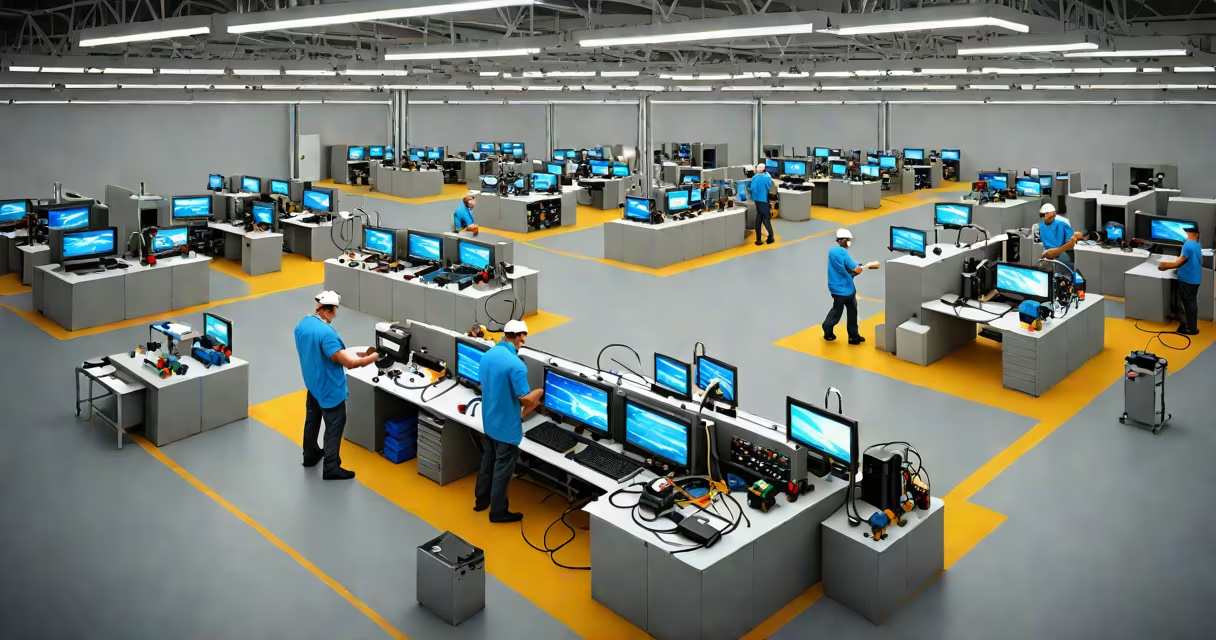
An OEM supplier is a company that manufactures products based on another company's design, technical specifications, and branding requirements. These suppliers produce goods at scale under contract, often delivering finished products ready for resale under the buyer's label. They are central to electronics, automotive, medical devices, and industrial equipment sectors.
OEM suppliers do not create new product concepts-they execute existing ones. A smartphone maker, for example, may provide a detailed engineering blueprint and bill of materials to an OEM supplier, which then produces the device in large volumes. The final product bears the buyer's brand name, not the supplier's.
This model allows companies to focus on design, marketing, and distribution while outsourcing production to specialized manufacturers with proven processes and economies of scale. According to the National Institute of Standards and Technology (NIST), OEM partnerships are critical for reducing time-to-market in high-tech industries.
OEM suppliers function through formal contracts that define product requirements, quality standards, delivery timelines, and intellectual property rights. The client provides engineering drawings, component lists, performance benchmarks, and sometimes even software firmware. The supplier handles procurement, assembly, testing, and logistics.
For example, a fitness tracker brand might work with an OEM supplier in Shenzhen to manufacture 50,000 units of a new smartwatch. The supplier sources the display, battery, sensors, and circuit board, assembles them using automated SMT lines, runs functional tests, and ships the units with the brand's packaging and logo.
These operations rely on strict compliance with ISO 9001 quality management systems and often require audits. The American National Standards Institute (ANSI) notes that certified OEMs reduce defect rates by up to 40% compared to unvetted vendors.
OEM suppliers vary by industry and complexity of output. Here's a breakdown of common categories:
| Type | Scope | Example |
|---|---|---|
| Full-Service OEM | Design, build, test, package, ship | Manufactures entire medical imaging devices from schematics |
| Component-Level OEM | Produces sub-assemblies or parts | Supplies printed circuit boards for industrial control panels |
| White-Label OEM | Builds products sold under multiple brands | Mass-produces Bluetooth speakers used by 12 different audio brands |
Some suppliers specialize in rapid prototyping, offering clients iterative builds within 7-10 days. Others focus on low-volume, high-complexity production-such as aerospace-grade components-where tolerances are measured in microns.
A key distinction: OEM suppliers are not resellers. They don't sell finished goods on retail shelves. They deliver to the client, who controls distribution and customer service.
Many people mistake OEM suppliers for dropshippers or wholesalers. Dropshippers fulfill orders from inventory they don't own. Wholesalers buy products in bulk and resell them at a markup. OEM suppliers don't hold stock-they make what's ordered.
Another error is assuming OEMs handle product design. In reality, the client owns the IP. An OEM supplier cannot rebrand or resell the product without written consent. Unauthorized reuse can lead to legal action under patent and trademark law.
There's also confusion between OEM and ODM (original design manufacturer). While both produce under contract, ODMs develop the product concept themselves. A company might hire an ODM to design and build a new line of wireless earbuds from scratch. The OEM, by contrast, follows a client-provided plan.
In 2022, a U.S.-based EV startup partnered with an OEM supplier in Taiwan to produce battery management systems for their electric SUV. The startup provided CAD files, safety certifications, and a list of approved semiconductor vendors. The OEM sourced components, assembled the PCBs in a cleanroom, ran 120-hour stress tests, and delivered 15,000 units over six months.
The final system was labeled "Proprietary Control Unit - Model X2" and integrated into the vehicle's dashboard. The OEM had no access to the software stack or proprietary algorithms. This arrangement protected the startup's IP while using the supplier's precision manufacturing capabilities.
I've personally visited such facilities during a supply chain audit. The production line ran 24/7 with real-time defect tracking. One sensor failure caused a 30-minute shutdown-just enough to trigger a full batch review. That level of oversight is standard in regulated industries.
OEM suppliers enable innovation by removing capital-intensive barriers to entry. A small tech firm can launch a new IoT device without building a factory. A healthcare provider can deploy custom diagnostic tools without mastering semiconductor fabrication.
They also support global supply chains. During the 2020 pandemic, many consumer electronics brands relied on OEMs in Southeast Asia to maintain output despite local lockdowns. The flexibility of these relationships helped stabilize markets.
Understanding what is an OEM supplier clarifies how modern products reach consumers. These partners are not behind-the-scenes players-they are foundational to product development, scalability, and market competitiveness.