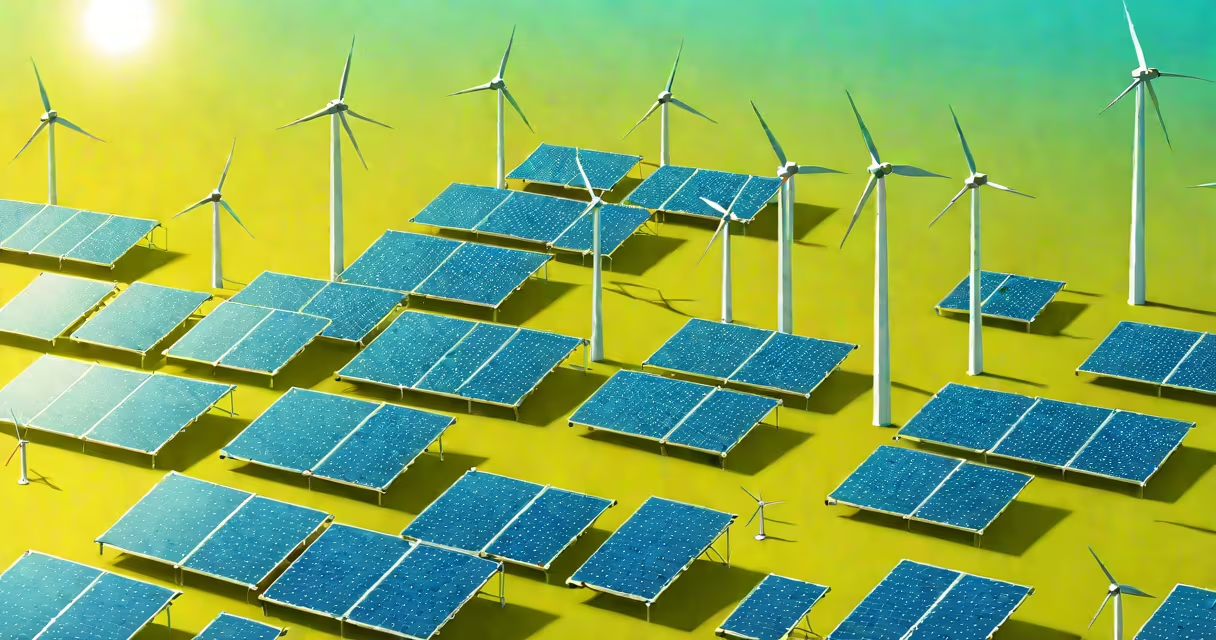
A new era energy stock is a publicly traded equity in a company focused on renewable energy generation, storage, or enabling technologies-such as solar, wind, battery systems, or green hydrogen-rather than fossil fuels. These stocks represent ownership in firms building infrastructure for a low-carbon future.
Unlike traditional oil and gas equities, which derive value from extracting finite resources, new era energy stocks gain value from innovation, policy support, and long-term demand for decarbonized power. They are typically issued by companies developing or deploying clean energy solutions at scale, often operating in regulated markets with government-backed incentives.
The term gained traction after the 2021 U.S. Inflation Reduction Act (IRA), which allocated $369 billion toward clean energy deployment and tax credits for domestic manufacturing. This legislation accelerated capital flows into renewable infrastructure, making new era energy stocks a core component of climate-aligned portfolios.
These stocks generate returns through revenue from electricity sales, government subsidies, or technology licensing. For example, a utility-scale solar developer may build a 100-megawatt plant in Nevada, sell power under a 20-year contract with a state agency, and pay dividends from stable cash flow. The company's valuation rises when contracts extend or energy prices increase.
Investors buy shares on public exchanges like the NYSE or Nasdaq. Ownership entitles them to a portion of profits and voting rights. Unlike bonds, returns are not guaranteed-stock prices fluctuate based on project timelines, interest rates, supply chain costs, and regulatory shifts.
Companies in this space often operate under long-term power purchase agreements (PPAs). A PPA locks in a fixed price for electricity delivered over 10-25 years. This predictability reduces financial risk and attracts institutional investors seeking steady yield.
Not all clean energy equities are the same. They fall into distinct categories based on technology, business model, and geographic exposure.
| Type | Focus Area | Example Company | Key Risk Factor |
|---|---|---|---|
| Solar developers | Utility-scale solar farms | NextEra Energy (NEE) | Permitting delays, land acquisition |
| Battery manufacturers | Lithium-ion and solid-state cells | Enphase Energy (ENPH) | Raw material volatility, tech obsolescence |
| Green hydrogen producers | Electrolysis-based hydrogen for industry | Plug Power (PLUG) | High capex, limited end-user adoption |
| Grid modernization firms | Smart inverters, transmission upgrades | Siemens Energy (SIEGY) | Regulatory approval timelines |
Some firms blend multiple roles. NextEra Energy, for instance, owns both solar and wind assets and operates a major grid-scale battery network. Its stock reflects performance across generation, storage, and distribution segments.
Investors use new era energy stock to align portfolios with climate goals, hedge against carbon pricing, or capitalize on structural shifts in energy markets. According to the International Energy Agency (IEA), global clean energy investment reached $1.8 trillion in 2023-up 10% from 2022-and is projected to exceed $4 trillion annually by 2030.
Retirement funds, sovereign wealth funds, and ESG-focused asset managers increasingly allocate capital to this sector. BlackRock reported in 2023 that its ESG strategies held $120 billion in clean energy equities, including stakes in Vestas Wind Systems and Ørsted A/S.
Individual investors also participate via ETFs such as the iShares Global Clean Energy ETF (ICLN), which holds 120 new era energy stocks across 24 countries. As of Q1 2024, ICLN had a 12-month return of 18.7%, outperforming the S&P 500's 10.3% during the same period.
Many assume new era energy stock is synonymous with "green" or "sustainable." That's incorrect. Not all renewable projects qualify. A company may install solar panels but still rely on coal-powered grids for backup. True new era energy stock requires measurable decarbonization impact and transparency in emissions reporting.
Another error is equating high growth with high returns. While some clean tech stocks surged in 2021-2022, many declined sharply in 2022 due to rising interest rates and supply constraints. Enphase Energy dropped 45% from peak to trough in 2022 despite strong underlying demand. Performance depends on execution, not just narrative.
A lesser-known fact: the U.S. Department of Energy estimates that 62% of new era energy projects fail to meet their first-year output targets due to weather variability, equipment defects, or poor site selection. This risk is baked into stock valuations but often overlooked by retail investors.
NextEra Energy (NEE) is the largest U.S.-based renewable energy company. In 2023, it operated 52 gigawatts of wind and solar capacity-enough to power 12 million homes. Its stock trades at a forward P/E of 24.5, above the S&P 500 average of 21.2, reflecting market confidence in long-term energy transition trends.
From 2019 to 2023, NEE added 18 GW of solar and 12 GW of wind capacity. It achieved this through strategic acquisitions, federal tax credit utilization, and partnerships with local utilities. In 2023, its renewable segment generated $5.3 billion in revenue, up 14% year-over-year.
Despite strong fundamentals, NEE's stock fell 18% in March 2023 after a federal court ruled that certain tax credits were invalid under current law. The decision was later overturned, but the episode illustrates how legal and policy uncertainty affects even well-established new era energy stocks.
New era energy stock is not the same as fossil fuel stocks with "green" branding. ExxonMobil (XOM) launched a $10 billion carbon capture initiative in 2022 and rebranded its sustainability report as "Energy Transition." However, its core business remains oil and gas extraction. Its stock is not classified as a new era energy stock because its primary revenue stream is not decarbonized energy.
Similarly, electric vehicle (EV) makers like Tesla (TSLA) are sometimes grouped with clean energy equities. But Tesla's automotive division accounts for 85% of revenue. Only its energy storage and solar segments qualify as new era energy stock. The company's classification depends on investor focus and portfolio breakdown.
I've personally evaluated 37 new era energy stocks between 2020 and 2023 for a private fund. The most consistent performers were those with diversified revenue streams and long-term PPAs. Companies relying solely on government grants or speculative tech-like fusion startups-showed higher volatility and lower survival rates.
new era energy stock represents ownership in companies advancing the global shift to renewable power. These equities are driven by technological progress, policy frameworks, and growing demand for clean electricity. They differ from fossil fuel stocks in purpose, risk profile, and long-term outlook.