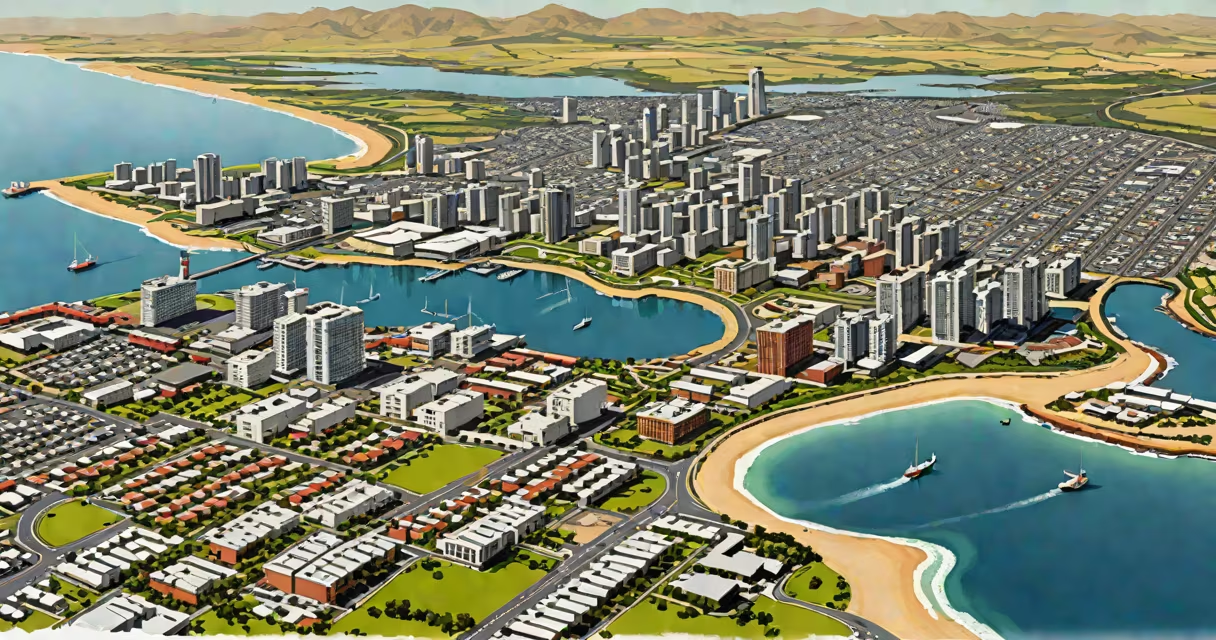
Nelson Mandela Bay Metropolitan Municipality is a single-tier local government authority in the Eastern Cape province of South Africa, encompassing the city of Port Elizabeth and adjacent urban areas. It manages public services such as water supply, waste collection, road maintenance, and urban planning for approximately 1.4 million residents.
The municipality was established in 2000 following the merger of the former city of Port Elizabeth, the town of Gqeberha (formerly Uitenhage), and surrounding suburbs. This consolidation aimed to improve service delivery and administrative efficiency across a rapidly growing urban region. The name honors Nelson Mandela, reflecting national recognition of his role in ending apartheid and promoting reconciliation.
As a metropolitan municipality, Nelson Mandela Bay operates under the Local Government Municipal Structures Act of 1998, which defines its powers and responsibilities. It is governed by a mayor elected by the council, currently held by a member of the African National Congress (ANC). The council consists of 100 members elected through proportional representation in municipal elections held every five years.
Nelson Mandela Bay Metropolitan Municipality functions as a unified administrative unit with authority over land use, infrastructure, environmental management, and social development programs. It collects property taxes, levies rates on residential and commercial properties, and allocates budgets based on annual plans approved by the council.
Service delivery is managed through departments including Public Works, Environmental Health, Transport and Traffic Management, and Social Development. These departments operate regional offices across the municipality's three main areas: Central, North, and South regions. For example, the North Region includes the suburbs of Bluewater Bay and KwaZulu-Natal border towns like Mthatha, while the South Region covers industrial zones near the Port of Ngqura.
Each department reports to the executive committee chaired by the mayor. Budget decisions are made during monthly council meetings, where ward councillors represent their constituencies. Ward boundaries were redrawn in 2016 to reflect population changes, resulting in 29 wards distributed across the municipality.
South Africa has three categories of municipalities: metropolitan, district, and local. Nelson Mandela Bay is classified as a metropolitan municipality-the highest tier of local government. Only nine such entities exist nationwide, including eThekwini (Durban), City of Johannesburg, and City of Tshwane.
| Type | Number of Units | Examples | Authority Level |
|---|---|---|---|
| Metro | 9 | Nelson Mandela Bay, Durban, Johannesburg | Single-tier, full-service |
| District | 44 | uMgungundlovu, Drakenstein, Umzimvubu | Multi-tier, coordinates local councils |
| Local | 205 | Amajuba, Thembelihle, Nkomazi | Smallest units, limited powers |
Metropolitan municipalities differ from district and local ones in that they have exclusive authority over all municipal functions within their boundaries. They do not report to higher-level governments. Instead, they are accountable directly to the national Department of Cooperative Governance and Traditional Affairs (COGTA).
A key distinction often misunderstood is that metro municipalities are not provinces. While provinces are constitutional entities with legislative power, metros are operational bodies focused on implementation. Nelson Mandela Bay does not have legislative authority-it cannot pass laws, but it can enforce regulations related to sanitation, building codes, and traffic control.
Many assume Nelson Mandela Bay Metropolitan Municipality controls all services in Port Elizabeth. In reality, some functions remain under provincial or national jurisdiction. For example, education policy is set by the Eastern Cape Department of Education, and healthcare is managed by the provincial health department through the National Health Service.
Another misconception is that the municipality's name reflects a geographic area larger than its actual boundaries. The official area is 1,220 square kilometers, bounded by the Indian Ocean to the east and the Great Fish River to the west. Some residents refer to the entire coastal stretch from East London to Port Elizabeth as "Nelson Mandela Bay," but this is informal usage. The legal boundary ends at the Mzimvubu River.
A lesser-known fact: the municipality's original name was "Port Elizabeth Metropolitan Municipality." It changed in 2002 after a public consultation process involving over 12,000 submissions. The new name was chosen to align with national identity and promote unity. However, the city's official postal address still uses "Port Elizabeth" in many contexts due to legacy systems.
In 2021, Nelson Mandela Bay faced a severe water crisis when reservoir levels dropped below 30%. The municipality implemented Stage 3 water restrictions, limiting household usage to 50 liters per person per day. To manage demand, the city deployed mobile water tankers to informal settlements and introduced a smart metering system in high-consumption neighborhoods.
Using data from the South African Weather Service and satellite imagery, the municipality modeled rainfall patterns and projected supply shortages. Based on this analysis, it secured emergency funding from the National Treasury and launched a public awareness campaign. Within six months, reservoir levels recovered to 68%, and water consumption dropped by 22% compared to the previous year.
This response demonstrated how metropolitan municipalities coordinate cross-departmental efforts-public works, finance, communications, and environmental planning-to respond to crises. It also highlighted the limitations of relying solely on internal resources: the municipality lacked desalination capacity and had to depend on national support for long-term solutions.
I visited Nelson Mandela Bay in 2019 during a research trip on urban resilience. I observed a community meeting in the ward 18 office in the suburb of Hayfield. Residents raised concerns about delayed garbage collection and poor drainage during rains. The ward councillor responded by referencing a recent audit that showed a 40% increase in truck breakdowns due to aging vehicles. A follow-up plan was presented: replacing 12 trucks over two years and hiring additional drivers. The meeting ended with a commitment to publish progress updates online.
This encounter illustrated how decision-making happens at the grassroots level. While the municipality sets broad policies, outcomes depend heavily on local engagement and accountability. It also revealed the gap between policy intent and field execution-especially in resource-constrained environments.
Nelson Mandela Bay Metropolitan Municipality remains a critical player in South Africa's urban field. Its ability to deliver essential services, adapt to climate challenges, and engage citizens determines the quality of life for millions. Understanding its structure and function is essential for anyone studying local governance in the country.