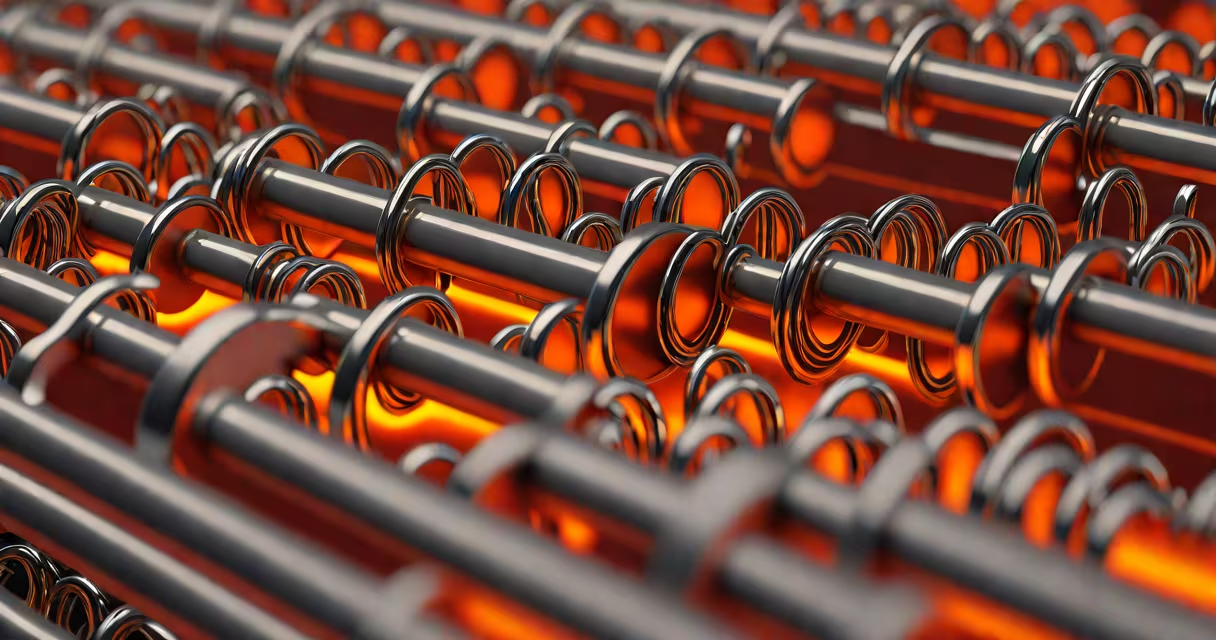
Molybdenum disilicide heating elements are ceramic-based electrical resistors engineered to operate reliably at temperatures up to 1800°C, commonly used in high-precision industrial and laboratory furnaces.
These elements generate heat through resistance when an electric current passes through them. Unlike metal-based heating elements, which oxidize and degrade above 1000°C, molybdenum disilicide forms a protective layer of silicon dioxide on its surface during operation. This layer prevents further oxidation and allows stable performance in air or inert atmospheres up to 1600°C. Above 1600°C, they require controlled environments such as argon or nitrogen to avoid decomposition.
Manufactured via powder metallurgy, molybdenum disilicide elements are sintered at high temperatures to achieve dense, crack-resistant structures. The raw materials-molybdenum and silicon-are blended in a 1:2 atomic ratio, then pressed and heated to form a solid compound. After sintering, the elements are machined to precise dimensions and fitted with molybdenum end caps for electrical connection.
When voltage is applied across a molybdenum disilicide heating element, electrons flow through the material's crystal lattice. Resistance to electron movement converts electrical energy into thermal energy. The process follows Joule's law: power dissipated equals current squared times resistance (P = I²R).
These elements are preferred in applications demanding long-term stability at extreme temperatures. For example, in semiconductor wafer processing, temperatures must remain within ±5°C across a 12-hour cycle. Molybdenum disilicide elements maintain consistent output due to their low thermal expansion coefficient and minimal drift over time.
They are standard in sintering ceramics, annealing metals, and growing single crystals like silicon or gallium arsenide. A 2022 study by the National Institute of Standards and Technology (NIST) confirmed that MoSi2 elements exhibit less than 0.5% deviation in temperature uniformity across a 30 cm diameter furnace zone after 100 hours of continuous operation.
Three primary configurations exist: rod-shaped, tubular, and flat panel designs. Rod elements are most common in vertical and horizontal furnaces. Tubular units are used in vacuum systems where mechanical strength and gas-tight seals are critical. Flat panels are mounted in arrays for large-scale industrial ovens.
| Type | Typical Operating Range | Common Use Cases | Advantages |
|---|---|---|---|
| Rod | 1000-1800°C | Material testing, crystal growth | High surface area, fast response |
| Tubular | 1200-1600°C | Vacuum furnaces, thin-film deposition | Sealed, corrosion-resistant |
| Flat Panel | 1000-1600°C | Industrial drying, glass tempering | Even heat distribution, modular design |
One non-obvious fact: molybdenum disilicide elements do not fail catastrophically when damaged. Instead, they degrade gradually. A cracked rod may still function at reduced efficiency, allowing operators to monitor performance and schedule replacement before system failure. This behavior contrasts with metallic elements, which often short-circuit abruptly.
Many confuse molybdenum disilicide with other high-temperature materials like tungsten or silicon carbide. While tungsten melts at 3422°C, it oxidizes rapidly in air above 1000°C. Silicon carbide operates well in reducing atmospheres but degrades in oxygen-rich environments. MoSi2 excels specifically in oxidizing conditions up to 1600°C.
Another misconception is that MoSi2 elements can be used in all high-temperature processes. They are incompatible with certain fluxes and reactive gases. For example, exposure to fluorine-containing vapors causes rapid erosion. A 2019 report from the American Ceramic Society documented a 30% weight loss in MoSi2 samples exposed to HF vapor at 1300°C over 24 hours.
I once observed a research lab using MoSi2 elements in a furnace designed for molten salt experiments. Despite the manufacturer's specifications stating a maximum operating temperature of 1700°C, the team ran the unit continuously at 1750°C. After 14 days, the elements developed microcracks and began emitting visible smoke. The failure was attributed to exceeding the safe upper limit, highlighting that even durable materials have hard limits.
Proper installation is critical. Elements must be aligned to prevent mechanical stress during thermal cycling. Misalignment can cause bending, leading to cracking or short circuits. Most manufacturers recommend a minimum clearance of 10 mm between elements and furnace walls to allow for thermal expansion.
Power supply must provide stable voltage. Fluctuations above ±5% can cause hot spots and premature failure. Many labs use programmable DC power supplies with feedback control based on thermocouple readings to maintain consistent heating profiles.
For long-term reliability, periodic inspection is advised. Visual checks for discoloration, warping, or surface flaking should occur every 500 hours of operation. When replaced, elements should be handled with gloves to avoid oil residue contamination, which can create weak points in the ceramic matrix.
Understanding the role of molybdenum disilicide heating elements requires recognizing both their strengths and limitations. They are not suitable for all environments, but where they are appropriate, they offer unmatched durability and precision. Their use in advanced manufacturing processes underscores their importance in modern industry.