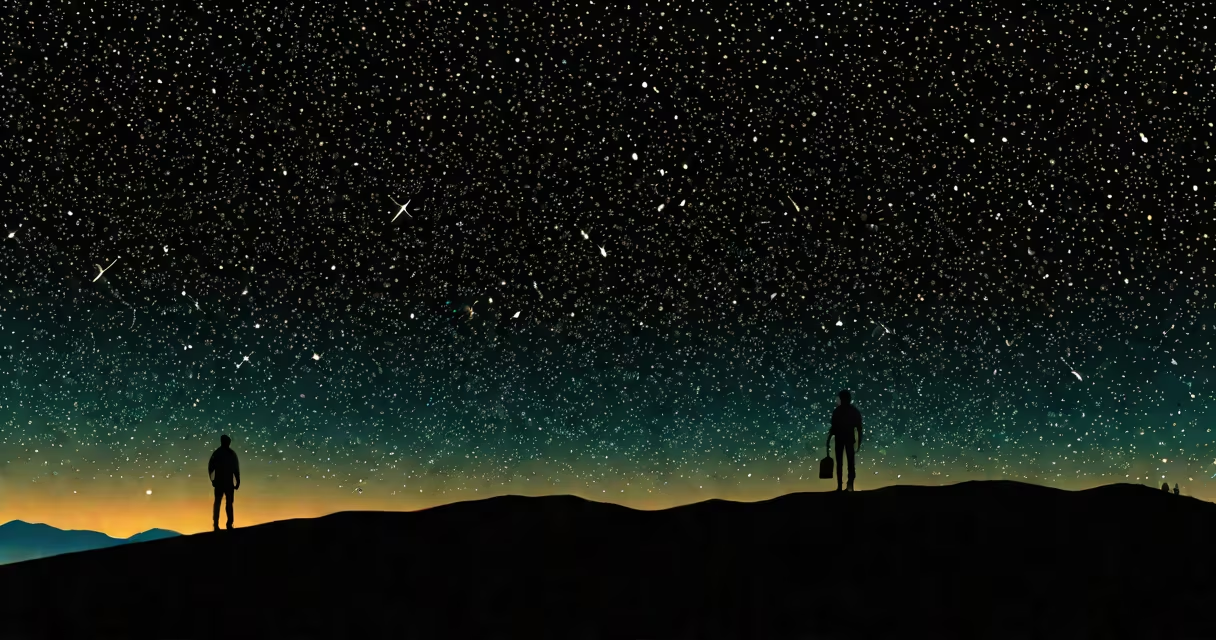
Look at the stars means observing the night sky with the naked eye to witness celestial objects like planets, constellations, and the Milky Way. This practice connects people to the cosmos through direct visual experience, requiring no equipment beyond clear skies and a willingness to pause.
Stargazing begins with stillness. Find a location away from city lights-ideally a rural area or designated dark sky park. Wait 20 minutes for your eyes to adjust to darkness. The human eye adapts to low light through rod cell activation, increasing sensitivity to faint starlight. This adaptation allows you to see stars as dim as magnitude 6 under optimal conditions.
Use a star map app like SkySafari or Stellarium to identify constellations. Orion, Cassiopeia, and Ursa Major appear regularly in northern latitudes between September and March. These patterns serve as navigational guides. For example, the two outer stars of Orion's belt point toward Sirius, the brightest star in the night sky, located in Canis Major.
Light from stars travels vast distances-some for thousands of years-before reaching Earth. When you look at the stars, you're seeing light emitted in the past. A star 100 light-years away appears as it did 100 years ago. This time delay makes stargazing a form of historical observation.
Atmospheric conditions affect visibility. Humidity, cloud cover, and air pollution scatter light, reducing contrast. Light pollution from urban areas washes out fainter stars. The International Dark-Sky Association rates locations based on sky brightness; places like Cherry Springs State Park in Pennsylvania maintain Class 2 ratings on the Bortle Scale, ideal for viewing.
Timing matters. The best viewing occurs during new moon phases when the sky is darkest. Moonlight interferes with faint star detection. In early autumn, the galactic center rises around midnight, offering views of dense star fields near Sagittarius.
The night sky contains objects categorized by origin and behavior:
| Type | Examples | Visibility Conditions |
|---|---|---|
| Stars | Sirius, Vega, Betelgeuse | Visible year-round from most latitudes |
| Constellations | Orion, Leo, Scorpius | Seasonal; best seen in specific months |
| Planets | Venus, Jupiter, Saturn | Appear near ecliptic; track slowly across sky |
| Galaxy | Milky Way, Andromeda | Andromeda visible only in fall; Milky Way best in summer |
Stars are distant suns. Planets reflect sunlight and appear brighter than stars due to proximity. The Milky Way is our galaxy's disk viewed edge-on. Its core lies in Sagittarius, visible in late spring and summer from mid-northern latitudes.
Look at the stars serves scientific, cultural, and personal purposes. Ancient civilizations used star positions for navigation and calendar systems. Polynesians crossed the Pacific using star paths, a method validated by modern experiments at the University of Hawaii's Polynesian Navigation Program.
Modern astronomers use naked-eye observations to detect transient events. In 2020, amateur observers reported the sudden appearance of a nova in the constellation Delphinus. The event was confirmed by professional observatories within days, proving that unaided vision remains valuable for discovery.
Psychological benefits include reduced stress and increased awe. A 2021 study published in *Frontiers in Psychology* found that participants who spent 15 minutes gazing at the night sky reported higher levels of wonder and lower cortisol levels compared to control groups. The sensation of smallness in the face of cosmic scale can build perspective and emotional resilience.
Many assume that looking at the stars requires expensive gear. A telescope is not needed to see the Moon's craters, Jupiter's moons, or Saturn's rings. With binoculars, you can resolve these features. But even without optics, the naked eye detects patterns and movement.
Another myth: all stars are equally bright. In reality, apparent brightness varies due to distance and intrinsic luminosity. Sirius appears brighter than Alpha Centauri not because it's closer, but because it emits more light. The magnitude scale assigns negative values to very bright objects-Sirius is -1.46, while the faintest visible stars are magnitude +6.
A lesser-known fact: meteors are not stars. They are debris burning up in Earth's atmosphere. The Perseid meteor shower, peaking August 11-13, produces up to 100 meteors per hour. Observers report seeing them as streaks lasting less than a second. Their radiant point-the spot in the sky they seem to come from-is in Perseus, hence the name.
I once watched the Perseids from a field in central New York. No lights. No noise. Just silence and motion. Over two hours, I counted 47 meteors. One left a persistent trail that lasted 15 seconds. That moment shifted my understanding: the sky isn't static. It moves, changes, and surprises.
Look at the stars is often mistaken for astrology. Astrology interprets planetary positions as influencing personality or fate. Astronomy, the science behind stargazing, studies physical properties and motions of celestial bodies. The two share historical roots but differ in methodology and evidence.
Some confuse stargazing with astrophotography. While both involve the night sky, photography captures long exposures that reveal details invisible to the eye-like nebulae or distant galaxies. A single exposure may last 30 seconds, accumulating light beyond human perception. Stargazing relies on real-time visual input.
Another error: assuming all stars are visible everywhere. The Southern Cross, prominent in southern skies, is invisible north of 25°N latitude. Conversely, the North Star (Polaris) is nearly stationary above the Arctic Circle. Geographic location determines which constellations are circumpolar-those that never set below the horizon.
Start with a clear night and a smartphone app. Open SkySafari, enable location services, and point your phone upward. The app overlays constellations and labels stars. Use it to locate Orion's Belt-three aligned stars in a row. Once identified, turn off the screen and observe without aid.
Track the Moon's phases. It cycles through new, waxing crescent, first quarter, waxing gibbous, full, waning gibbous, last quarter, and waning crescent over 29.5 days. During a full moon, star visibility drops. Choose nights near new moon for maximum detail.
Join a local astronomy club. Events like star parties offer guided tours of the sky. The Astronomical Society of the Pacific hosts monthly virtual meetups with live sky views. You can also participate in citizen science projects such as Globe at Night, which collects data on light pollution by measuring star visibility.
For deeper exploration, consider using a pair of 7x50 binoculars. They show Jupiter's four Galilean moons and the Pleiades cluster. These tools cost under $50 and require no training. They improve the experience without replacing the act of simply looking.
Remember: you don't need to know the name of every star to benefit from looking at the stars. The act itself-pausing, noticing, being present-carries meaning. As Carl Sagan wrote, "Somewhere, something incredible is waiting to be known."
When you look at the stars, you join a tradition older than language. It's a quiet act of curiosity. A way to remember that you are part of something vast. Try it tonight. Find a patch of sky. Look. Stay still. Let the stars speak.