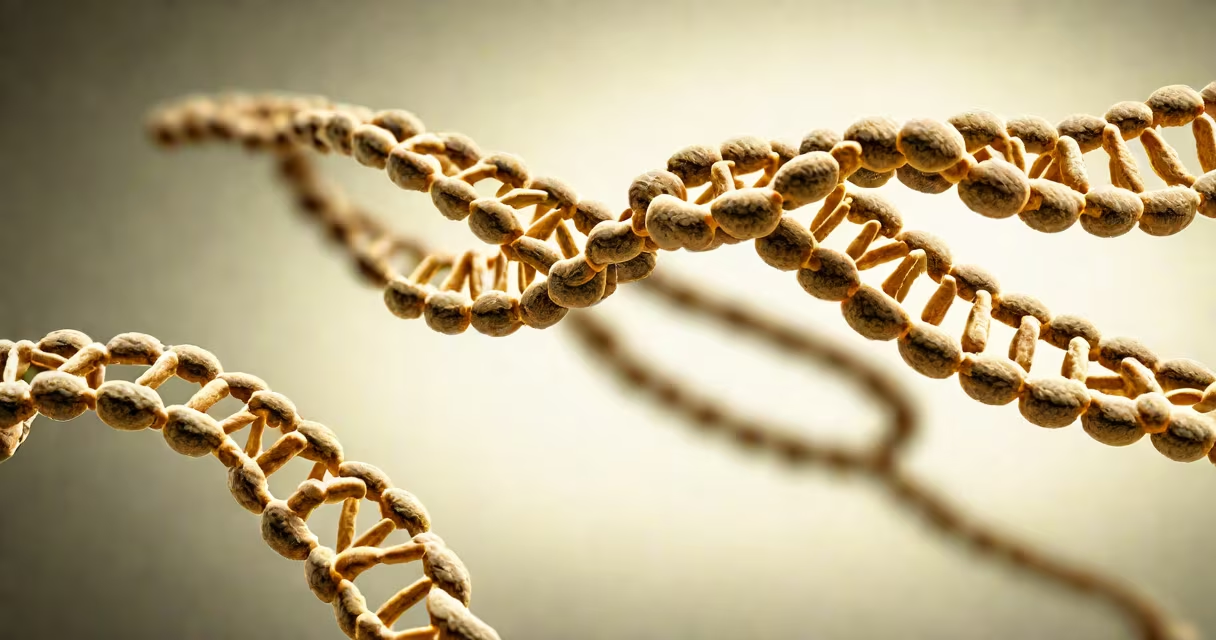
Linkage definition in genetics refers to the tendency of genes located near each other on the same chromosome to be inherited together during meiosis, reducing the likelihood of recombination between them. This phenomenon contradicts Mendel's law of independent assortment when genes are physically close.
Genes on the same chromosome do not assort independently because they are physically connected. During gamete formation, homologous chromosomes exchange segments through crossing over. When two genes are far apart, this exchange frequently separates them. But when they're close, the chance of crossover between them is low. The result is that their alleles are often passed on as a unit.
For example, in fruit flies (*Drosophila melanogaster*), the gene for eye color (white eyes) and the gene for wing size (vestigial wings) are both on chromosome 2. These traits rarely appear in recombinant combinations in offspring, indicating strong linkage. This observation led Thomas Hunt Morgan to discover genetic linkage in the early 20th century.
During meiosis I, homologous chromosomes pair and may exchange DNA segments via crossing over. The probability of a crossover event between two loci increases with physical distance along the chromosome. Genes less than 10 centimorgans (cM) apart typically show strong linkage, meaning they are inherited together more than 50% of the time.
Recombination frequency-the percentage of offspring that show a new combination of alleles-measures how tightly linked two genes are. A recombination frequency of 1% corresponds to 1 cM. If two genes have a recombination frequency of 5%, they are 5 cM apart. Frequencies above 50% indicate unlinked genes, which behave as if they are on different chromosomes or very far apart.
For instance, in a test cross between a heterozygous individual (AaBb) and a homozygous recessive (aabb), if 90% of offspring inherit parental allele combinations (AB and ab), and only 10% show recombinant types (Ab and aB), the genes are linked with a recombination frequency of 10%. This translates to a genetic distance of 10 cM.
Linkage is categorized by strength based on recombination frequency:
| Linkage Type | Recombination Frequency | Genetic Distance | Implication |
|---|---|---|---|
| Complete linkage | 0% | 0 cM | No recombination observed; genes always inherited together. |
| Partial linkage | 0-50% | 0-50 cM | Most common; recombination occurs occasionally. |
| Unlinked | 50% | >50 cM | Behaves as if on separate chromosomes. |
Complete linkage is rare in nature but can occur in species with suppressed recombination, such as in male *Drosophila*, where crossing over does not happen. Partial linkage is typical in most eukaryotes and forms the basis for genetic mapping.
Geneticists use recombination frequencies to build linkage maps-linear representations of gene order and spacing on chromosomes. These maps are essential for identifying disease-causing genes and tracking inheritance patterns in families.
Many assume that linked genes always produce the same phenotype. That's incorrect. Linkage affects genotype transmission, not expression. Two linked genes can still exhibit independent phenotypic effects due to dominance, epistasis, or environmental influence.
A frequent error is equating linkage with co-dominance or incomplete dominance. These are distinct concepts. Co-dominance refers to how alleles are expressed in the phenotype (e.g., AB blood type), while linkage concerns chromosomal proximity and inheritance patterns.
Another misunderstanding is that linkage prevents evolution. On the contrary, linkage can preserve beneficial gene combinations, accelerating adaptation. However, it can also hinder selection by keeping deleterious alleles attached to advantageous ones-a problem known as "genetic hitchhiking."
Linkage analysis is central to human genetics. In families with hereditary diseases, researchers track marker alleles alongside symptoms to locate disease genes. For example, cystic fibrosis was mapped using linkage analysis in the 1980s. Scientists identified a region on chromosome 7 associated with the disease, later pinpointing the *CFTR* gene.
In agriculture, linkage helps breeders select multiple desirable traits simultaneously. Corn plants with high yield and drought tolerance were developed by selecting for linked markers. This reduces breeding cycles compared to traditional methods.
I once observed a lab experiment where students crossed two strains of *Arabidopsis thaliana*. One had purple flowers and tall stems; the other had white flowers and short stems. F1 offspring were all purple and tall. In the F2 generation, 75% showed parental combinations, but 25% displayed recombinant phenotypes. The recombination frequency was 25%, placing the flower color and stem height genes about 25 cM apart-clear evidence of partial linkage.
According to the National Human Genome Research Institute, linkage mapping remains a foundational tool in genome-wide association studies (GWAS), especially when studying complex traits influenced by multiple genes.
Linkage is often confused with epistasis-where one gene masks the effect of another-or pleiotropy-where one gene influences multiple traits. These are different mechanisms. Epistasis alters phenotype expression; linkage alters inheritance patterns.
For example, in mice, coat color is controlled by multiple genes. The *Agouti* gene determines banding pattern, but the *Extension* gene controls pigment production. If both are on the same chromosome and inherited together, they are linked. But if *Agouti* affects fur color and also influences metabolism, that's pleiotropy-not linkage.
Understanding the difference is critical in genetic counseling. A family history of heart disease and diabetes might suggest shared genetic risk, but linkage analysis confirms whether the genes are physically close or merely correlated by chance.
Linkage definition in genetics remains a key part of molecular biology, enabling precise mapping of genomes and informing medical diagnostics, evolutionary studies, and crop improvement. Its role in explaining inheritance beyond Mendel's laws ensures ongoing relevance in research and education.