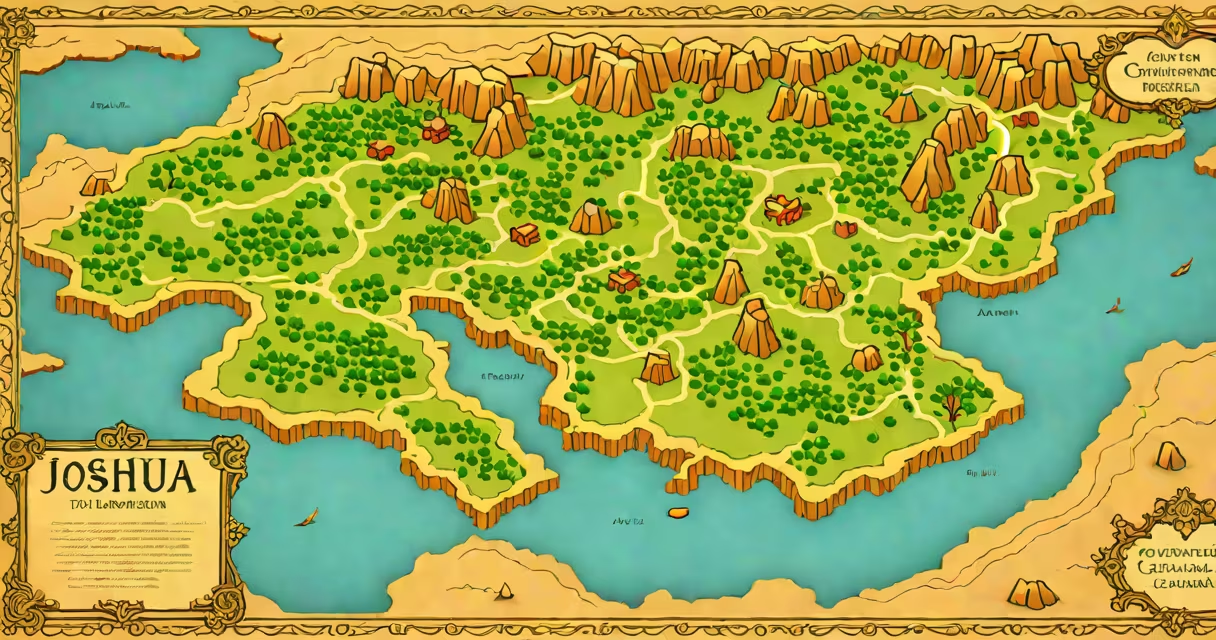
Joshua 16 describes the allocation of land in Canaan to the tribes of Ephraim and Manasseh, descendants of Joseph, following the conquest led by Joshua. The chapter records God's command to divide the promised land among the twelve tribes, with specific boundaries assigned to Joseph's two sons.
The division of land in Joshua 16 reflects a structured process rooted in divine authority. After the Israelites crossed the Jordan River and defeated Jericho and Ai, the central task became assigning portions of the conquered territory. The focus here is on Joseph's lineage-Ephraim and Manasseh-two tribes that together formed a large and influential group within the nation. Their inheritance was not given to them as a single unit but split between two distinct regions, reflecting both unity and separation within the family.
According to the Hebrew Bible, the land was apportioned by lot under the direction of Eleazar the priest and Joshua. This method ensured fairness and removed human bias. The process is described in detail in Joshua 13-19, with each tribe receiving a designated area based on census data and geographic features. The actual distribution was carried out by the Levitical priests and tribal leaders, who surveyed the land and marked boundaries.
Joshua 16 begins with a direct statement: "The allotment for the tribe of Joseph fell to Ephraim and Manasseh." The text specifies that the territory of Ephraim lay south of Shechem and extended westward toward the Mediterranean. Its southern boundary ran from Micmethath near Bethel to the valley of Beth-Horon, then to Kiriath-Baalah. The northern boundary touched the Jordan River near Jericho, and the western edge bordered the Mediterranean Sea.
Manasseh's portion was located to the east of the Jordan River and included areas such as Gilead and parts of Bashan. However, Joshua 16 focuses only on the western side of the Jordan-the land west of the river-where Ephraim and Manasseh were settled. The chapter notes that the land was divided according to ancestral lines, with each clan receiving a share based on their patriarchal descent.
A key feature of this assignment is the inclusion of cities and natural landmarks. For example, the city of Gezer was part of Ephraim's territory, though it was later taken by the Egyptians during the time of Solomon. This detail appears in 1 Kings 9:16, confirming that the original boundary set in Joshua 16 was not static-it evolved over centuries due to military and political changes.
The boundaries in Joshua 16 are not arbitrary. They follow a pattern seen throughout the book: rivers, mountains, and major towns serve as markers. The Jordan River forms a natural eastern border, while the Mediterranean Sea marks the western limit. Mountains like Tabor and Gilgal appear as reference points. These features helped define the land in ways that were practical for navigation and governance.
Each boundary line corresponds to a specific region. For example, Ephraim's territory included the hill country around Shechem and Bethel. The text states that the area extended "from the Jordan to the sea" and "from the wilderness to the great sea." This phrasing echoes earlier promises made to Abraham in Genesis 15:18, where God says, "To your descendants I give this land, from the river of Egypt to the great river, the Euphrates." Though the full extent was never realized, the promise was fulfilled in part through the allotment recorded in Joshua 16.
| Tribal Group | Primary Territory | Key Cities | Boundary Features |
|---|---|---|---|
| Ephraim | Central highlands, west of Jordan | Shechem, Bethel, Gezer | Jordan River, Mediterranean Sea, Bethel ridge |
| Manasseh (West) | North-central hills, adjacent to Ephraim | Shiloh, Beth-El, Jabesh-Gilead | Mount Ephraim, Jordan Valley |
One non-obvious point often missed is that Ephraim and Manasseh were not treated equally in the narrative. While both descended from Joseph, Ephraim received a larger and more central portion. This may reflect the prominence of Ephraim in later traditions-Ephraim became the name associated with the northern kingdom after the split in 930 BCE. The capital city of Samaria, established by Omri, was located in Ephraim's territory.
Many readers assume that the land division in Joshua 16 was purely symbolic or ceremonial. But archaeological evidence supports the reality of early Israelite settlement patterns. Excavations at sites like Shechem and Bethel show continuous occupation from the Late Bronze Age into the Iron Age, aligning with the biblical timeline. The presence of storage jars, ash pits, and cultic objects at these locations suggests organized community life consistent with the tribal structure described in Joshua.
Another misconception is that the entire land was fully conquered and settled by the time Joshua died. The text itself admits gaps: "The people of Joseph did not drive out the Canaanites who lived in Gezer." This line appears in Joshua 16:10 and is important-it shows that the conquest was incomplete. The Canaanites remained in the land and were eventually integrated into the population, sometimes through forced labor or intermarriage.
This detail is significant because it contradicts the idea of a total, clean sweep. Instead, the biblical narrative presents a gradual process of coexistence and cultural blending. The Israelites did not expel all inhabitants. As noted in the 4 x 7 16, the reality of mixed populations shaped the development of Israelite society far more than a myth of total conquest.
Gezer provides a clear example of how the land assignment in Joshua 16 played out over time. Located about 30 kilometers west of Jerusalem, Gezer was listed as part of Ephraim's territory. Archaeological excavations led by Yigael Yadin in the 1960s revealed a massive city gate and a complex water system dating to the 13th century BCE-consistent with the period of the Israelite monarchy.
The site shows layers of occupation. The lower levels contain artifacts from the Middle Bronze Age, while the upper strata display Iron Age material culture. A stele fragment found at Gezer bears the name of Pharaoh Shishak, who raided the region in the 10th century BCE. This confirms that Gezer was still a strategic location long after the initial allocation in Joshua 16.
When Solomon married the daughter of Pharaoh, he gave her Gezer as a dowry. This event is recorded in 1 Kings 9:16: "Solomon gave the town of Gezer to his wife, because she had come to him from Egypt." The transfer of Gezer from Israelite control to foreign influence illustrates how the original boundaries shifted due to political alliances and warfare.
I once spent a weekend tracing the boundaries of Joshua 16 using satellite maps and archaeological databases. What struck me was how closely the described borders matched modern terrain. The valley of Beth-Horon, for example, is still a narrow pass between two ridges-difficult to cross without preparation. The route from Bethel to Shechem follows a series of terraced hills that would have required careful planning to settle.
Even more telling was the absence of certain features. Modern roads and settlements have erased many ancient markers. Yet the layout remains visible. The central highlands of Ephraim are still elevated relative to the coastal plain, and the Jordan Valley is unmistakably a fault line. This consistency suggests that the biblical authors were not inventing geography-they were recording what they saw.
Joshua 16 explained reveals a detailed, divinely guided plan for distributing land among the tribes of Israel. It is not a mythic tale but a historical record of territorial assignment based on lineage, geography, and divine command. The chapter underscores that the promise of land was fulfilled incrementally, with ongoing challenges from remaining Canaanite populations. Understanding Joshua 16 requires recognizing both its religious significance and its real-world context.