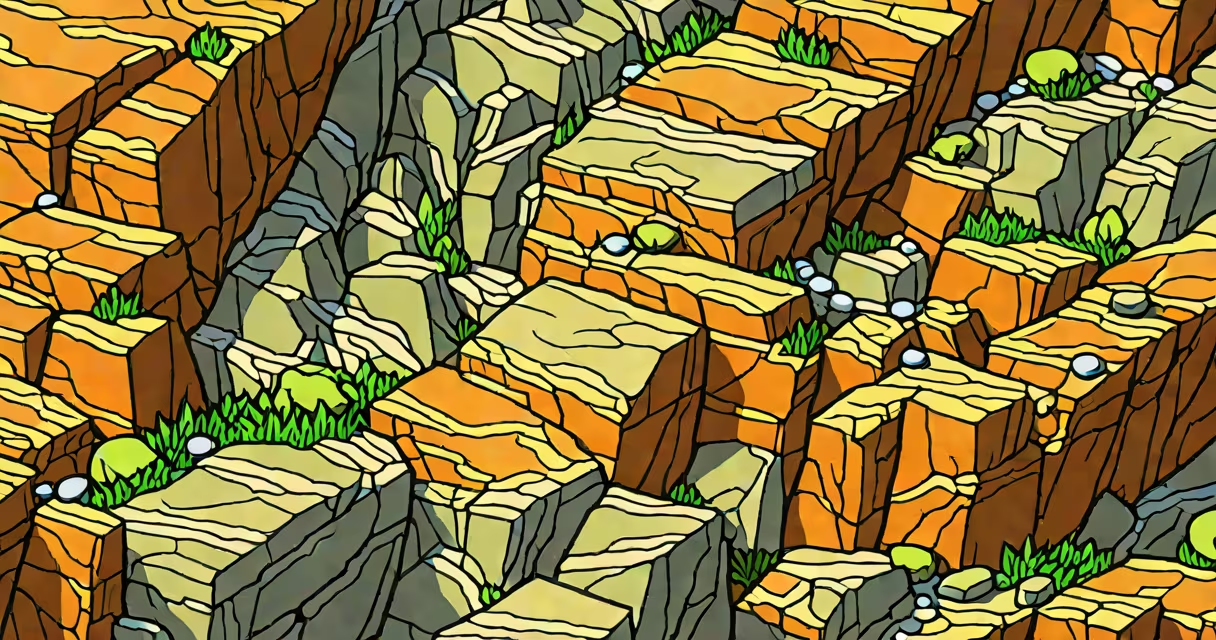
Metamorphic rocks form when existing igneous, sedimentary, or other metamorphic rocks undergo physical and chemical changes due to high temperature, pressure, or chemically active fluids, without melting. The transformation alters mineral composition and texture while preserving the original rock's bulk chemistry.
This process occurs deep within Earth's crust, typically between 10 and 30 kilometers below the surface, where temperatures exceed 200°C and pressures reach hundreds of megapascals. These conditions cause minerals to recrystallize into denser, more stable forms. For example, clay minerals in shale may change into mica and chlorite, producing slate.
According to the U.S. Geological Survey, metamorphism happens gradually over millions of years. The rate depends on rock composition, fluid presence, and the intensity of stress. Heat alone can induce recrystallization; pressure can align minerals into parallel layers, creating foliation-a key feature in many metamorphic rocks.
Metamorphic change begins when a parent rock-called a protolith-is buried beneath layers of sediment or thrust during tectonic collisions. As depth increases, temperature rises and confining pressure builds. If fluids are present, they accelerate ion exchange between minerals, enabling new phases to grow.
Two primary mechanisms drive metamorphism: contact metamorphism and regional metamorphism. Contact metamorphism occurs near magma intrusions, where heat radiates into surrounding rock. The affected zone is narrow-usually less than a kilometer wide-but temperatures can exceed 800°C. This produces hornfels, a fine-grained, non-foliated rock.
Regional metamorphism affects large areas during mountain-building events. It results from prolonged exposure to both elevated temperature and directed pressure. The Himalayas, for instance, contain extensive zones of gneiss and schist formed during the India-Eurasia collision. The pressure causes minerals to align perpendicular to the force, creating visible banding.
Metamorphic rocks are classified by texture and mineralogy. Texture indicates whether the rock is foliated (layered) or non-foliated (uniform grain). Foliation arises from directional pressure, which forces platy or elongated minerals to orient themselves.
| Type | Texture | Common Minerals | Formation Conditions |
|---|---|---|---|
| Slate | Foliated | Clay, mica | Low-grade, moderate pressure |
| Phyllite | Foliated | Mica, chlorite | Intermediate grade, slight recrystallization |
| Schist | Foliated | Biotite, garnet, quartz | High-grade, strong alignment |
| Gneiss | Foliated | Quartz, feldspar, biotite | Very high temperature and pressure |
| Marble | Non-foliated | Calcite, dolomite | High heat, low pressure |
| Hornfels | Non-foliated | Plagioclase, quartz, cordierite | High heat, minimal pressure |
Marble forms when limestone is heated to around 600°C. Calcite grains recrystallize into larger interlocking crystals, eliminating pores and increasing hardness. This is why marble is used in sculpture and flooring-it resists wear better than unaltered limestone.
A common misconception is that metamorphic rocks melt during formation. They do not. Melting would produce igneous rock. Instead, metamorphic processes occur below the melting point. The boundary between metamorphism and melting lies at approximately 800°C for most crustal rocks, depending on water content and pressure.
Metamorphic rocks dominate continental crust roots. They're exposed at the surface through uplift and erosion. The Appalachian Mountains contain well-preserved sequences of slate and phyllite, remnants of ancient tectonic activity from the Paleozoic Era.
Geologists study these rocks to reconstruct past plate movements. For example, the presence of blueschist-a high-pressure, low-temperature rock-indicates subduction zones where oceanic crust sank beneath another plate. Blueschist contains glaucophane, a blue amphibole mineral stable only at depths greater than 30 km.
During fieldwork in the Sierra Nevada, I observed a sequence of gneiss with alternating bands of quartz and feldspar. The rock had been deformed under extreme pressure, causing mineral alignment. Cross-cutting dikes of granite later cooled above it, confirming the timing of deformation. This sequence helped date the region's tectonic history.
Many assume metamorphic rocks are always harder than their parent rock. That's false. Slate, for instance, splits cleanly along planes-ideal for roofing tiles-but it's softer than sandstone. Its strength comes from layering, not hardness.
Another error is equating metamorphism with weathering. Weathering breaks down rock at the surface through wind, water, or ice. Metamorphism occurs underground. A rock can weather into sediment, then be buried and transformed into a new rock type. But weathering and metamorphism are distinct processes.
Some think all metamorphic rocks have visible bands. Not true. Non-foliated rocks like marble and quartzite lack banding. Quartzite forms when sandstone is heated and compressed until quartz grains fuse into a solid mass. It appears uniform under magnification and fractures with a conchoidal pattern, unlike foliated rocks.
The U.S. Geological Survey notes that metamorphic textures provide clues about the rock's history. Foliation direction reveals the orientation of past compressive forces. Mineral zoning-where elements vary in concentration across a crystal-can indicate changing temperature and pressure over time.
Understanding how metamorphic rocks are formed clarifies Earth's internal dynamics. These rocks record deep-time geologic events invisible to the naked eye. Their study informs everything from resource exploration to hazard assessment.