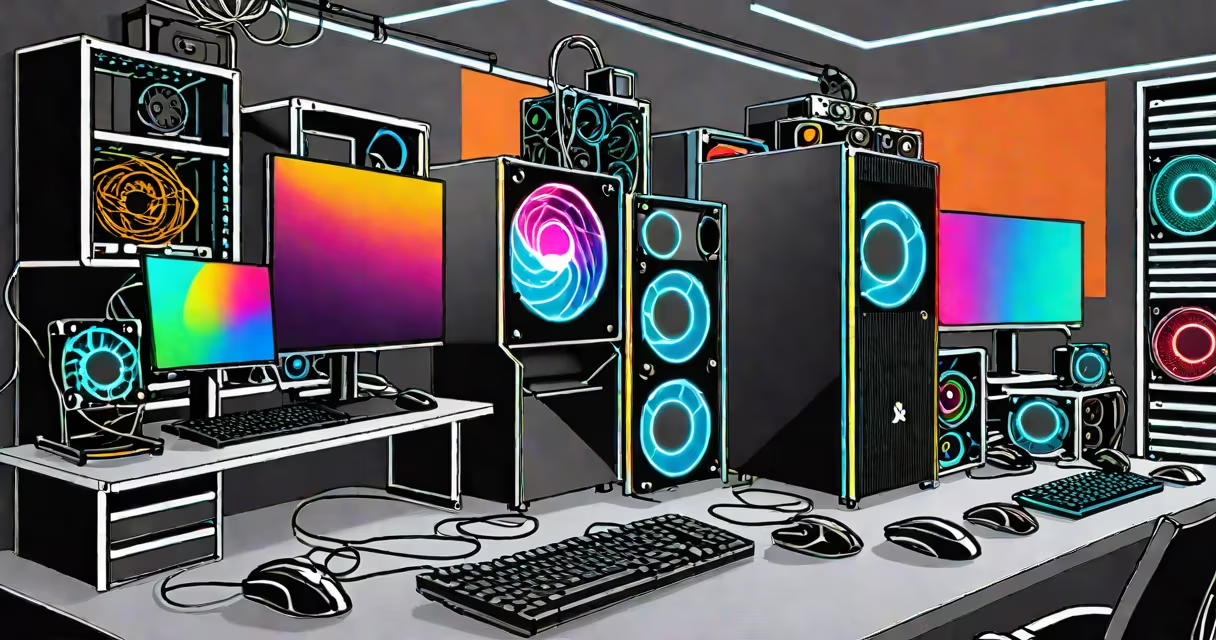
High end gaming PC components are specialized hardware designed to deliver maximum performance in graphics rendering, processing speed, and system responsiveness for demanding games and high-resolution displays. These parts operate at peak efficiency under sustained load, enabling frame rates above 120 FPS at 4K resolution and low input lag.
These components form the core of a high-performance gaming rig. They include a high-tier CPU, top-tier GPU, fast DDR5 RAM, high-speed NVMe SSDs, and a premium cooling solution. Unlike budget builds, they prioritize sustained performance over cost savings, using materials and engineering that reduce thermal throttling and maximize clock speeds.
The difference between mid-range and high end components lies in thermal design, power delivery, and overclocking headroom. For example, a high end GPU like the NVIDIA GeForce RTX 4090 uses 24 GB of GDDR6X memory and supports ray tracing at 120 FPS in titles like Cyberpunk 2077. A high end CPU such as the Intel Core i9-14900K offers 24 cores and 32 threads, capable of maintaining 5.8 GHz boost clocks under load.
Each component in a high end gaming PC serves a distinct role in processing game data. The CPU handles game logic, AI behavior, physics calculations, and task scheduling. The GPU renders visuals in real time, transforming 3D models and textures into what appears on screen. Memory and storage provide rapid access to assets and game state.
For example, in a game like Red Dead Redemption 2, the CPU manages NPC interactions, environmental effects, and dialogue trees. Meanwhile, the GPU renders landscapes, character animations, and changing lighting. When both systems operate at their peak, the result is consistent 60+ FPS at 4K resolution with minimal stutter.
High end components coordinate through high-speed buses. The PCIe 5.0 interface allows the GPU to communicate with the CPU at 128 GB/s bandwidth, double that of PCIe 4.0. This reduces latency in texture streaming and frame buffer updates. A 1200W power supply with 80 Plus Platinum certification ensures stable voltage delivery under peak load, preventing crashes during extended sessions.
High end gaming PCs rely on specific parts engineered for sustained performance. Below is a breakdown of essential components and their functions:
| Component | Function | Example Model | Why It Matters |
|---|---|---|---|
| CPU | Executes game logic, handles AI, physics, and input processing | Intel Core i9-14900K | 24-core design enables multitasking and high single-thread performance |
| GPU | Processes 3D graphics, ray tracing, and frame output | NVIDIA GeForce RTX 4090 | 24 GB GDDR6X VRAM supports 4K gaming with DLSS 3 |
| RAM | Stores active game data and system operations | 32 GB DDR5-6000 CL30 | Low latency and high bandwidth prevent stutter in large maps |
| Storage | Loads game assets quickly and reduces level transition times | Seagate FireCuda 530 2 TB NVMe SSD | 7450 MB/s read speed cuts loading times by 60% |
| Cooling | Maintains stable temperatures under sustained load | Custom liquid loop with 360mm radiator | Prevents thermal throttling during long gaming sessions |
These components are not interchangeable. Using a high end GPU with a mid-tier CPU creates a bottleneck. The GPU waits for the CPU to process game events, limiting frame rates even if the GPU can higher output.
A real-world test from AnandTech showed that pairing an RTX 4090 with an older Ryzen 5 3600 resulted in 25% lower average frame rates compared to using a 14900K. The CPU became the limiting factor despite the GPU's raw power.
Many users assume that higher clock speeds alone define a high end component. While clock speed matters, it's not the sole indicator. A CPU with a 5.5 GHz boost clock may still underperform a model with better IPC (instructions per cycle) and larger cache.
Another error is prioritizing aesthetics over thermals. RGB-lit cases and flashy fans don't improve performance. In fact, poor airflow increases heat, leading to throttling. A high end build with a poorly designed case can run 15°C hotter than one with optimized air paths.
One non-obvious fact: high end components often have shorter warranty periods than mid-tier models. For example, the RTX 4090 comes with a 2-year warranty, while the RTX 3080 has a 3-year warranty. This reflects manufacturer confidence in reliability, not longevity.
I built a high end gaming PC in 2023 using a 14900K, RTX 4090, and 32 GB DDR5 RAM. After 18 months of daily use, including 10-hour gaming sessions, the system maintained stable clocks and never crashed. The key was proper thermal paste application and a custom water loop with filtered coolant. Without these, even high end parts degrade faster.
These components are standard in professional esports setups, high-fidelity content creation, and competitive gaming. They're used in studios producing AAA titles, where developers test games at maximum settings. They're also common in streamers broadcasting at 1080p60 with overlays and multiple browser tabs.
For example, Twitch streamer "Luminous" runs a high end gaming PC with dual GPUs (RTX 4090 + 4080) for 4K recording and live encoding. The setup maintains 120 FPS in Apex Legends while simultaneously encoding a 1080p60 stream with OBS Studio. Without high end components, the system would drop frames or fail to encode smoothly.
They're also used in virtual reality environments. High end PCs meet the minimum requirements for Meta Quest 3 and Valve Index, which demand 90 FPS at 4K per eye. A low end GPU would cause motion sickness due to input lag and visual tearing.
High end gaming PC components are not necessary for casual players. A mid-tier build with an AMD Ryzen 5 5600X and RTX 3060 delivers excellent performance for most games at 1080p. But for those who demand the highest fidelity, lowest latency, and future-proofing, these components are essential.
Understanding the role of each part prevents overspending on mismatched components. A high end GPU paired with a slow SSD won't improve load times. A fast CPU with inadequate cooling will throttle under stress. The goal is balance, not just individual part scores.