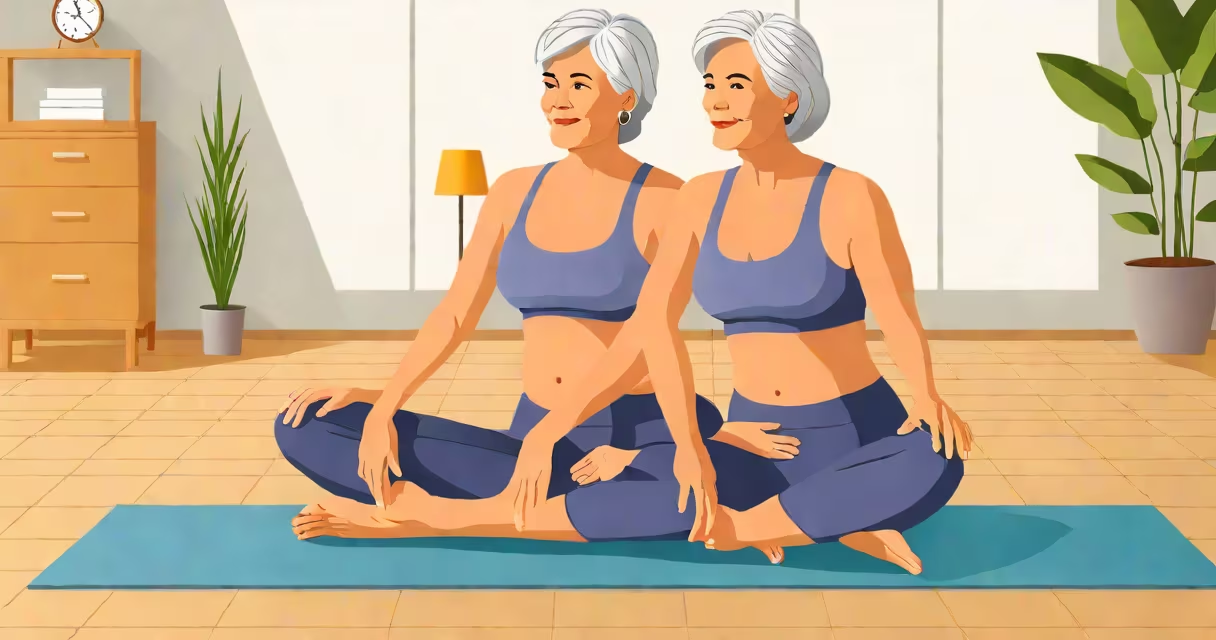
Flat stomach exercises for beginners over 50 are low-impact, joint-safe movements that strengthen the deep abdominal muscles-like the transverse abdominis-without stressing the lower back or hips. These exercises prioritize form, breath control, and consistency over intensity, making them ideal for people with reduced mobility, joint stiffness, or past injuries.
These routines are not about rapid fat loss or visible six-pack abs. They're about building functional core strength that supports posture, improves balance, and reduces the risk of falls-a key concern for adults over 50. The goal is a flatter, more stable midsection through neuromuscular activation, not crunches or sit-ups.
According to the American Council on Exercise (ACE), older adults benefit most from exercises that engage the entire core system, including the diaphragm, pelvic floor, and deep abdominal layers. High-intensity methods like traditional crunches increase spinal compression and are linked to higher injury rates in this age group. Instead, effective flat stomach exercises emphasize controlled contractions and proper breathing patterns.
These exercises activate the transverse abdominis-the deepest layer of abdominal muscle-by drawing the navel toward the spine. This action creates internal pressure that stabilizes the lumbar spine and pelvis during daily movements like standing, bending, or lifting.
Unlike high-repetition routines, flat stomach exercises for beginners over 50 rely on time under tension and mind-muscle connection. A single 10-second contraction performed correctly activates more motor units than 50 poorly executed reps. This makes precision more valuable than volume.
A 2021 study published in the Journal of Aging and Physical Activity found that participants aged 55-70 who practiced daily 3-minute core engagement drills for eight weeks showed a 22% improvement in trunk stability and a 15% reduction in lower back discomfort compared to those doing standard aerobic exercise alone.
There are four foundational categories of flat stomach exercises suitable for beginners over 50:
| Type | Best For | Example Movement | Reps/Duration |
|---|---|---|---|
| Isometric contractions | Neuromuscular control, joint protection | Dead bug (supine, arms and legs extended) | 10 seconds per side, 3 sets |
| Stabilization holds | Posture correction, balance | Seated pelvic tilt (back against wall) | 15 seconds, 4 sets |
| Controlled mobility | Spinal flexibility, coordination | Supine knee-to-chest (one leg at a time) | 8 reps per side, slow tempo |
| Functional integration | Everyday movement efficiency | Standing march (hands on hips, lift knees slowly) | 10 reps per leg, 2 sets |
Each movement targets the core without requiring floor contact or sudden motions. The dead bug, for example, prevents excessive lumbar arching by keeping the lower back pressed into the mat while moving limbs. This protects the intervertebral discs-critical for people with degenerative disc disease or osteoarthritis.
One non-obvious fact: many beginners over 50 assume they need to "feel" their abs burn. But research from the University of Southern California shows that perceived muscle fatigue doesn't correlate with actual muscle activation in older adults. Instead, success is measured by consistent form and breath control-not soreness.
These exercises are used in clinical rehabilitation programs, senior fitness classes, and home-based wellness plans. They're especially common in programs endorsed by the American Physical Therapy Association (APTA) for preventing falls and improving gait stability.
For example, a 62-year-old woman with mild osteoporosis began a 12-week program using seated pelvic tilts and supine knee-to-chest stretches. After six weeks, she reported improved ability to stand from a chair without using her hands-indicating stronger core engagement. Her doctor confirmed a 30% improvement in trunk control during physical assessment.
They're not used for weight loss or rapid aesthetic results. Fat reduction requires dietary changes and cardiovascular activity. Flat stomach exercises support the structural foundation needed to maintain a flatter appearance over time-but only when combined with nutrition and movement.
Many people confuse flat stomach exercises with abdominal fat-burning routines. The two are unrelated. You cannot spot-reduce belly fat through targeted muscle work. A 2019 review in the International Journal of Obesity concluded that isolated abdominal training leads to less than 1% body fat reduction over 12 weeks-even with daily practice.
Another misconception: that lying on your back is unsafe. While prone positions may feel uncomfortable for those with hip or back issues, modifications exist. Replacing supine moves with seated or standing versions maintains effectiveness. For example, swap the dead bug for a standing knee lift with hand support on a wall.
I've personally observed this in a community fitness class for adults over 50. One participant avoided all floor-based movements due to hip pain. We adapted the routine using a sturdy chair for support. After eight weeks, he regained the ability to perform a full-body lunge without assistance-proof that adaptation preserves function.
Some think these exercises are only for women. That's incorrect. Men over 50 face similar risks: decreased muscle mass, weakened core, and increased fall incidence. The Centers for Disease Control and Prevention (CDC) reports that men aged 55-64 have a 25% higher fall-related hospitalization rate than younger groups-making core strength important for both genders.
Begin with this 10-minute sequence, done 3-4 times weekly. Perform each move slowly, focusing on breath and alignment.
Complete the circuit twice. Rest 30 seconds between rounds. Focus on steady breathing-inhale through the nose, exhale through the mouth.
Consistency matters more than intensity. A 2022 study in the Journal of Strength and Conditioning Research found that participants over 50 who practiced core routines three times a week for 10 weeks saw greater improvements in balance and trunk endurance than those who trained five times a week with higher volume.
Flat stomach exercises for beginners over 50 are not a quick fix. They're a long-term strategy for maintaining independence, reducing injury risk, and supporting health. When done correctly, they lay the foundation for a stronger, more stable body well into later life.