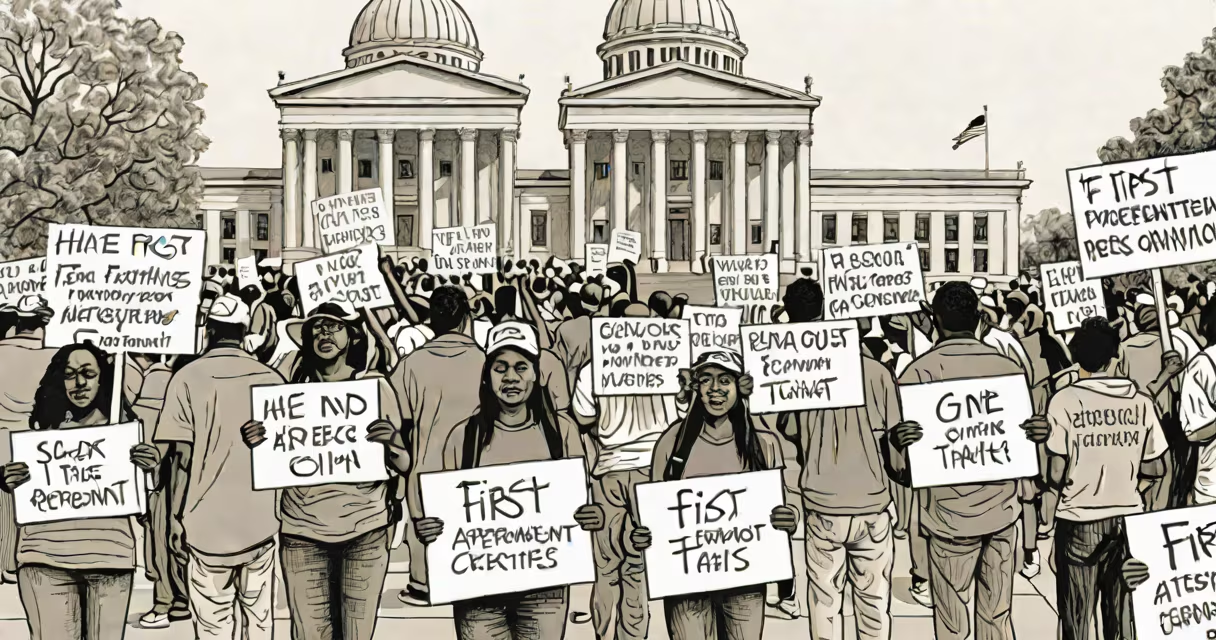
First amendment activities are forms of expression-such as speech, protest, art, and press coverage-that the U.S. Constitution protects from government censorship or punishment. These rights stem from the First Amendment's guarantee that Congress shall make no law abridging freedom of speech, religion, press, assembly, or petition.
The Supreme Court has consistently ruled that not all communication qualifies as protected activity. The key test is whether the expression serves a societal purpose beyond mere disruption. For example, shouting "fire" in a crowded theater when there is no fire violates public safety and is not protected, even though it involves speech.
Under the First Amendment, individuals may criticize government officials, publish news reports about public figures, wear symbolic clothing like armbands in school, and gather peacefully to protest policies-all without fear of state retaliation. These actions are legally recognized as first amendment activities because they contribute to democratic discourse and civic engagement.
These activities are protected because the Founders believed that open debate strengthens democracy. When citizens speak out, they inform others, influence policy decisions, and hold leaders accountable. The courts interpret this protection through precedent, balancing individual rights against legitimate government interests like national security or public order.
For instance, in *Tinker v. Des Moines Independent Community School District* (1969), the Supreme Court upheld students' right to wear black armbands to protest the Vietnam War. The Court ruled that symbolic speech in a school setting is protected unless it causes substantial disruption. This decision established that silent protest counts as first amendment activity.
Government regulation of expression must meet strict scrutiny: it must serve a compelling interest and be narrowly tailored. A law banning all political speeches near polling places during elections would fail this test because less restrictive alternatives exist, such as time, place, and manner restrictions.
Not all expressive acts fall under the same legal standard. Some are presumed protected; others require context-based evaluation. The following table outlines common categories:
| Type | Examples | Legal Status |
|---|---|---|
| Political speech | Campaign signs, speeches at rallies, op-ed articles | Strongly protected |
| Symbolic speech | Wearing armbands, burning flags, silent protests | Protected if intended to convey a message |
| Artistic expression | Protest music, satirical cartoons, performance art | Protected unless inciting violence or obscenity |
| Press and media | News reporting, investigative journalism, editorial content | Protected, especially when covering public affairs |
| Religious expression | Prayer at public events, religious signage on private property | Protected, but subject to venue rules and neutrality standards |
One non-obvious distinction: wearing a flag pin is not automatically protected. Courts have ruled that symbolic expression must communicate a message. A person wearing a flag pin during a parade may be expressing patriotism, but if the pin is worn to provoke conflict or intimidate others, it may lose protection under the First Amendment.
Many assume that the First Amendment protects all speech, including threats, hate speech, and false statements. That is incorrect. The Supreme Court has repeatedly clarified that the First Amendment does not shield speech that incites imminent lawless action (*Brandenburg v. Ohio*, 1969), contains defamation, or constitutes fraud.
For example, falsely claiming that a candidate stole an election can be punished under state libel laws. The federal government can also regulate false commercial advertising. These exceptions exist because the Constitution balances free expression with other societal values like truth, safety, and fairness.
A common error is equating "free speech" with "unlimited speech." In reality, the First Amendment only restricts government action-not private companies. Social media platforms like Facebook and Twitter can ban users based on their own community guidelines. This means that while your post is protected from government removal, it may still be removed by a private platform.
In the summer of 2020, widespread demonstrations occurred across the United States following the death of George Floyd. Protesters gathered in cities like Minneapolis, New York, and Los Angeles, carrying signs, chanting slogans, and marching peacefully. These actions were first amendment activities.
Local governments responded differently. In some cases, police used force to disperse crowds. Courts later reviewed these actions under the First Amendment. In *City of San Diego v. Pappas* (2021), a federal judge ruled that police had violated protesters' rights by using tear gas without warning and arresting individuals who were not engaged in violent behavior.
This case illustrates that even lawful protest can be met with unlawful suppression. The protection of first amendment activities depends not just on the act itself, but on how authorities respond to it.
I attended a student-led protest at a public university in 2022 over changes to campus free speech policies. Students held signs reading "Free Speech Is Not a Privilege" and "Protect Our Rights." They spoke at a designated speaker's corner, stayed within a 10-foot radius, and avoided blocking walkways.
University administrators initially threatened to cite participants for violating campus rules. After legal advice was sought, the administration backed down. The protest remained peaceful and ended without arrests. This event confirmed that first amendment activities are most secure when they follow clear boundaries and avoid provocation.
These activities are essential in democratic societies. They allow marginalized voices to be heard, expose corruption, and enable public debate on issues ranging from climate change to healthcare reform. Without them, government power would go unchecked.
According to the American Civil Liberties Union (ACLU), over 1,200 incidents of protest suppression were documented between 2017 and 2022. Many involved peaceful demonstrators being arrested or detained without cause. The ACLU argues that such actions violate the spirit and letter of the First Amendment.
Similarly, the Reporters Without Borders World Press Freedom Index ranks the U.S. at 42nd globally in 2023, citing increasing legal pressure on journalists covering sensitive topics. This shows that even in countries with strong constitutional frameworks, threats to first amendment activities persist.
Not all expression is protected. The First Amendment does not cover incitement, obscenity, child pornography, true threats, or speech that violates existing laws. For example, a person who sends threatening messages via social media can be prosecuted-even if the message is labeled as "joke."
Another misconception is that online speech enjoys the same level of protection as offline speech. While the First Amendment applies to digital platforms, courts have ruled that private companies are not bound by it. A tweet criticizing a politician may be protected from government censorship, but it can still be deleted by Twitter's moderation team.
First amendment activities are constitutionally protected expressions that promote open dialogue and democratic participation. They include speech, protest, art, and press work, provided they do not cross into illegal or harmful territory. Understanding what counts as protected expression-and what doesn't-is critical for citizens, journalists, and lawmakers alike.