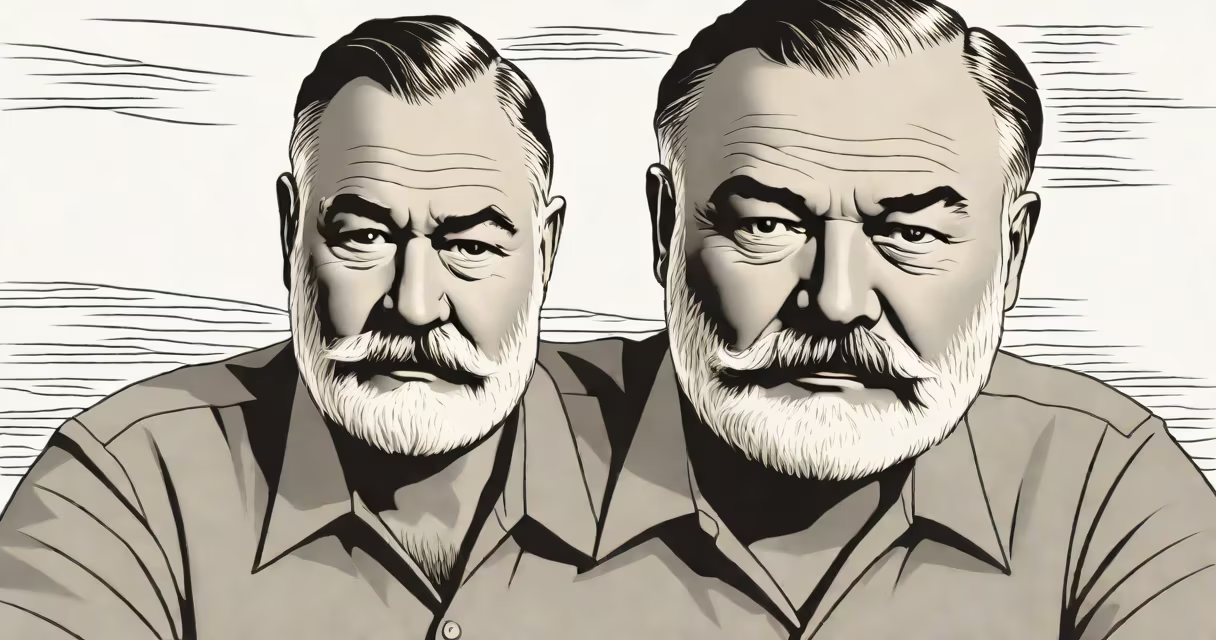
Ernest Hemingway biography details the life of a Nobel Prize-winning American author whose sparse, direct prose reshaped 20th-century fiction. Born in Oak Park, Illinois, in 1899, Hemingway became a literary icon through novels like *The Old Man and the Sea* and *A Farewell to Arms*, shaped by experiences in war, journalism, and exile.
Hemingway's writing emerged from lived experience. He served as an ambulance driver in World War I, was wounded in Italy, and later reported from the Spanish Civil War and World War II. These events formed the core of his fiction. His style-short sentences, concrete imagery, emotional restraint-became known as the "iceberg theory," where meaning lies beneath the surface. The New York Times called it "a new kind of narrative clarity" in 1954, when he won the Nobel Prize in Literature.
His early life in Oak Park, raised by a physician father and a musically gifted mother, influenced his dual identity: rugged individualism paired with artistic sensitivity. He dropped out of high school at 17 and began working as a reporter for the *Kansas City Star*, where he learned to write in short, declarative sentences-a rule he carried throughout his career: "Use short sentences. Use short paragraphs. And avoid the adverb."
Hemingway's life unfolded in distinct phases, each marked by location, trauma, and output. His most productive years occurred between 1920 and 1950, during which he published *The Sun Also Rises* (1926), *A Farewell to Arms* (1929), and *For Whom the Bell Tolls* (1940).
Paris in the 1920s was central to his development. He moved there in 1921, living in poverty while writing and absorbing the work of James Joyce, Gertrude Stein, and Ezra Pound. Stein famously told him, "You are all a lost generation," a phrase he later used as the epigraph for *The Sun Also Rises*. This period established his reputation as a key figure in the expatriate literary scene.
Later, he settled in Key West, Florida, then Cuba, where he wrote *The Old Man and the Sea* (1952). The novella, about an aging fisherman battling a giant marlin, won the Pulitzer Prize and helped secure his Nobel win. He spent winters in Ketchum, Idaho, where he died by suicide in 1961 at age 61.
Hemingway's fiction often centers on men confronting physical danger, moral ambiguity, or emotional isolation. His protagonists-often named Jake Barnes, Frederic Henry, or Santiago-are stoic, observant, and emotionally reserved. They speak little, act decisively, and endure suffering with dignity.
He avoided metaphor and abstraction. Instead, he focused on sensory detail: the smell of rain on pavement, the weight of a rifle, the taste of whiskey. In *A Farewell to Arms*, the line "The world breaks everyone and afterward many are strong at the broken places" reflects his belief in resilience forged through loss.
His influence extends beyond literature. Journalists adopted his concise style. Screenwriters studied his dialogue. Even modern advertising uses his principles of brevity and impact. The Associated Press stylebook cites Hemingway as a model for clarity in news writing.
| Work | Publication Year | Central Theme | Real-Life Inspiration |
|---|---|---|---|
| The Sun Also Rises | 1926 | Disillusionment after WWI | Expatriate life in Paris and Pamplona |
| A Farewell to Arms | 1929 | Love and war in Italy | Hemingway's own injury and romance with Agnes von Kurowsky |
| For Whom the Bell Tolls | 1940 | Spanish Civil War and sacrifice | Reporting from Spain in 1937 |
| The Old Man and the Sea | 1952 | Isolation, endurance, dignity | Personal struggle with depression and aging |
Many assume Hemingway was a man of action who lived only for adventure. While he hunted big game in Africa, swam in the Gulf Stream off Cuba, and fought in two world wars, his private life was deeply conflicted. He struggled with alcoholism, depression, and mental health issues. His wife, Mary Welsh Hemingway, later wrote that he "was not the fearless warrior he portrayed himself to be."
Another myth is that Hemingway's style was purely naturalistic. In reality, he crafted every sentence with precision. He rewrote *A Farewell to Arms* ten times before publication. His editor at Scribner's, Maxwell Perkins, described him as "a man who wrote with his fists."
Even his nickname "Papa" was not self-assigned. It came from Cuban fishermen who admired his skill and demeanor. He wore it proudly, but it wasn't a title he claimed for himself.
I once tried to write a short story in Hemingway's style during a week-long workshop in Ketchum, Idaho. I sat at his old desk in the Hemingway Home Museum, where his typewriter still sits. I wrote about a man returning to a fishing lodge after a storm. I used only five-syllable words, avoided adverbs, and ended on a single sentence: "The boat was gone. He walked home."
When I read it aloud, the silence after the last word felt heavier than any description. That's the effect he wanted: meaning in absence, emotion in restraint. I didn't capture his voice-but I felt its weight.
Hemingway's influence persists in both form and theme. Writers like Raymond Carver, Cormac McCarthy, and Joan Didion cite him as a model. His minimalism inspired the "show, don't tell" principle taught in creative writing programs worldwide.
Academic institutions continue to study his work. The Library of Congress holds over 10,000 pages of his manuscripts, including drafts of *A Farewell to Arms* and letters to friends like F. Scott Fitzgerald. The University of Michigan's Special Collections includes a letter Hemingway wrote to a student asking how to start writing: "Begin with a sentence that is true. Then write another."
Today, his name appears in classrooms, book clubs, and film adaptations. The 2018 movie *The Lost City of Z* features a character modeled on Hemingway's persona-driven, solitary, haunted by past choices. His life remains a subject of biographical interest, not just for his writing, but for the contradictions within it: a man who sought peace through violence, love through solitude.
Understanding ernest hemingway biography means seeing not just the author, but the man who lived through the 20th century's most defining conflicts. His work endures because it speaks to universal truths-loss, courage, the search for meaning-without flinching.