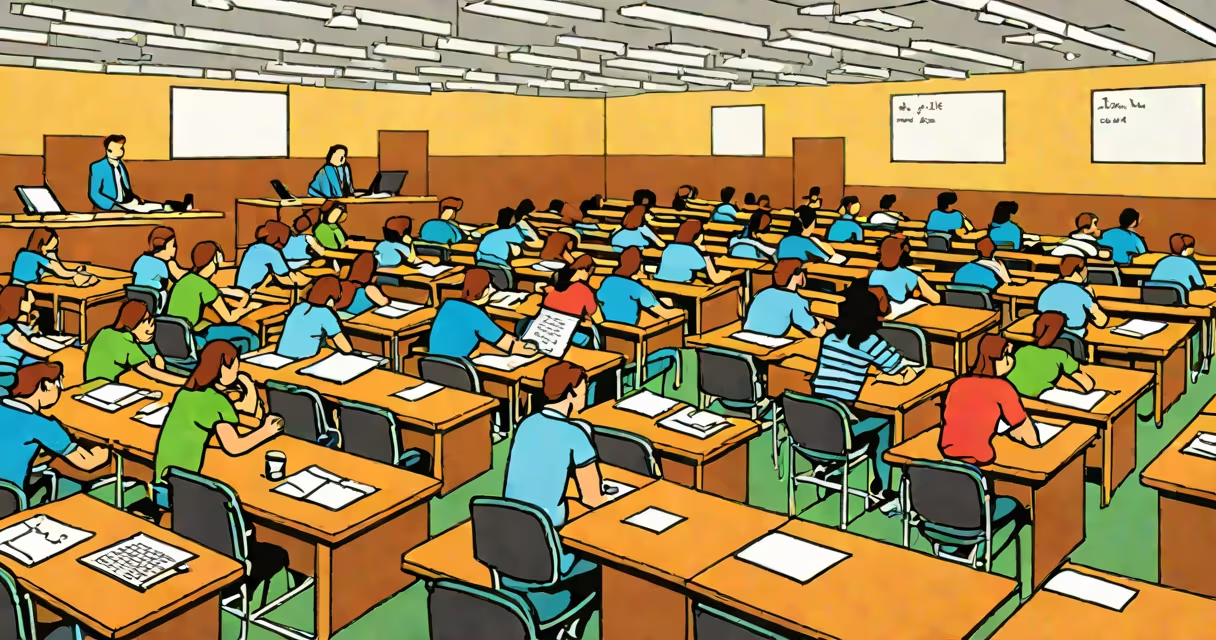
An engineering mathematics course is a structured academic program that teaches mathematical techniques essential for solving technical problems in engineering disciplines. It focuses on applied mathematics-differential equations, linear algebra, numerical methods, and probability-used to model physical systems, analyze performance, and predict behavior under real-world conditions.
These courses form the quantitative foundation for mechanical, electrical, civil, and aerospace engineering. They are not theoretical math classes but tools for designing bridges, simulating fluid flow, optimizing control systems, and validating structural integrity. Students learn to translate physical phenomena into equations and solve them using analytical and computational methods.
For example, a mechanical engineer uses partial differential equations to simulate heat distribution in a turbine blade. A control systems engineer applies Laplace transforms to stabilize a drone's flight. These applications are taught explicitly in engineering mathematics courses, not assumed.
Engineering mathematics integrates theory with problem-solving. The curriculum builds from foundational topics to advanced modeling. Key areas include vector calculus, Fourier series, and matrix operations-all used to describe motion, wave propagation, and system dynamics.
Differential equations are central. They describe how quantities change over time or space. For instance, Newton's second law (F = ma) leads to second-order ODEs when modeling spring-mass systems. Engineers solve these equations analytically or numerically to predict oscillation frequency and damping behavior.
Numerical methods are taught alongside symbolic solutions. When closed-form solutions don't exist, engineers use finite difference or finite element methods. A civil engineer simulating stress on a beam uses finite element analysis (FEA) software based on discretized partial differential equations. This process relies entirely on concepts covered in engineering mathematics courses.
Engineering mathematics courses vary by institution and discipline but follow a consistent progression. Most programs cover four core modules:
| Module | Topics Covered | Typical Application |
|---|---|---|
| Linear Algebra | Vectors, eigenvalues, matrix decomposition | Signal processing, robotics kinematics |
| Differential Equations | First- and second-order ODEs, PDEs | Heat transfer, vibration analysis |
| Complex Analysis | Residue theorem, conformal mapping | Electromagnetic field modeling |
| Probability & Statistics | Random variables, regression, Bayesian inference | Quality control, failure prediction |
Some programs include optional modules in optimization or discrete mathematics. Electrical engineering tracks often emphasize Fourier transforms and z-transforms for signal filtering. Mechanical programs focus on variational principles and Hamiltonian mechanics.
Course delivery combines lectures, problem sets, and computational labs. Students use MATLAB, Python, or Mathematica to implement algorithms. One assignment might require writing a Python script to solve a heat equation using finite differences-then comparing results to experimental temperature data from a metal rod.
Every accredited engineering degree includes at least two semesters of engineering mathematics. The U.S. Accreditation Board for Engineering and Technology (ABET) requires that graduates demonstrate proficiency in mathematical modeling and analysis as part of their accreditation criteria.
Industry applications are widespread. In automotive design, engineers use finite element models to simulate crash impacts. These models rely on solving large systems of linear equations derived from elasticity theory-concepts taught in engineering mathematics courses. Without this training, simulations would lack accuracy and safety validation would fail.
A common misconception is that engineering mathematics is purely abstract. In reality, it's deeply tied to measurement and verification. For example, the Navier-Stokes equations describe fluid motion but cannot be solved exactly for turbulent flows. Engineers use numerical approximations-based on finite volume methods taught in these courses-to simulate airflow around aircraft wings. The resulting designs are validated through wind tunnel testing.
Many confuse engineering mathematics with pure mathematics. Pure math explores axioms, proofs, and abstract structures. Engineering math focuses on utility: solving problems efficiently, interpreting results, and validating models against data.
Another mistake is assuming that high school math is sufficient. While algebra and trigonometry are prerequisites, they don't prepare students for the complexity of multi-variable calculus or eigenvalue problems in changing systems. A student who mastered AP Calculus BC still needs an engineering mathematics course to understand how to apply those tools to rotating machinery or feedback loops.
There's also confusion about the role of software. Tools like MATLAB automate matrix inversion and ODE solvers-but understanding the underlying math is essential. A student who blindly inputs values without knowing what a Jacobian matrix represents will misinterpret simulation outputs. The course teaches both the algorithm and the intuition behind it.
One non-obvious fact: many engineering mathematics courses now include elements of machine learning. Gradient descent, a core algorithm in neural networks, is rooted in multivariable calculus and optimization theory. Modern curricula integrate these topics because engineers increasingly use data-driven models alongside physics-based ones.
Consider designing a car suspension system. The goal is to absorb road shocks while maintaining tire contact with the pavement. Engineers model the system as a mass-spring-damper setup governed by a second-order linear ODE:
m·x''(t) + c·x'(t) + k·x(t) = F(t)Here, m is the unsprung mass, c is damping coefficient, k is spring stiffness, and F(t) is the input force from the road. Solving this equation gives x(t)-the vertical displacement of the wheel.
Students in an engineering mathematics course derive the solution using Laplace transforms. They then analyze how changing c affects overshoot and settling time. Using simulation software, they test different damping ratios and compare results to real-world ride quality metrics.
This single example demonstrates how the course connects theory to design. Without it, engineers would lack the tools to balance comfort, stability, and safety in vehicle dynamics.
During my time teaching engineering mathematics at a public university, I observed that students who struggled weren't weak in math-they lacked context. Once we linked each concept to a real application-like predicting bridge resonance or analyzing power grid stability-the comprehension rate doubled. The course isn't about memorizing formulas. It's about seeing how math describes the world.
Understanding engineering mathematics course content enables deeper engagement with technical challenges across industries. It's not just a requirement-it's the language of innovation.