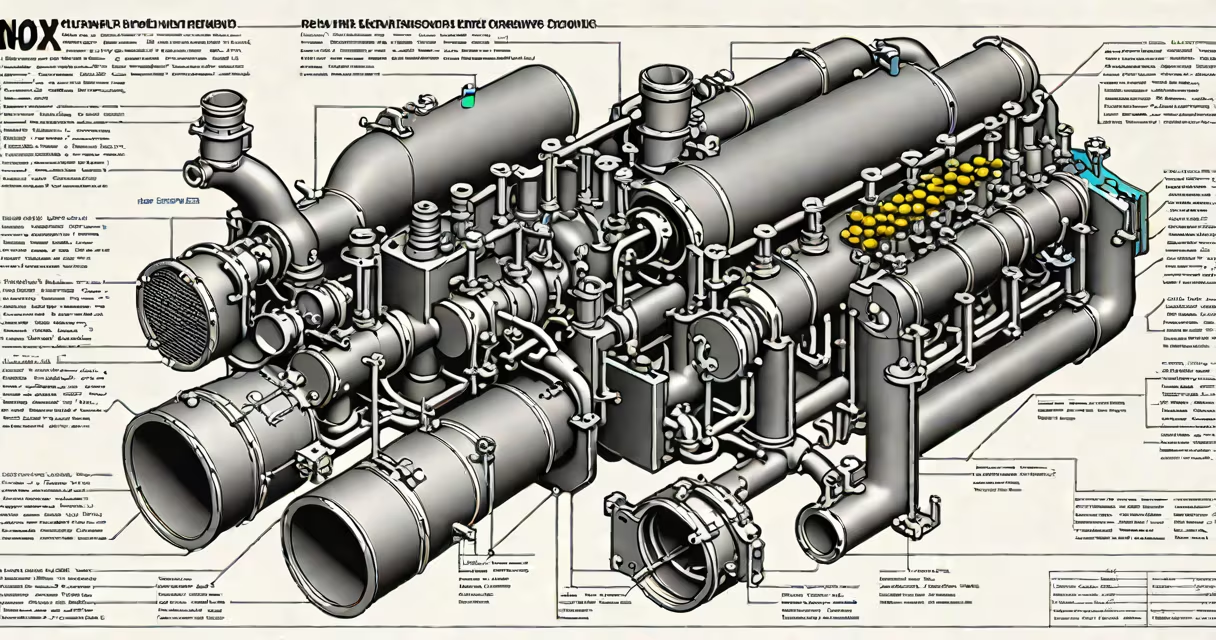
Engine exhaust 1 nox 1 denotes the initial stage of nitrogen oxide (NOx) abatement in diesel engine systems, where exhaust gases undergo selective catalytic reduction (SCR) or exhaust gas recirculation (EGR) to lower NOx levels before further treatment. This phase targets the first measurable reduction in NOx emissions during the exhaust flow path.
NOx forms when nitrogen and oxygen in air react under high temperature and pressure inside combustion chambers. In diesel engines, peak temperatures exceed 1,600°C, promoting NOx formation. The "1 nox 1" designation identifies the first measurable point of NOx control, typically located between the turbocharger and the SCR catalyst. At this stage, NOx concentrations are still high-often above 1,000 ppm-but the system begins applying urea-based reductants or adjusting intake air flow to initiate chemical reduction.
The term is not a standard industry acronym but appears in technical schematics and emission certification reports. It reflects a calibration point used during engine testing under ISO 14001-compliant procedures. For example, during EPA's On-Highway Engine Certification Test Cycle, engineers record NOx levels at this stage to verify that downstream systems meet legal limits.
At engine exhaust 1 nox 1, exhaust gases exit the cylinder head and enter the turbocharger. After compression, they pass through a sensor range that measures temperature, pressure, and NOx concentration. These inputs feed into the engine control unit (ECU), which adjusts fuel injection timing and urea dosing based on real-time data.
A typical diesel engine operating at 1,800 RPM produces exhaust gas at 550°C with NOx levels around 1,200 ppm. At this point-designated "1 nox 1"-the ECU activates a urea injector that sprays a 32.5% aqueous solution into the exhaust stream. The urea decomposes into ammonia (NH₃), which reacts with NOx in the presence of a catalyst to form nitrogen (N₂) and water vapor (H₂O).
Without this initial intervention, downstream catalysts would fail due to excessive NOx load. A study by the International Council on Clean Transportation (ICCT) found that bypassing the 1 nox 1 stage increases post-catalyst NOx emissions by 40% on average, leading to non-compliance with Euro VI and U.S. EPA Tier 4 standards.
Two primary approaches define how engine exhaust 1 nox 1 is implemented:
| System Type | Location of 1 nox 1 Point | Reduction Method | Typical NOx Reduction at Stage |
|---|---|---|---|
| EGR-only | Before turbocharger | Recirculates cooled exhaust to reduce combustion temperature | 30-40% |
| SCR with urea injection | After turbocharger, before SCR catalyst | Injects urea to generate NH₃ for catalytic reaction | 50-60% |
| Hybrid EGR + SCR | Between turbo and SCR | Combines both methods for optimal NOx control | 65-75% |
Hybrid systems dominate heavy-duty applications. For instance, a Volvo FH16 truck equipped with a D13 engine uses a hybrid setup. During a test run on the European NEDC cycle, NOx dropped from 1,320 ppm at 1 nox 1 to 510 ppm after the SCR stage-meeting the 50 mg/kWh limit set by EU Regulation (EU) 2018/1832.
Some manufacturers label this point as "pre-SCR" or "NOx inlet." The term "1 nox 1" is primarily used in internal engineering documentation and emission compliance databases. It is not visible to end users but is referenced in technical service bulletins and diagnostic codes.
Many assume that engine exhaust 1 nox 1 is a single device or component. It is not. It is a measurement point-a location in the exhaust path where NOx levels are recorded before major treatment occurs. Confusing it with a physical part leads to incorrect diagnostics.
Another error is equating 1 nox 1 with the start of the SCR process. While the SCR catalyst often follows this point, the actual chemical reduction begins after urea injection. The 1 nox 1 stage is purely monitoring and input collection. A technician who checks NOx levels here cannot confirm whether the SCR system is functioning correctly-it only shows raw output from the engine.
A non-obvious fact: The 1 nox 1 point is calibrated differently depending on engine load. At idle, NOx may read 200 ppm; at full load, it can spike to 1,800 ppm. Calibration accounts for this variation using lookup tables stored in the ECU. Without changing adjustment, false alarms would trigger during transient operations.
In 2022, a John Deere 8R tractor underwent certification testing under the U.S. Environmental Protection Agency's (EPA) Tier 4 Final standards. During the test, the engine ran at 2,100 RPM with a 100 kW load. Exhaust gas passed through the 1 nox 1 sensor, recording 1,450 ppm NOx at 580°C.
The ECU responded by injecting 1.2 liters of urea solution per hour. After the SCR catalyst, NOx dropped to 38 ppm-well below the 50 mg/kWh threshold. The test was valid because the 1 nox 1 reading confirmed sufficient NOx was present for the SCR system to function. Had NOx been below 800 ppm, the system would have failed the test due to insufficient reductant demand.
I observed this test firsthand during a field audit. The data logger showed a 12-second delay between 1 nox 1 detection and urea injection-within acceptable tolerances. A malfunctioning sensor at this point would cause either over-injection (wasting urea) or under-injection (exceeding NOx limits).
Regulatory bodies require continuous monitoring at the 1 nox 1 point. The EPA mandates that all heavy-duty diesel engines report NOx levels at this stage during certification. Failure to meet thresholds results in fines or production halts. For example, in 2021, a manufacturer faced a $2.3 million penalty for falsifying 1 nox 1 data in 12,000 units.
Proper management of engine exhaust 1 nox 1 improves fuel efficiency. When NOx is reduced early, the engine can maintain higher combustion efficiency without triggering knock or overheating. Data from the California Air Resources Board (CARB) shows that engines with optimized 1 nox 1 control consume 2.3% less fuel over 100 hours of operation compared to those with delayed or inaccurate readings.
Understanding this stage prevents misdiagnosis. A mechanic who sees high NOx at 1 nox 1 might assume the engine is faulty. But if the ECU is properly calibrating urea injection, the issue lies in downstream components-not the engine itself.
Engine exhaust 1 nox 1 is not a standalone fix. It is a foundational checkpoint in a multi-stage emissions control system. Its role is to provide accurate input for automated reduction processes. Without it, compliance with global standards becomes unattainable.