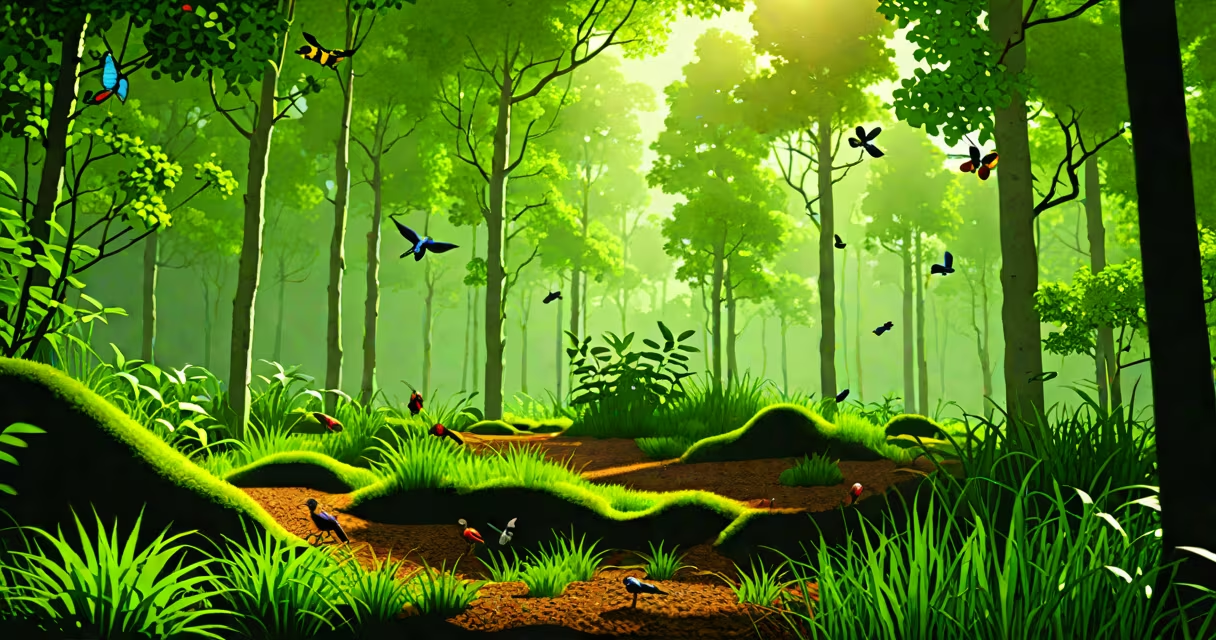
Ecology is the scientific study of interactions among organisms and their physical environment, forming the foundation of environmental science. It examines how living things depend on each other and their surroundings to survive and evolve.
Environmental science integrates ecology with chemistry, geology, physics, and biology to understand and solve real-world environmental problems. Ecology provides the structure for analyzing how human activities affect ecosystems, species distribution, and long-term environmental health.
For example, researchers studying the decline of bee populations in North America use ecological principles to trace causes such as pesticide exposure, habitat loss, and climate shifts. This analysis informs conservation strategies and policy decisions in environmental science.
Ecology operates at multiple levels, from individual organisms to entire biospheres. The most common levels are organism, population, community, system, and biome. Each level reveals different patterns of interaction and energy flow.
At the organism level, biologists study how a single animal adapts to temperature changes. A population focuses on groups of the same species-like all gray wolves in Yellowstone National Park. A community includes multiple interacting populations, such as wolves, elk, and aspen trees in the same area.
An system combines living organisms with abiotic factors like sunlight, water, and soil. For instance, a freshwater pond system includes algae, fish, frogs, bacteria, oxygen levels, pH, and nutrient cycles. These elements form feedback loops that maintain balance-or trigger collapse when disrupted.
Ecologists classify systems based on their structure and function. Terrestrial, aquatic, and atmospheric systems differ in energy input, material cycling, and resilience to disturbance.
| Type | Key Features | Example |
|---|---|---|
| Terrestrial | Land-based; influenced by climate, soil, and topography | Desert scrubland in Arizona |
| Aquatic | Water-dependent; includes freshwater and marine zones | Great Barrier Reef in Australia |
| Atmospheric | Driven by air currents, temperature gradients, and gas exchange | Global carbon cycle involving CO₂ absorption by forests |
Each system follows predictable patterns. In tropical rainforests, high biodiversity supports complex food webs. In contrast, arid deserts have fewer species adapted to extreme heat and low precipitation.
Ecology underpins environmental science's ability to predict outcomes of human actions. When a city expands into wetlands, ecologists model how this reduces flood control capacity and displaces native species.
For instance, the construction of the Three Gorges Dam in China altered river flow, sediment transport, and fish migration. Ecological assessments revealed long-term risks to downstream ecosystems, including reduced fertility in farmland and increased erosion.
Environmental scientists use these insights to recommend alternatives or mitigation measures. Without ecological understanding, solutions often fail because they ignore interdependencies within natural systems.
Many people confuse ecology with environmentalism. Ecology is a scientific discipline focused on observation and analysis. Environmentalism is a social movement advocating for environmental protection through policy and activism.
Another error is assuming that all ecosystems are stable. In reality, many are changing and prone to sudden shifts. The 2010 Deepwater Horizon oil spill caused rapid changes in Gulf Coast marine ecosystems. Within months, fish kills and algal blooms disrupted food chains, demonstrating how quickly ecological balance can break.
A lesser-known fact: ecological resilience varies widely. Some ecosystems recover from disturbances in years; others take decades or never return. Coral reefs damaged by warming oceans may take 10 to 20 years to rebuild-assuming conditions remain favorable. But if acidification continues, recovery becomes unlikely.
Consider a city planning a new park. An ecologist evaluates soil quality, native plant species, and potential wildlife corridors. They calculate how much green space is needed to support pollinators and reduce urban heat islands.
In Portland, Oregon, planners used ecological models to design a network of greenways connecting parks and rivers. Data showed that even small patches of native vegetation increased bird diversity by 40% within five years. This outcome was measurable and repeatable across similar urban settings.
Without ecological data, cities risk creating spaces that look green but offer little benefit to biodiversity or air quality. The difference lies in using evidence-based design rather than aesthetics alone.
My team once monitored bird activity in a newly planted urban garden in Seattle. We recorded 27 species in the first year-double the number seen in adjacent paved areas. This confirmed that even modest green infrastructure supports ecological function when designed with native plants and connectivity in mind.
Ecology differs from environmental chemistry, which studies pollutants and their reactions. While both inform environmental science, ecology emphasizes relationships and processes over chemical composition.
Biodiversity is a core concept in ecology. It refers to the variety of life forms across all levels-from genes to ecosystems. High biodiversity increases system stability. A 2019 study published in Nature found that ecosystems with greater species richness recovered faster from drought events.
Environmental science uses ecological data to assess risks. For example, modeling deforestation in the Amazon involves tracking tree cover loss, carbon emissions, and species extinction rates. These metrics come from ecological research, not guesswork.
Understanding ecology definition in environmental science enables accurate assessment of environmental threats and effective interventions. It is not just about nature-it's about predicting how systems respond to change.