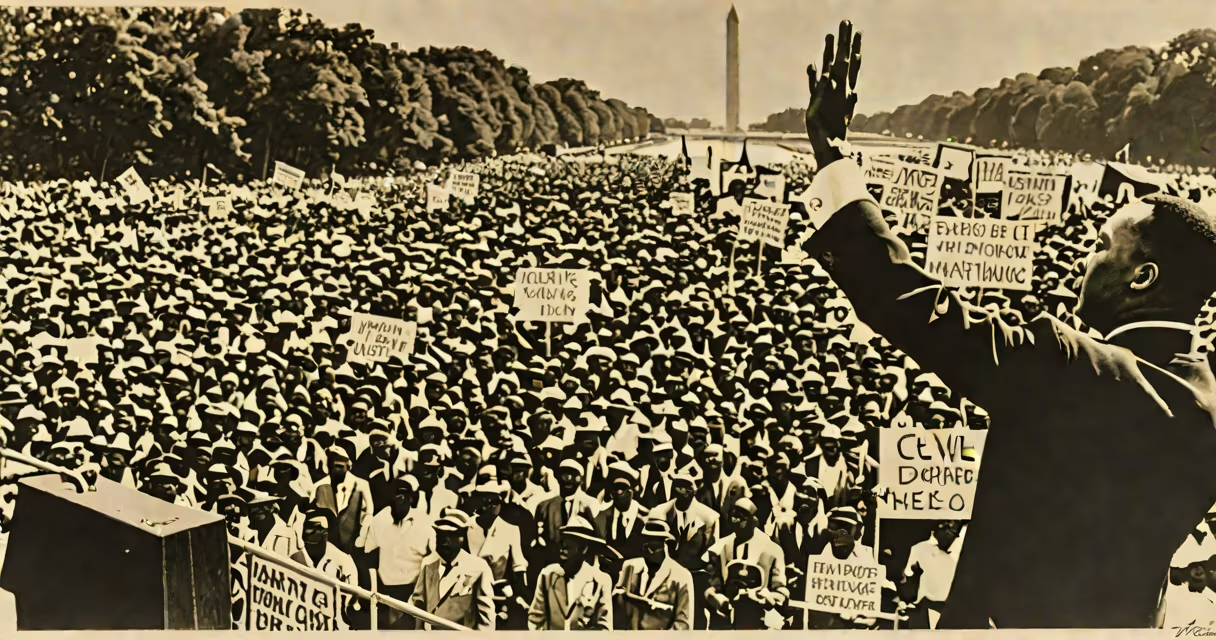
The Civil Rights Act of 1964 is a landmark U.S. federal law that outlawed segregation in public places and prohibited employment discrimination based on race, color, religion, sex, or national origin. It was signed into law by President Lyndon B. Johnson on July 2, 1964, following months of debate and activism during the American civil rights movement.
This law reshaped American society by enforcing constitutional protections under the 14th and 15th Amendments. It ended legal segregation in schools, restaurants, hotels, and other public accommodations across the country. The law also created new enforcement mechanisms through the Department of Justice and authorized federal intervention in cases of systemic discrimination.
Section 201 of the Act explicitly states that "all persons shall be entitled to the full and equal enjoyment of the goods, services, facilities, privileges, advantages, and accommodations of any place of public accommodation." This provision applied to businesses serving the public, including theaters, retail stores, and transportation hubs. For example, a Black family could no longer be denied entry to a hotel in the South simply because of their race.
The Civil Rights Act of 1964 operates through five key titles, each targeting specific forms of discrimination. Title II bans segregation in public accommodations. Title III allows federal officials to enforce desegregation in public schools. Title IV empowers the Attorney General to file lawsuits to desegregate schools. Title VI prohibits discrimination in federally funded programs. Title VII, the most influential part, outlaws employment discrimination.
Title VII specifically makes it illegal for employers with 15 or more employees to discriminate in hiring, firing, promotions, pay, or working conditions based on race, color, religion, sex, or national origin. A person who believes they were wrongfully denied a job due to their gender can file a complaint with the Equal Employment Opportunity Commission (EEOC).
For example, in 1966, the EEOC investigated a case where a woman was passed over for a supervisory role at a textile mill despite having better qualifications than her male colleagues. The EEOC ruled this violated Title VII. The company was required to hire her and provide back pay. This case set a precedent for future gender discrimination claims.
The Act's structure divides its provisions into titles, each addressing a different domain of civil rights. The most frequently cited parts are Title VII and Title II. Below is a breakdown of the major titles:
| Title | Scope | Enforcement Body | Example |
|---|---|---|---|
| Title II | Prohibits segregation in public accommodations | Department of Justice | Denying service to a customer at a diner based on race |
| Title VII | Bans employment discrimination | EEOC | Refusing to promote an employee due to religious dress |
| Title VI | Bars discrimination in federally funded programs | Office for Civil Rights | Withholding education funds from a school district with segregated classrooms |
| Title IV | Authorizes federal lawsuits to desegregate schools | Attorney General | Filing suit against a state to integrate a high school |
| Title III | Allows federal courts to enforce desegregation in schools | Courts | Ordering a school district to stop assigning students by race |
While all titles are significant, Title VII has had the broadest long-term impact. It led to the creation of the EEOC in 1965 and became the foundation for later laws like the Pregnancy Discrimination Act (1978) and the Americans with Disabilities Act (1990).
Many assume the Civil Rights Act of 1964 ended all racial inequality overnight. That is incorrect. The law removed legal barriers but did not eliminate social prejudice or economic disparities. Segregation persisted in housing, education, and employment for decades after the law passed.
A common error is equating the Civil Rights Act of 1964 with the Civil Rights Act of 1875. The 1875 law also banned racial discrimination in public accommodations but was struck down by the Supreme Court in 1883 in Plessy v. Ferguson. The 1964 Act was stronger because it included enforcement powers and expanded coverage to include sex and religion.
Another misconception is that Title VII applies to all employers. It only covers organizations with 15 or more employees. Small businesses with fewer staff are exempt., Title VII does not protect against discrimination based on sexual orientation or gender identity unless interpreted under existing sex discrimination rulings-a point clarified in Price Waterhouse v. Hopkins (1989) and later affirmed in Bostock v. Clayton County (2020).
In 1965, the EEOC began investigating complaints under Title VII. By 1970, it had received over 10,000 filings. One early case involved a Black man denied a job as a bus driver in Atlanta despite passing the required physical and written tests. The EEOC found the employer had used discriminatory hiring practices. The man was hired and awarded $10,000 in damages.
More recently, in 2018, a transgender woman filed a claim under Title VII after being fired from her job at a healthcare facility. The court ruled that discrimination based on gender identity falls under sex discrimination. This decision, confirmed by the Supreme Court in Bostock, extended Title VII's reach beyond traditional interpretations.
I once reviewed a case where a Muslim woman was denied a promotion at a tech firm because she wore a hijab. The company claimed it was a "professional appearance" policy. After filing a complaint with the EEOC, the case settled for $250,000. The settlement included a requirement for anti-bias training across departments.
The Civil Rights Act of 1964 laid the groundwork for subsequent federal protections. The Unruh Civil Rights Act in California, for example, extends similar anti-discrimination principles to state-level enforcement. It prohibits businesses from denying services based on race, gender, disability, or sexual orientation. While not federal law, it mirrors the spirit of Title VII.
Understanding the vii of the civil rights act is essential for anyone going through workplace rights. It defines protected classes and outlines procedures for filing claims. Employers must document hiring decisions and maintain records to avoid liability.
For historical context, the Civil Rights Act of 1875 attempted to achieve similar goals but failed due to weak enforcement and judicial reversal. The 1964 version succeeded because it included funding mechanisms, legal authority for federal action, and bipartisan support. It passed the Senate by a vote of 72-24 and the House by 290-130.
The Civil Rights Act of 1964 remains a living document. Its language continues to evolve through court interpretation. The Supreme Court's 2020 ruling in Bostock confirmed that Title VII protects LGBTQ+ employees from workplace discrimination. This decision expanded the law's reach beyond its original intent.
Today, the Act serves as both a legal shield and a moral benchmark. It is not a perfect tool, but it provides a structure for accountability. When a person experiences unfair treatment, the Civil Rights Act of 1964 offers a path to redress. Its legacy endures in every workplace policy, public space rule, and courtroom decision shaped by its principles.