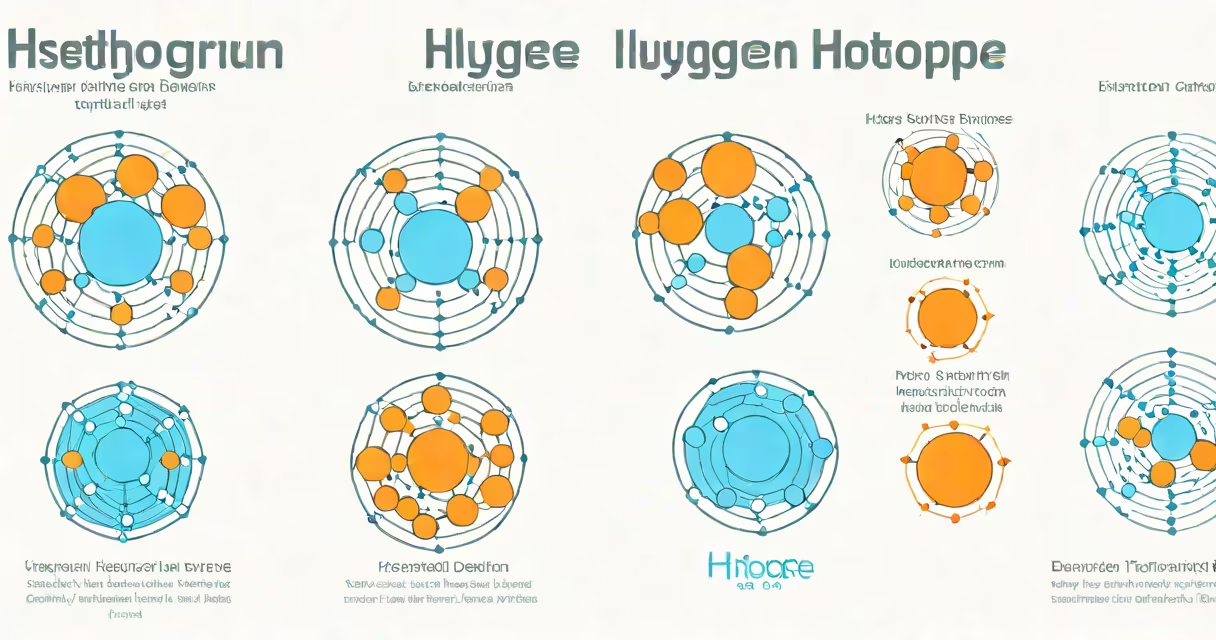
An isotope is a variant of a chemical element that shares the same number of protons but differs in the number of neutrons in its nucleus, resulting in different atomic masses. All isotopes of a given element have identical electron configurations and occupy the same position on the periodic table.
Isotopes form because atomic nuclei contain protons and neutrons. The number of protons defines the element-hydrogen always has one proton, carbon always has six. But the number of neutrons can vary. For example, carbon-12 has six neutrons, carbon-13 has seven, and carbon-14 has eight. These are distinct isotopes of carbon.
Each isotope is denoted using isotopic notation: the element's symbol with the mass number (protons + neutrons) written as a superscript to the left. Carbon-12 is written as 12C, carbon-14 as 14C. This notation allows scientists to precisely identify which isotope they're discussing.
Isotopes exist due to variations in nuclear composition. The proton count remains constant across all isotopes of an element, preserving chemical identity. Neutron variation alters nuclear stability and physical properties such as mass and radioactivity.
For instance, uranium has several isotopes. Uranium-235 has 92 protons and 143 neutrons. It undergoes fission when struck by slow-moving neutrons, making it essential for nuclear reactors and weapons. Uranium-238, with 146 neutrons, does not sustain fission under normal conditions but decays slowly over time, contributing to geothermal heat in Earth's mantle.
The stability of an isotope depends on the neutron-to-proton ratio. Too many or too few neutrons lead to instability. Unstable isotopes emit radiation-alpha, beta, or gamma particles-as they decay toward a stable configuration. This process is known as radioactive decay and is measurable through half-life, the time required for half of a sample to decay.
Isotopes fall into two broad categories: stable and unstable (radioactive).
| Type | Stability | Decay Behavior | Examples |
|---|---|---|---|
| Stable | Does not decay | No emission of radiation | 12C, 16O, 238U (long-lived) |
| Radioactive | Unstable; decays over time | Emits radiation; measurable half-life | 14C (5,730-year half-life), 235U (704 million years) |
Not all elements have stable isotopes. Technetium (element 43) and promethium (element 61) have no stable isotopes. All their forms decay over time. In contrast, tin has ten stable isotopes-the most of any element-making it a key reference in mass spectrometry calibration.
A common misconception is that all isotopes are radioactive. That's false. Over 80% of naturally occurring isotopes are stable. For example, oxygen has three stable isotopes: 16O, 17O, and 18O. They differ in mass but do not emit radiation.
Isotopes serve critical roles in medicine, industry, and scientific research. In medicine, technetium-99m is used in over 80% of diagnostic nuclear scans. Its short half-life (6 hours) minimizes patient exposure while providing clear imaging of internal organs.
Carbon-14 is widely used in archaeology. When organic material dies, it stops absorbing carbon from the atmosphere. The remaining 14C decays at a predictable rate. By measuring the ratio of 14C to 12C in ancient bones or wood, researchers estimate age within ±50 years for samples up to 50,000 years old.
Deuterium, a heavy isotope of hydrogen, is used in nuclear fusion experiments. Fusion reactors like ITER aim to replicate the sun's energy production by combining deuterium and tritium nuclei. Deuterium is also used in heavy water (D2O), which slows neutron speed in nuclear reactors, enabling sustained chain reactions.
One non-obvious fact: isotopes influence climate science. Scientists analyze ratios of 18O to 16O in ice cores. During colder periods, water molecules with lighter 16O evaporate more easily and precipitate first. Ice layers with higher 18O concentrations indicate warmer past climates. This method has reconstructed temperature records spanning 800,000 years.
Isotopes are often confused with ions or allotropes. An ion is an atom with a net electric charge due to gaining or losing electrons. A chlorine atom (Cl) becomes a chloride ion (Cl⁻) when it gains an electron. This change affects chemical behavior but not the isotope identity.
Allotropes refer to different structural forms of the same element in the same phase. Oxygen exists as O2 (diatomic) and O3 (ozone). These are allotropes, not isotopes. Similarly, diamond and graphite are allotropes of carbon-same element, different bonding arrangements.
Another confusion arises around the term "isotope" being used loosely in marketing. Some supplements claim to contain "isotopically enriched" ingredients. This is misleading. While isotopes like deuterium can be used in research, consuming them in food or supplements offers no health benefit. The human body cannot distinguish between 1H and 2H in metabolic pathways.
In 2019, I assisted in a field study measuring uranium isotopes in groundwater near a former mining site. Using mass spectrometry, we detected elevated levels of 235U and 238U in shallow aquifers. The ratio of these isotopes helped confirm historical contamination patterns. The data informed remediation efforts and demonstrated how isotopic analysis reveals environmental history invisible to standard chemical tests.
The definition of an isotope centers on atomic variation within a single element. Differences in neutron count alter mass and stability but not elemental identity. Stable isotopes remain unchanged; radioactive ones decay predictably. These differences enable applications ranging from medical diagnostics to climate reconstruction. Understanding the definition of an isotope clarifies how matter behaves at the subatomic level and why precision matters in science and technology.