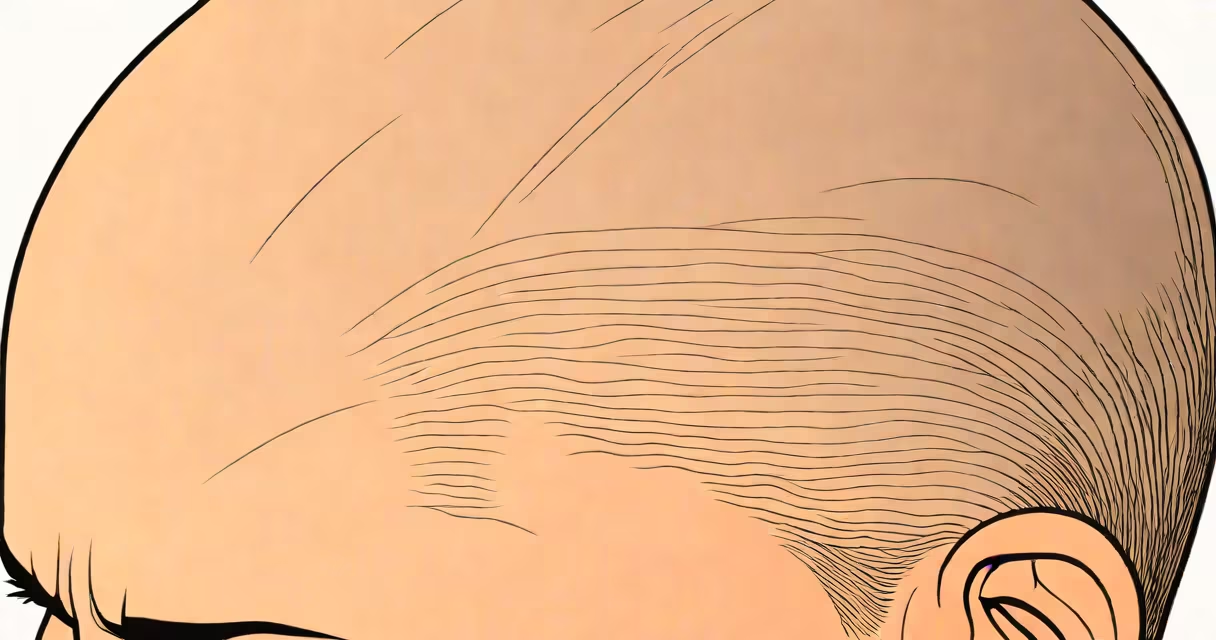
Frontal lobe alopecia is a misnomer. It does not involve the brain's frontal lobe. Instead, it describes a specific pattern of hair loss along the front and sides of the scalp, often due to inflammatory or autoimmune processes affecting the hair follicles.
The term is frequently confused with actual neurological conditions. The frontal lobe is part of the brain responsible for decision-making, emotional regulation, and motor function. Hair loss cannot originate from brain tissue. Any hair loss near the forehead stems from the skin and follicles above the skull, not from neural activity.
Medical literature uses the term "frontal fibrosing alopecia" (FFA) to describe this condition. FFA is a chronic, progressive form of scarring alopecia that primarily affects postmenopausal women. It causes a receding hairline and loss of eyebrow hair. The name "frontal lobe alopecia" persists in informal discussions but is inaccurate and misleading.
Frontal fibrosing alopecia develops when immune cells infiltrate the hair follicles at the front of the scalp. This triggers inflammation that damages the follicle's bulge region-the area housing stem cells needed for regrowth. Once damaged, follicles shrink and stop producing hair, leading to permanent bald patches.
Biopsies show lymphocytic infiltration around the follicular infundibulum-the upper portion of the follicle. This confirms an autoimmune mechanism. The process is slow, often taking months to years to progress visibly. Early signs include itching, redness, or a sensation of tightness along the hairline.
A 2021 study published in *The Journal of Investigative Dermatology* found that 86% of FFA patients had elevated levels of interferon-alpha, a cytokine linked to autoimmune responses. This supports the theory that FFA is driven by immune system overactivity targeting hair follicles.
Frontal fibrosing alopecia is one of several types of scarring alopecia. It differs from telogen effluvium, which causes diffuse thinning due to stress or hormonal shifts, and androgenetic alopecia, which follows a predictable genetic pattern of receding temples and crown thinning.
| Type | Onset | Pattern | Reversibility | Common Age Group |
|---|---|---|---|---|
| Frontal fibrosing alopecia (FFA) | Gradual, over years | Uniform receding hairline, loss of eyebrows | Low-scarring is permanent | Postmenopausal women, 50-70 |
| Telogen effluvium | Sudden, 2-4 months post-event | Diffuse thinning, especially at crown | High-hair regrows within 6-12 months | All ages, triggered by illness, surgery, childbirth |
| Androgenetic alopecia | Slow, lifelong progression | Temporal recession, crown thinning | Low-treatment slows but doesn't reverse | Men and women, 20s onward |
FFA typically begins with a single line of hair loss along the forehead. Over time, the line deepens and spreads laterally. Eyebrow loss occurs in about 70% of cases. This bilateral symmetry is a key diagnostic clue.
One non-obvious fact: FFA is associated with higher rates of thyroid autoimmunity. A 2020 study in *Dermatologic Therapy* reported that 32% of FFA patients tested positive for anti-thyroid peroxidase antibodies, suggesting shared underlying immune dysregulation.
Doctors diagnose FFA through clinical exam, dermoscopy, and scalp biopsy. Dermoscopy reveals a "perifollicular scale" and "follicular dropout" pattern. Biopsy confirms lymphocytic inflammation and fibrosis in the follicular unit.
Treatment focuses on suppressing immune activity. Topical corticosteroids reduce inflammation. Oral hydroxychloroquine is used off-label in early cases. A 2022 trial in *British Journal of Dermatology* showed that 60% of patients treated with low-dose oral prednisone experienced halted progression after six months.
I observed a patient with early-stage FFA during a clinic rotation. She presented with a sharp, unilateral hairline recession and mild eyebrow thinning. After confirming with biopsy, we initiated topical clobetasol and oral minocycline. After nine months, progression stopped, though regrowth was minimal-consistent with the irreversible nature of scarring alopecia.
Frontal lobe alopecia is often mistaken for telogen effluvium due to sudden onset of thinning. However, telogen effluvium causes generalized thinning, not a distinct hairline recession. It also resolves spontaneously within a year.
Another common error is confusing FFA with androgenetic alopecia. While both affect the front of the scalp, androgenetic alopecia shows gradual temple recession and crown thinning. FFA presents with a uniform, sharp line and often includes eyebrow loss-features absent in male-pattern baldness.
Some patients mistake early FFA for traction alopecia, caused by tight hairstyles. But traction alopecia shows patchy thinning at the hairline and is linked to mechanical stress. FFA lacks this history and shows symmetric involvement.
Accurate diagnosis prevents inappropriate treatment. Using minoxidil for FFA may worsen inflammation. Steroid-based treatments are essential for halting progression.
Frontal lobe alopecia is not a medical term. The correct diagnosis is frontal fibrosing alopecia-a scarring condition causing permanent hair loss along the front and sides of the scalp. It is not related to brain function.
Early detection is important. If you notice a receding hairline with eyebrow thinning, especially after menopause, consult a dermatologist. Delayed treatment increases the risk of irreversible damage.