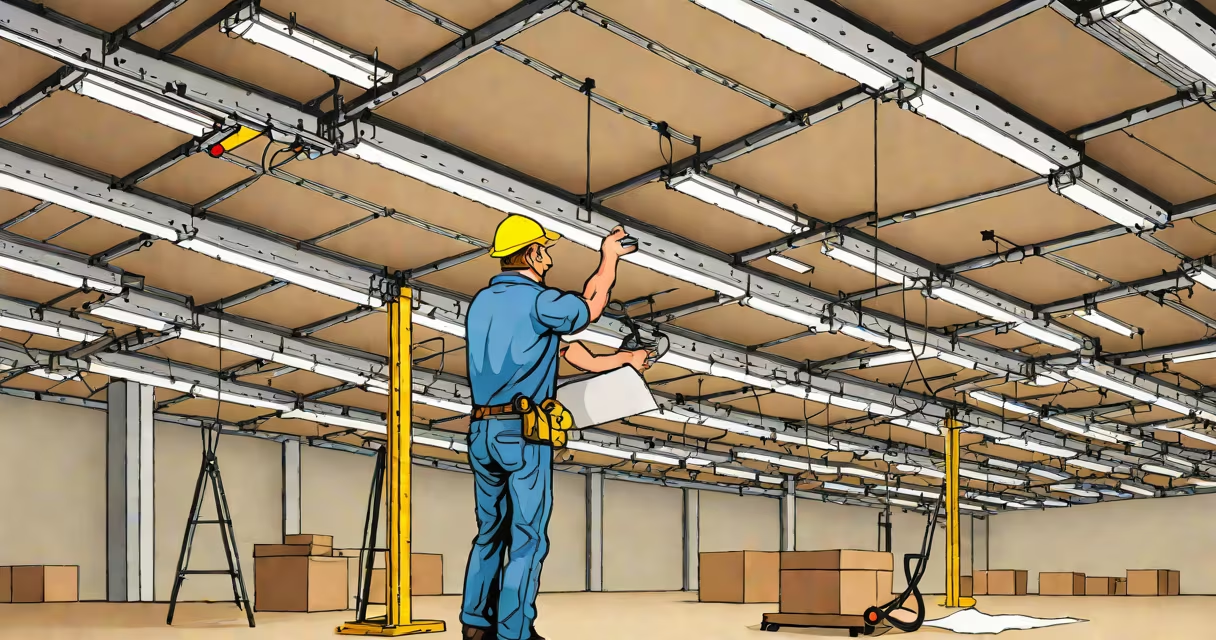
A commercial lighting company specializes in designing, supplying, and installing lighting systems tailored for large-scale indoor environments such as offices, factories, retail stores, hospitals, and warehouses. These firms focus on functionality, energy efficiency, and long-term cost savings rather than aesthetic flair.
Unlike residential lighting providers, commercial lighting companies handle complex electrical layouts, high-bay fixtures, motion sensors, daylight harvesting, and compliance with building codes like the International Energy Conservation Code (IECC). They assess space usage, workflow patterns, and safety standards to deliver lighting that supports productivity and reduces operational overhead.
For example, a 50,000-square-foot distribution center might require 120 high-intensity LED fixtures mounted at 20 feet above floor level. A commercial lighting company calculates optimal spacing, color temperature (typically 4000K for clarity), and lumen output (minimum 50,000 lumens per fixture) based on task lighting requirements and local regulations.
These companies begin with a site audit. Technicians measure room dimensions, ceiling height, existing light levels using a lux meter, and document current equipment. They then model lighting performance using software like Dialux or Relux to simulate illumination uniformity and glare control.
After analysis, they propose a lighting plan that meets minimum illumination standards set by the Illuminating Engineering Society (IES). For instance, a retail store requires 500 lux at floor level for product visibility, while a manufacturing floor needs 300 lux to prevent eye strain during precision tasks.
Once approved, the company procures fixtures compliant with ENERGY STAR and UL standards. Installation follows strict safety protocols, including lockout-tagout procedures and coordination with facility managers to minimize downtime. Final testing includes photometric verification to ensure actual light levels match design specs.
Commercial lighting companies deploy several system types based on application:
| Type | Use Case | Typical Features | Example Application |
|---|---|---|---|
| High-Bay LED Fixtures | Warehouses, factories | 6000-10,000 lumens, IP65 rating, 5-year warranty | 30-foot-high warehouse aisles |
| Linear LED Panels | Offices, schools | 3000-5000 lumens, 3500K color temp, dimmable | Open-plan office ceilings |
| Track Lighting with LED Modules | Retail stores, galleries | Adjustable heads, 2700K-4000K, recessed or surface mount | Display cases in a boutique |
| Emergency Lighting Systems | Stairwells, exits, corridors | 90-minute battery backup, EN 1838 certified | Fire exit routes in a hospital |
Some companies offer integrated smart controls via IoT platforms. A grocery chain in Texas reduced energy use by 42% after installing motion-sensor-controlled LED lighting in storage areas through a commercial lighting provider's automated system.
Many assume commercial lighting companies simply sell lights. In reality, they provide engineered lighting solutions. A single fixture replacement may seem straightforward, but improper installation can cause flickering, inconsistent brightness, or even fire hazards due to voltage mismatch.
Another misunderstanding is equating "commercial" with "industrial." While both serve large buildings, industrial settings demand higher durability. A factory environment may require IP66-rated fixtures resistant to dust, moisture, and vibration-features not needed in a clean office space.
One non-obvious difference: commercial lighting companies often have in-house electrical engineers who validate load calculations and circuit design. A failed project in a Boston medical clinic resulted from a contractor underestimating the amperage draw of 40 new LED panels. The issue was caught only after a circuit breaker tripped repeatedly. The correct firm would have run a load study before ordering equipment.
Energy codes now mandate lighting power density (LPD) limits. The 2021 IECC sets LPD caps at 0.75 W/ft² for offices and 0.50 W/ft² for warehouses. A commercial lighting company ensures compliance through precise fixture selection and layout optimization.
I once observed a retrofit project at a 10,000 sq ft office in Denver. The client hired a general electrician who replaced fluorescent troffers with standard LED panels. Within six months, employees reported eye fatigue. A commercial lighting company later diagnosed the problem: the new panels emitted 5000K light, which increases blue light exposure and disrupts circadian rhythms. Replacing them with 3500K fixtures resolved the issue.
When selecting a commercial lighting company, verify certifications. Look for membership in the National Electrical Contractors Association (NECA) and accreditation from the Lighting Controls Association (LCA). These organizations enforce training standards and ethical practices.
For larger projects, consider firms offering lifecycle support. A logistics firm in Georgia saved $18,000 annually after switching to a commercial lighting company that included maintenance, bulb replacement, and performance reporting via cloud-based dashboards.
Choosing a qualified commercial lighting company ensures safety, regulatory compliance, and measurable energy reduction. Their work goes beyond wiring-it's about creating environments where people see, move safely, and operate efficiently.
Understanding what a commercial lighting company delivers helps avoid costly mistakes in planning and execution. Whether upgrading a small retail space or redesigning a multi-floor corporate campus, the right partner makes a tangible difference in performance and long-term savings.