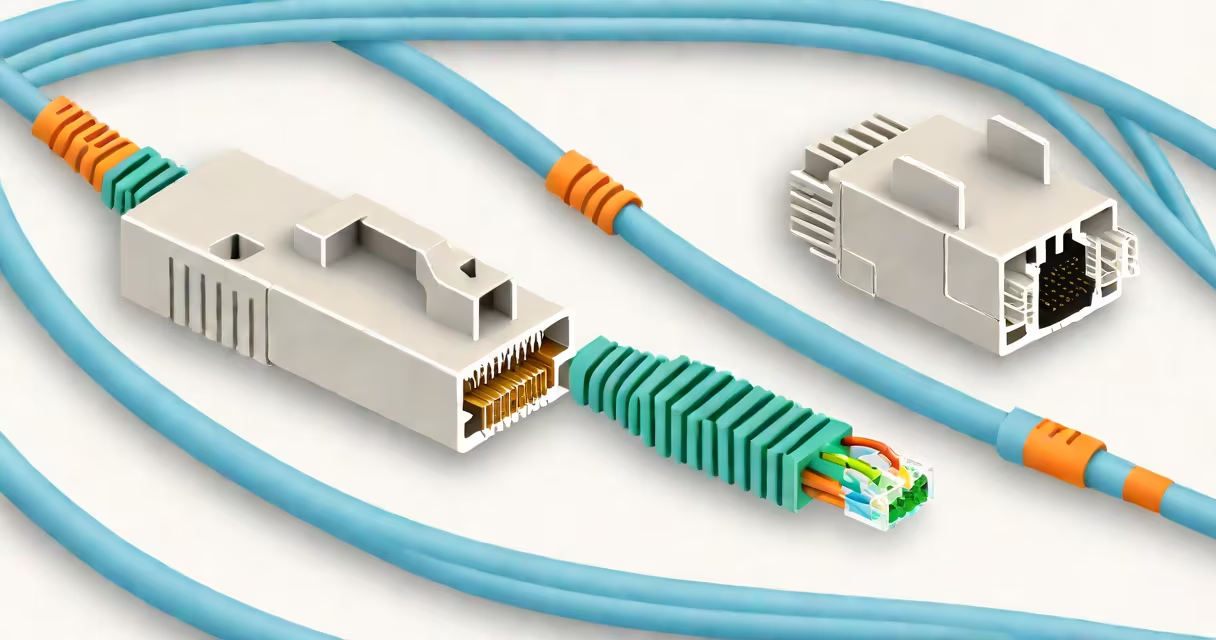
A cat 6 poe cable combines Category 6 Ethernet wiring with Power over Ethernet (PoE) capability, enabling both high-speed data transmission and electrical power delivery through a single twisted-pair cable. It supports speeds up to 10 Gbps over distances up to 55 meters and powers devices like IP cameras, VoIP phones, and wireless access points without requiring separate power lines.
Cat 6 poe cable uses four twisted pairs of copper wire, with specific insulation and shielding to reduce crosstalk and electromagnetic interference. The standard specifies a minimum of 23 AWG wire gauge and tighter tolerances on twist rates compared to older standards like Cat 5e. This design allows for higher bandwidth and better performance under load.
PoE functionality relies on IEEE 802.3af and 802.3at standards, which define how power is injected into the cable. In traditional PoE, power is delivered over the same pairs used for data-typically pins 1,2 and 3,6 in the 8P8C connector. Cat 6 poe cables meet the current PoE standards, including PoE+ (up to 30 watts) and newer variants like PoE++ (up to 90 watts), though actual power delivery depends on the switch and device compatibility.
The cable transmits data using differential signaling across twisted pairs. For PoE, power is injected at the source-usually a PoE-enabled switch or injector-and travels alongside data signals. The receiving device (like a security camera) separates the power from the data using internal circuitry. This dual function eliminates the need for additional power outlets near networked devices.
Each pair in a Cat 6 cable handles a portion of the data stream. Pairs 2 and 3 carry data in opposite directions during transmission. When PoE is active, power flows between the same pairs. The cable's construction-tighter twists, improved insulation, and often a drain wire-minimizes signal degradation and heat buildup, especially under sustained power loads.
For example, a surveillance system using Cat 6 poe cable can run a 1080p IP camera over 100 meters with stable video streaming and consistent power delivery. The cable maintains signal integrity even in environments with high electromagnetic noise, such as industrial settings or near HVAC systems.
There are two primary categories of Cat 6 poe cable: unshielded (UTP) and shielded (STP/FTP). UTP is common in residential and small office installations due to lower cost and easier installation. STP offers better protection against interference and is preferred in high-noise environments like factories or server rooms.
| Type | Shielding | Use Case | Max Distance |
|---|---|---|---|
| Unshielded (UTP) | None | Home networks, small offices | 100 meters |
| Shielded (FTP) | Braided foil around all pairs | Industrial sites, noisy environments | 100 meters |
| Individually Shielded (S/FTP) | Twisted pairs individually shielded + foil | High-security or mission-critical systems | 100 meters |
Not all Cat 6 cables support PoE. Only those rated for PoE (often labeled "PoE-ready" or "IEEE 802.3af/at compatible") can safely deliver power. Using a non-PoE-rated cable for powered devices risks overheating, signal loss, or equipment damage.
Common applications include installing IP-based security cameras, wireless access points, digital signage, and VoIP phones. These devices benefit from centralized power management and reduced cabling complexity. A single Cat 6 poe cable can replace both a data cable and a power cord, simplifying routing and reducing clutter.
In commercial buildings, Cat 6 poe cable enables smart lighting systems controlled via network commands. A single switch can power dozens of lights and sensors across multiple floors, adjusting based on occupancy or time of day. This integration reduces energy waste and maintenance costs.
For example, a retail store installed Cat 6 poe cable to connect 12 IP cameras and 8 Wi-Fi access points. All devices were powered and managed from a central PoE switch in the server room. The setup reduced installation time by 40% compared to running separate power lines and saved $1,200 in labor and materials.
Many assume Cat 6 poe cable can deliver unlimited power. That's incorrect. While Cat 6 supports up to 90 watts under PoE++ (IEEE 802.3bt), the actual power available depends on the switch, cable quality, and distance. Over 50 meters, voltage drop becomes significant, limiting usable power.
Another misconception is that all Cat 6 cables work with PoE. Not true. Some low-cost Cat 6 cables use thinner wire or poor insulation, leading to excessive heat under load. The TIA-568-C.2 standard requires Cat 6 cables to pass specific tests for attenuation and crosstalk-only certified cables meet these thresholds.
A key distinction: Cat 6 poe cable is not interchangeable with Cat 7. Cat 7 uses heavier shielding and larger conductors, supporting higher frequencies (up to 600 MHz vs. 250 MHz for Cat 6). However, Cat 7 is not required for most PoE applications. Using Cat 7 where Cat 6 suffices adds unnecessary cost and rigidity.
I once tested a batch of Cat 6 poe cables labeled "PoE-compatible." After measuring voltage drop over 70 meters, one cable lost 12 volts-enough to prevent a camera from booting. Replacing it with a certified Cat 6 cable restored power delivery. This showed that labeling alone doesn't guarantee performance.
Cat 6 poe cable differs from Cat 5e and Cat 7 in speed, shielding, and power handling. Cat 5e supports up to 1 Gbps and basic PoE (802.3af), but not 10 Gbps. Cat 7 supports 10 Gbps but is bulkier and more expensive-overkill for most PoE deployments.
Compared to fiber optic cabling, Cat 6 poe cable is cheaper and easier to install. Fiber offers longer reach and immunity to EMI, but requires specialized tools and training. For indoor runs under 100 meters, Cat 6 poe remains the practical choice.
When selecting a cable, verify it meets TIA-568-C.2 and ISO/IEC 11801 standards. Look for markings like "Cat 6" and "PoE-ready" on the jacket. Avoid cables sold without certification-these may fail under load or cause safety hazards.
Understanding cat 6 poe cable ensures reliable deployment in modern networks. It's not just about data-it's about delivering power efficiently and safely over a single cable. Proper selection prevents downtime, reduces costs, and supports scalable infrastructure.