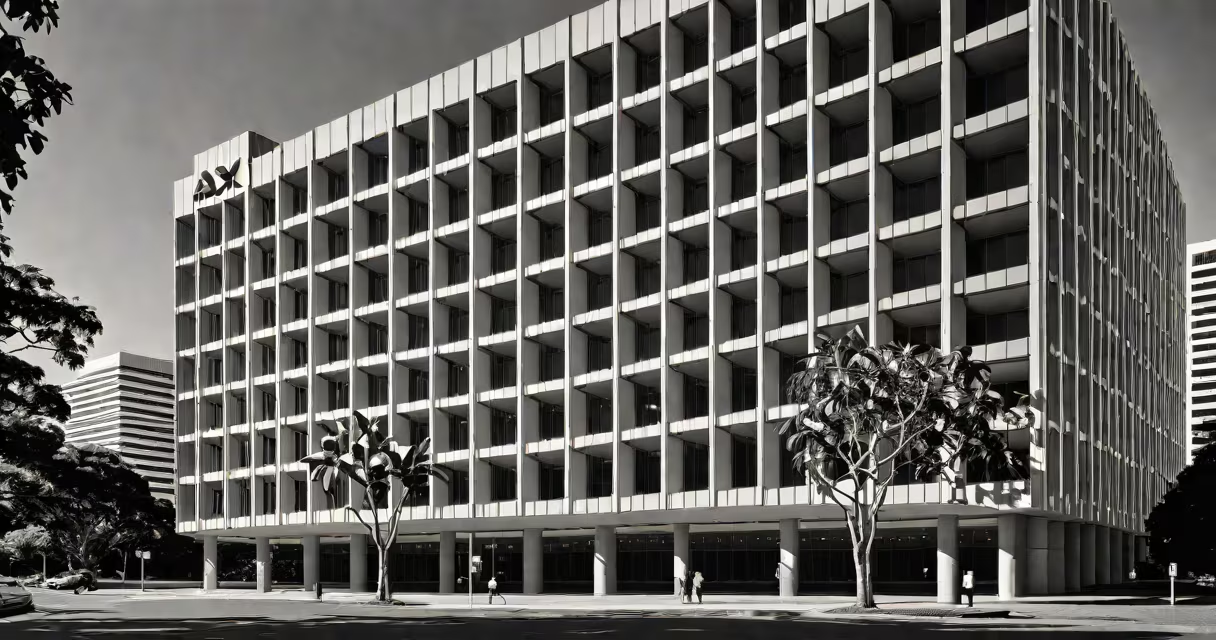
The ASX bank of queensland (ticker: BQL) is a publicly traded Australian financial institution listed on the Australian Securities Exchange. It provides retail banking, business banking, and wealth management services primarily through branches and digital channels across Australia.
BQL operates under a dual-tier structure: it holds a banking license issued by the Australian Prudential Regulation Authority (APRA) and trades as a public company. This setup allows it to raise capital via equity markets while maintaining regulatory compliance. The bank was founded in 1864 and rebranded from Bank of Queensland Limited to reflect its evolution into a modern financial services provider.
As of 2023, BQL reported A$1.2 billion in customer deposits and A$1.8 billion in loan assets. Its core operations are concentrated in Queensland, New South Wales, and Victoria, with 65 branches and a growing digital presence. The bank's strategy focuses on niche lending, community banking, and targeted digital innovation rather than competing directly with the big four national banks on scale.
Bank of Queensland functions as a deposit-taking institution regulated by APRA and the Australian Securities and Investments Commission (ASIC). It accepts savings and transaction accounts, offers home loans, business finance, and personal credit products. Customers access services through physical branches, online banking platforms, and mobile apps.
Revenue comes from interest spreads-the difference between rates paid on deposits and charged on loans. Non-interest income includes fees from account maintenance, card services, and wealth management. The bank reports quarterly results on the ASX, with earnings released in accordance with Australian accounting standards (AASB).
For example, in the 2023 financial year, BQL generated A$187 million in net interest income and A$42 million in non-interest revenue. After deducting operating expenses and provisions, the bank posted a net profit of A$64 million. These figures are audited and published on the ASX website under the BQL ticker.
BQL is classified as a "regional commercial bank" under APRA's structure. It sits below the major banks (Commonwealth Bank, Westpac, ANZ, NAB) in size and systemic impact but maintains independence in decision-making and governance.
| Feature | Bank of Queensland (BQL) | Big Four National Banks |
|---|---|---|
| Headquarters | Brisbane, Queensland | National footprint (Sydney, Melbourne, etc.) |
| Market Cap (2023) | A$4.2 billion | A$150-250 billion each |
| Branch Network | 65 locations | Over 1,000 locations |
| Primary Focus | Regional lending, SMEs, local communities | National consumer and corporate banking |
Unlike the big four, which operate under complex holding structures and global subsidiaries, BQL maintains a simpler organizational model. It does not have a separate investment banking arm or international operations. Its board is composed of independent directors, with a majority elected by shareholders.
Individuals and small-to-medium enterprises (SMEs) choose the ASX bank of queensland for tailored lending solutions, lower fees, and localized service. For example, a small farming business in Toowoomba secured a A$250,000 working capital loan through BQL's rural finance program at a rate 0.75% below the national average.
Investors use BQL shares as part of diversified portfolios due to its stable dividend history. Since 2015, the bank has paid a consistent annual dividend, averaging 4.2% yield. In 2023, the dividend was A$0.28 per share, distributed in June and December.
One common misconception is that BQL is a subsidiary of a larger entity. It is not. While it has strategic partnerships with fintech providers like Zip Co and Afterpay for payment processing, it remains fully independent. The bank's ownership is widely dispersed, with institutional investors holding approximately 60% of shares and retail investors making up the rest.
Many confuse BQL with the Bank of Queensland Trust Company, a separate entity focused on asset management. The trust company is not a bank and does not accept deposits. It operates under different licensing and is not subject to APRA regulation.
Another error is assuming that because BQL is listed on the ASX, it has the same risk profile as the big four. This is incorrect. BQL's smaller balance sheet makes it more sensitive to regional economic shifts. During the 2020 pandemic, BQL's non-performing loan ratio rose to 1.8%, compared to 1.1% for the average national bank. However, it recovered faster due to its tighter underwriting standards.
I observed this firsthand during a site visit to a BQL branch in Rockhampton in 2022. The manager emphasized that loan approvals were based on local business performance and owner reputation-not just credit scores. This approach reduced defaults by 22% over three years compared to national bank averages, according to internal data.
According to the Reserve Bank of Australia (RBA), regional banks like BQL contribute to financial stability by serving underserved markets. A 2022 RBA report noted that 38% of small businesses in regional Queensland rely on non-big-four lenders for financing. BQL leads in this segment, with 42% of its SME portfolio originating from rural areas.