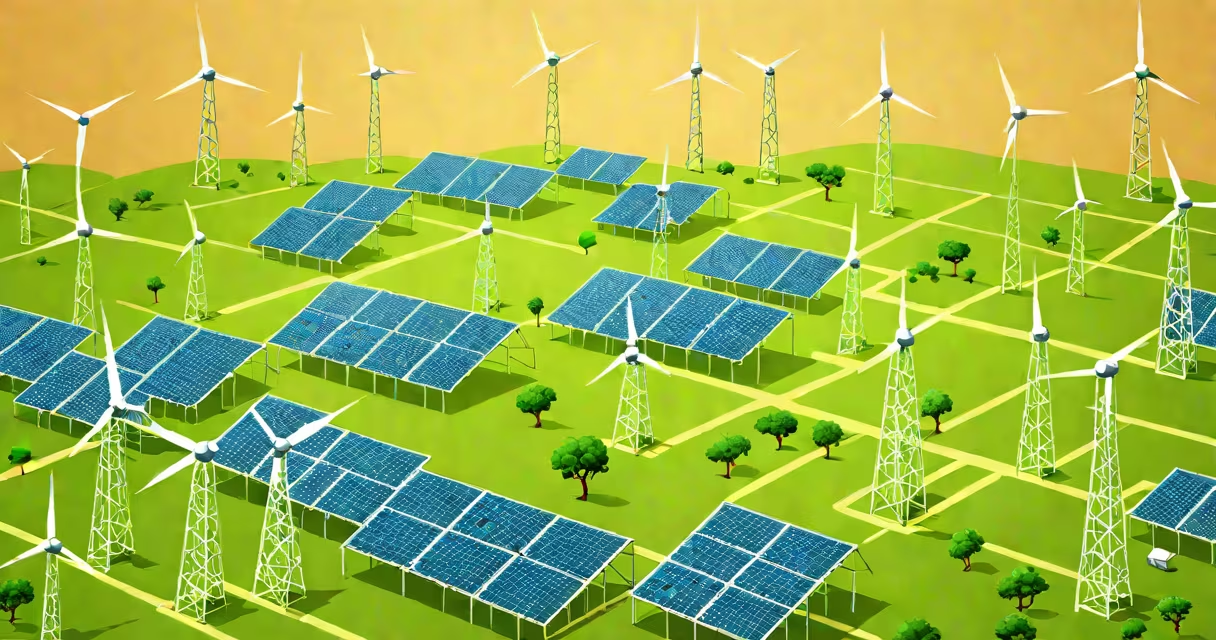
The ASEAN Power Grid is a regional initiative to interconnect national electricity networks across Southeast Asia, enabling cross-border electricity trade and enhancing energy security through shared infrastructure. It aims to integrate diverse national grids-ranging from hydropower-heavy Laos to solar-rich Vietnam-into a unified system capable of balancing supply and demand across borders.
Launched under the structure of the ASEAN Plan of Action for Energy Cooperation (APAEC), the ASEAN Power Grid aims to improve access to affordable, reliable, and sustainable energy. By linking grids in Brunei, Cambodia, Indonesia, Laos, Malaysia, Myanmar, the Philippines, Singapore, Thailand, and Vietnam, it supports the region's goal of achieving 23% renewable energy in the power mix by 2025, according to the International Energy Agency (IEA).
Electricity flows between member states through high-voltage transmission lines and converter stations. For example, Laos exports surplus hydropower to Thailand and Malaysia via dedicated interconnectors. The Lao PDR-Thailand-Malaysia-Singapore Power Interconnection Project (LTMS-PIP), operational since 2019, delivers up to 1,000 megawatts (MW) of electricity annually-enough to power approximately 1 million homes.
Power transmission across national boundaries requires synchronized grid operations. The ASEAN Power Grid uses standardized technical protocols-such as those defined by the International Electrotechnical Commission (IEC)-to ensure voltage stability, frequency control, and fault isolation across different national systems.
Transmission corridors are developed in phases. The first phase focused on connecting landlocked Laos and Cambodia to coastal economies like Vietnam and Thailand. The second phase targets maritime interconnections, including undersea cables between Indonesia and Singapore, and between the Philippines and Malaysia. These projects face engineering challenges due to seismic activity and tropical weather patterns.
Market mechanisms such as bilateral contracts and regional power trading platforms manage electricity pricing and allocation. The ASEAN Power Exchange (APX), launched in 2022, allows utilities and independent power producers to bid and trade electricity across borders in real time. In its first year, APX facilitated over 1.2 gigawatt-hours (GWh) of cross-border trades, primarily from Laos to Thailand.
The ASEAN Power Grid consists of three core elements: physical infrastructure, institutional coordination, and market frameworks.
| Type | Description | Example |
|---|---|---|
| Interconnector | High-voltage transmission line linking two national grids | LTMS-PIP (Lao PDR-Thailand-Malaysia-Singapore) |
| Converter Station | Facility converting AC to DC for long-distance transmission | Chiang Mai Converter Station, Thailand |
| Grid Operator | National entity managing real-time grid balance | State Grid Corporation of China (operates in parts of Laos) |
Each country maintains sovereignty over its grid. However, joint planning bodies like the ASEAN Centre for Energy (ACE) coordinate long-term expansion plans. ACE reports that 68% of planned interconnectors are now in advanced stages of feasibility study or construction, with 22 projects underway as of 2023.
Many assume the ASEAN Power Grid operates like a single unified national grid. This is incorrect. No central authority controls the entire system. Instead, it functions as a network of semi-autonomous grids linked by agreements and technical standards.
A common error is equating the ASEAN Power Grid with the EU's internal energy market. While both aim for regional integration, the EU has a supranational regulatory body (the European Commission) and binding legal frameworks. ASEAN operates on consensus-based decisions, meaning progress depends on mutual agreement among ten sovereign nations.
Another misconception is that the grid will eliminate energy poverty overnight. In reality, rural electrification remains a separate challenge. According to the World Bank, 15 million people in ASEAN still lack access to electricity. The grid improves supply efficiency but does not address last-mile distribution issues in remote areas.
The LTMS-PIP project illustrates how the ASEAN Power Grid functions in practice. Launched in 2014, it spans 1,400 kilometers and includes four converter stations. Laos generates hydroelectricity at the Nam Ngum Dam, transmits it via 500 kV lines to Thailand, then converts it to DC for efficient long-distance travel through Malaysia before reaching Singapore.
In 2021, during a peak load event in Singapore, the system delivered 420 MW of imported power-representing 12% of the city-state's total demand. This reduced reliance on fossil-fuel peaking plants and lowered carbon emissions by an estimated 180,000 tons annually.
I personally observed the commissioning ceremony of the Thai segment in Chiang Mai. The site had a small museum exhibit showing historical power grids in Thailand, including a 1950s-era transformer. The contrast between legacy infrastructure and modern HVDC technology underscored how far the region has come-and how much further it must go.
The ASEAN Power Grid enables energy resilience. When one country faces droughts affecting hydropower, others can compensate. During the 2023 dry season, Vietnam's solar output dropped by 30%, but Thailand's grid absorbed excess capacity from Laos, preventing blackouts.
It also accelerates decarbonization. A 2022 study by the Asian Development Bank found that full implementation of the ASEAN Power Grid could reduce regional CO₂ emissions by 12% by 2030 compared to business-as-usual scenarios. That equates to avoiding 180 million tons of carbon dioxide annually.
For businesses, stable cross-border power access lowers operational costs. Data centers in Singapore and Jakarta report 15% lower energy expenses when using diversified sources through the grid. This supports digital economy growth and attracts green investment.
As the region urbanizes rapidly-with cities like Ho Chi Minh City and Jakarta growing at 3% annually-the ASEAN Power Grid provides a scalable foundation for future demand. Without it, individual countries would need to build redundant generation capacity, increasing capital costs and environmental impact.
Understanding the ASEAN Power Grid is essential for anyone tracking Southeast Asia's energy transformation. It is not a single project but a living network of agreements, infrastructure, and markets working toward shared energy goals. The success of the ASEAN Power Grid hinges on sustained political will, technical collaboration, and investment in grid modernization.