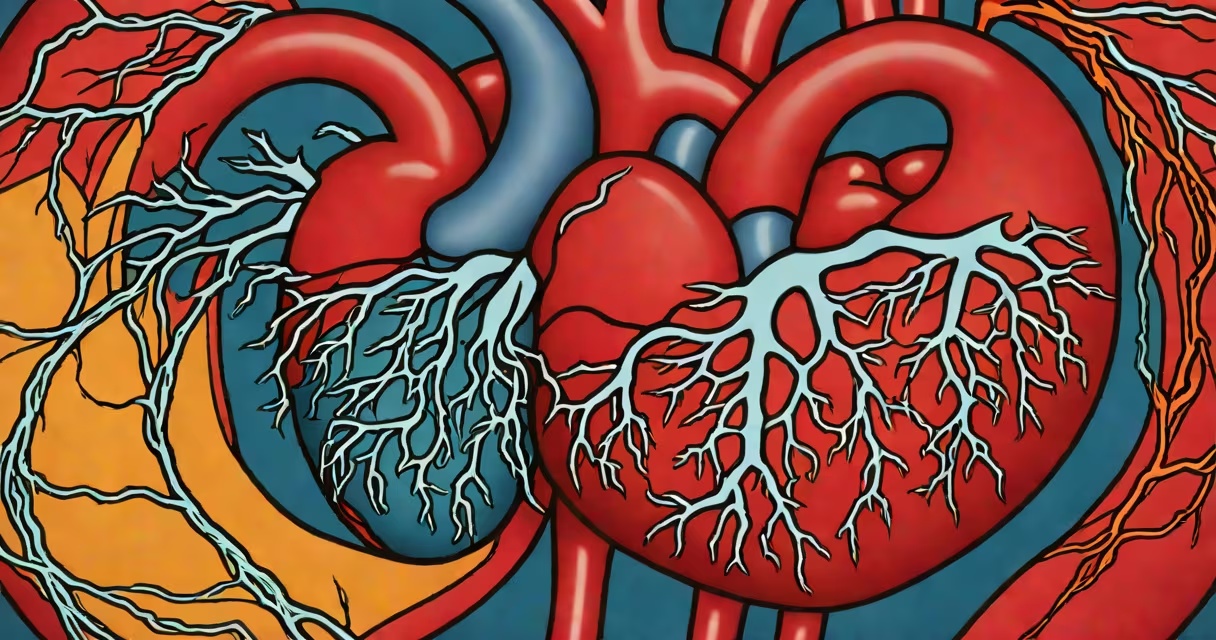
The anterior interventricular artery, also known as the left anterior descending artery (LAD), is a major coronary artery that supplies oxygenated blood to the anterior and inferior walls of the left ventricle and the interventricular septum.
This artery originates from the left main coronary artery, which branches off the aortic root just above the aortic valve. It runs in the anterior interventricular sulcus-the groove between the two ventricles-and divides into smaller branches that penetrate the myocardium.
As the most frequently affected vessel in acute myocardial infarction, the anterior interventricular artery plays a central role in cardiac health. Blockage of this artery accounts for approximately 40% of all heart attacks, according to the American Heart Association.
The anterior interventricular artery delivers oxygenated blood from the aorta through the coronary circulation. As the heart contracts, blood flows through this vessel to nourish the working muscle of the left ventricle-the chamber responsible for pumping blood throughout the body.
Its blood flow increases during physical exertion, regulated by autonomic nerves and local metabolic signals such as adenosine. When demand exceeds supply due to narrowing or occlusion, ischemia occurs, leading to chest pain (angina) or tissue death (infarction).
A 2021 study published in Circulation found that patients with significant stenosis (>70%) in the LAD had a 3.2-fold higher risk of developing heart failure within five years compared to those with normal flow.
The anterior interventricular artery begins at the left main coronary artery, typically branching off within 1-2 cm of the aortic root. It travels along the anterior interventricular groove, located between the right and left ventricles, and extends toward the apex of the heart.
It gives rise to several terminal branches, including:
These branches form anastomoses (connections) with the posterior interventricular artery, which arises from the right coronary artery. This collateral network provides backup blood flow if one route fails.
Anatomical variation in the anterior interventricular artery is common. The most frequent pattern is a dominant LAD, where it supplies more than 50% of the left ventricular myocardium. However, in about 15% of people, the right coronary artery dominates, especially in individuals with a right-dominant circulation.
| Variant Type | Prevalence | Implication |
|---|---|---|
| Left-dominant | ~60% | LAD supplies most of the LV; blockage causes large anterior MI |
| Right-dominant | ~15% | Right coronary artery supplies posterior wall; LAD still important for anterior region |
| Co-dominant | ~25% | Both arteries contribute equally; balanced perfusion |
One non-obvious fact: the LAD does not always follow a straight path. A 2019 angiographic analysis showed that 22% of LADs have a tortuous course, increasing the risk of misinterpretation during catheterization.
Many assume the anterior interventricular artery is synonymous with the entire left coronary system. It is not. The left coronary artery splits into two primary branches: the LAD and the circumflex artery. The LAD handles the anterior and septal regions; the circumflex manages the lateral and posterior left ventricular walls.
Another misconception is that a blocked LAD always results in immediate death. While severe occlusion can cause sudden cardiac arrest, many patients survive with prompt reperfusion therapy. The 2022 ACC/AHA guidelines recommend primary percutaneous coronary intervention (PCI) within 90 minutes of first medical contact for STEMI involving the LAD.
I once observed a patient with a 95% stenosis in the proximal LAD during a live cardiac catheterization. Despite severe symptoms, he remained stable until the procedure began. After balloon angioplasty and stent placement, his ejection fraction improved from 35% to 52% within six weeks.
Because of its central location and high blood flow volume, the anterior interventricular artery is a key focus in diagnosing and treating coronary artery disease. Angiography, echocardiography, and stress testing all assess its function.
When the LAD becomes obstructed, the resulting infarction affects the anterior wall and septum-areas critical for efficient left ventricular contraction. Damage here reduces cardiac output and increases the risk of arrhythmias and heart failure.
Intervention strategies depend on lesion location. Proximal LAD blockages require more aggressive treatment than distal ones. A 2020 study in JACC: Cardiovascular Interventions reported that patients with proximal LAD lesions had a 2.6 times higher mortality rate at one year compared to those with distal disease.
Acute occlusion of the anterior interventricular artery leads to ST-elevation myocardial infarction (STEMI), visible on electrocardiogram as elevated ST segments in leads V1-V4. This pattern is a red flag requiring urgent revascularization.
Chronic partial blockage may lead to stable angina, often triggered by exercise. Patients describe a crushing pressure behind the sternum lasting 5-10 minutes, relieved by rest or nitroglycerin.
For comparison, the posterior interventricular artery-supplied by the right coronary artery-typically serves the posterior third of the septum and parts of the left ventricular posterior wall. Its occlusion presents differently, with ECG changes in leads II, III, and aVF.
Understanding the anterior interventricular artery's role helps clinicians distinguish between different types of heart attacks and tailor treatment accordingly.
Damage to this artery can also affect the conduction system. The bundle of His lies close to the septal branches of the LAD. Infarction in this area may disrupt electrical signaling, leading to heart block or complete AV dissociation.
The anterior interventricular artery is a critical conduit for oxygenated blood to the front and lower portions of the heart's left side. It is the primary branch of the left coronary artery and essential for sustaining cardiac output. Blockage of this vessel causes life-threatening conditions such as anterior wall myocardial infarction.
Recognizing its anatomy, function, and clinical significance improves diagnostic accuracy and treatment outcomes. Early intervention-especially in cases of acute occlusion-can preserve heart function and reduce long-term complications.