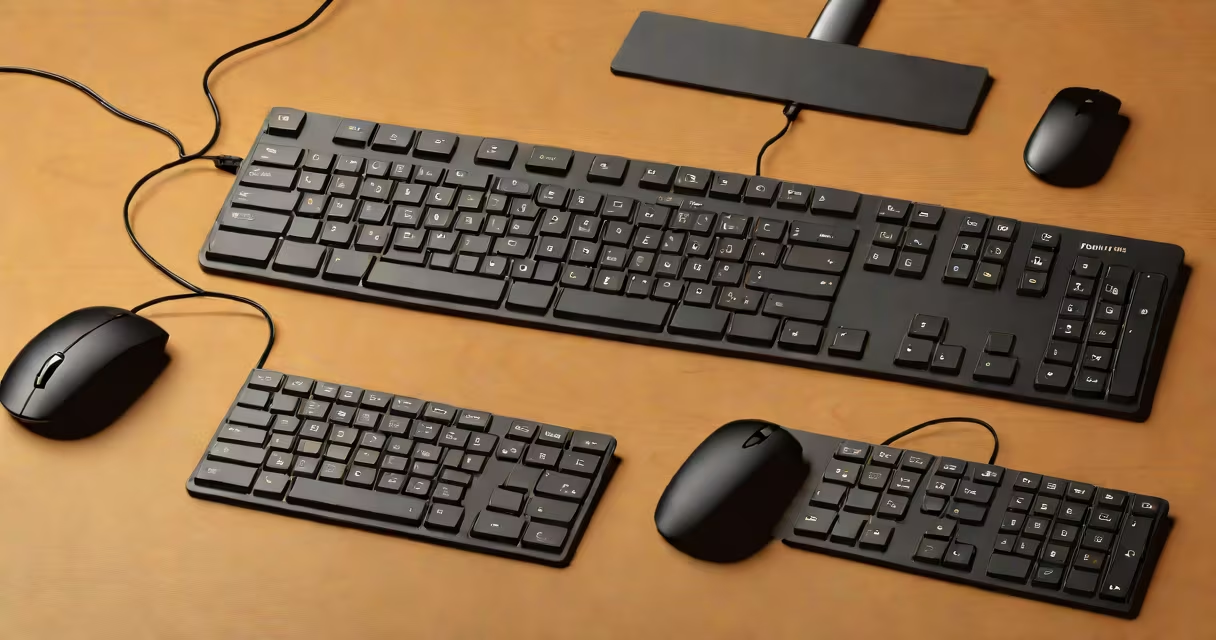
A 2 pc 1 keyboard and mouse is a bundled set containing one keyboard and one mouse sold together as a single unit. These sets are designed for immediate plug-and-play use on desktop computers, offering coordinated design, consistent layout, and often shared connectivity such as USB or Bluetooth.
Most 2 pc 1 keyboard and mouse sets use a single USB receiver or Bluetooth pairing to connect both devices simultaneously. This eliminates the need for multiple ports or separate drivers. The keyboard typically uses a standard QWERTY layout with function keys, while the mouse features a scroll wheel and left/right click buttons. Both components are built to match in color, size, and tactile feel, creating a cohesive input system.
These combos are common in entry-level and mid-range computer setups. They appear in retail bundles from brands like Logitech, Microsoft, and Dell. A typical set includes a wired USB keyboard and mouse, though wireless versions using a single nano-receiver are increasingly popular. Prices range from $25 to $70 depending on build quality and features like backlighting or programmable keys.
The keyboard and mouse communicate with the host computer through a shared connection method. Wired models use a USB cable connected to a port on the PC. Wireless models rely on a single USB nano-receiver or Bluetooth 5.0+ pairing. When powered on, both devices register as separate input devices under the operating system's device manager.
For wireless operation, the nano-receiver plugs into a USB port and acts as a bridge between the computer and the paired devices. The keyboard sends keystrokes via radio frequency signals, and the mouse transmits movement and click data. The receiver decodes these signals and forwards them to the OS as standard HID (Human Interface Device) commands.
Some advanced 2 pc 1 keyboard and mouse sets support multi-device switching. For example, a Logitech K400 Plus wireless combo allows users to switch between two computers using a dedicated button on the keyboard. This feature is useful for people who work across multiple machines but still want a unified input experience.
There are three primary types of 2 pc 1 keyboard and mouse setups based on connectivity and form factor:
| Type | Connection | Use Case | Example |
|---|---|---|---|
| Wired USB | Standard USB-A cable | Home office, budget builds | Microsoft Basic Keyboard and Mouse (6400) |
| Wireless with USB receiver | Single nano-receiver | Desk space optimization, reduced cable clutter | Logitech MK270 |
| Bluetooth-only | Bluetooth 5.0 or higher | Laptop users, multi-device switching | Apple Magic Keyboard with Touch ID and Magic Mouse 2 |
Wireless sets with a single USB receiver are the most common. They offer low latency and stable performance without draining laptop batteries. Bluetooth-only models require no dongle but may have slightly longer pairing times and less range in crowded RF environments.
Ergonomic designs are available in select 2 pc 1 sets. These feature split-keyboard layouts or vertical mice to reduce wrist strain during prolonged typing sessions. According to the American Academy of Orthopaedic Surgeons, proper ergonomics can reduce the risk of repetitive strain injuries by up to 40% over long-term use.
Many users assume that a 2 pc 1 keyboard and mouse set must be purchased as a brand-specific bundle. This is not true. Third-party retailers sell compatible keyboards and mice from different manufacturers as long as they share the same interface protocol. For example, a Logitech keyboard can work with a Microsoft mouse if both support the same USB HID profile.
Another misconception is that all wireless 2 pc 1 sets require a separate receiver. Some models, especially those designed for laptops or tablets, use Bluetooth and do not require a physical dongle. These are ideal for users with limited USB ports or those who travel frequently.
A lesser-known fact: many 2 pc 1 sets use a shared firmware update mechanism. For example, Logitech's SetPoint software allows users to update both devices' drivers and settings from a single interface. This simplifies maintenance and ensures compatibility across updates.
Consider a remote worker setting up a home office. They choose a Logitech MK270 wireless keyboard and mouse combo. The kit arrives with a single USB nano-receiver. After plugging it into their Windows 11 laptop, the system detects both devices automatically within 3 seconds. The keyboard has a quiet mechanical switch feel, and the mouse has a high-precision sensor with 1600 DPI sensitivity.
They use the keyboard for document editing and email, and the mouse for going through spreadsheets and web pages. The compact design fits neatly on a small desk. Over six months of daily use, they report no lag, no disconnections, and minimal battery drain. The set costs $38 at retail, including tax.
This example shows how a 2 pc 1 keyboard and mouse delivers reliability and simplicity. It requires no technical setup beyond plugging in the receiver. The integrated design prevents mismatched components and reduces decision fatigue when buying accessories.
Choose a 2 pc 1 keyboard and mouse when you need a complete, ready-to-use input solution. These are ideal for students, remote workers, and casual users who prioritize ease of setup and consistency. They're also effective for secondary monitors or guest workstations where temporary access is needed.
For professionals requiring advanced customization, such as macro programming or key remapping, standalone devices offer greater flexibility. However, for general productivity tasks-writing, browsing, spreadsheet work-these combos deliver sufficient performance at low cost.
When shopping, verify compatibility with your OS. Most 2 pc 1 sets work with Windows 10/11, macOS, and Linux. Check the product page for supported operating systems. Avoid models labeled "Windows-only" if using a Mac or Chromebook.
A 2 pc 1 keyboard and mouse is a practical, integrated solution for everyday computing. It balances affordability, ease of use, and visual harmony. Whether replacing worn peripherals or building a new workstation, this setup delivers predictable performance without complexity.