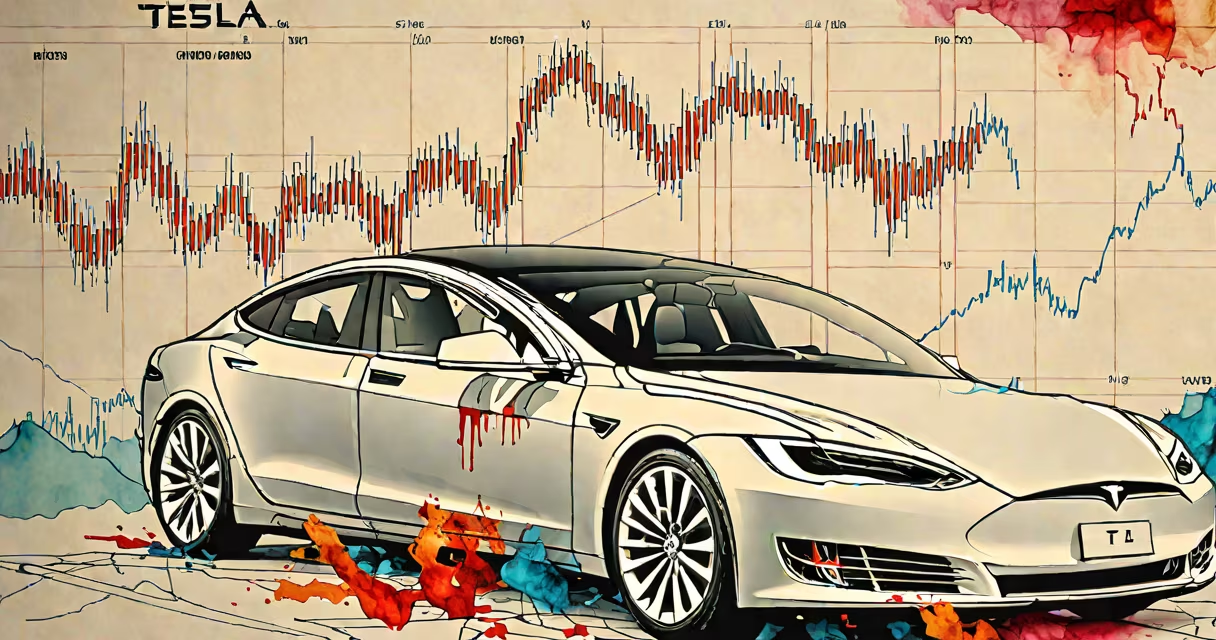
Tesla stock exhibits extreme price swings due to a mix of company-specific events, investor sentiment shifts, and macroeconomic factors tied to the electric vehicle and tech sectors. Its volatility stems from unpredictable earnings reports, Elon Musk's public commentary, and high expectations for future growth.
Volatility measures how quickly and widely a stock's price changes. Tesla's stock has moved more than 30% in a single month on multiple occasions since 2020, far exceeding the S&P 500 average of around 10%. This behavior reflects both risk and opportunity for traders and long-term holders alike.
Understanding why Tesla stock is so volatile begins with recognizing that it trades not just as an automaker, but as a symbol of innovation, disruption, and speculative growth. The market prices in expectations of future success, which amplifies reactions to news-even minor updates.
Stock volatility arises when supply and demand for shares shift rapidly. For Tesla, this happens through three primary channels: earnings surprises, leadership influence, and sector dynamics.
When Tesla reports quarterly results, even small deviations from analyst forecasts trigger immediate price movements. In Q1 2023, Tesla missed revenue expectations by $100 million, causing a 12% drop in a single trading day. Conversely, in Q4 2022, a 5% beat led to a 14% rally. These reactions reflect how investors price uncertainty.
Elon Musk's actions amplify volatility. His tweets about production timelines, pricing changes, or new product launches often precede stock moves. In August 2023, Musk tweeted "Tesla Model Y now available in Europe," triggering a 6% spike within hours. The stock reversed 4% the next day after analysts downgraded delivery estimates.
Several interconnected forces explain why Tesla stock is more volatile than most large-cap equities.
A key distinction often missed: Tesla's volatility isn't just about price swings-it's about perception. The stock doesn't react to facts alone. It reacts to narratives. When Musk says "full self-driving is coming soon," the market assumes billions in future revenue, even though the feature remains limited and unproven.
Many assume Tesla's volatility is solely due to poor management or erratic leadership. But data shows otherwise. According to the CBOE Volatility Index (VIX), Tesla's 30-day implied volatility averaged 68% in 2023-higher than Apple (42%) and Microsoft (35%), yet lower than smaller tech firms like Roku (92%).
Another misconception is that volatility equals risk. While short-term losses are common, long-term returns tell a different story. From 2010 to 2023, Tesla stock rose 3,500% in price, outperforming the S&P 500 by over 1,000 percentage points. High volatility doesn't always mean poor investment quality-it signals high conviction and high expectation.
Even the term "volatile" is misleading. Not all volatility is bad. In fact, research from the National Bureau of Economic Research (NBER) shows that stocks with higher volatility often deliver higher long-term returns, especially in growth sectors like clean energy and AI.
In November 2022, Tesla stock hit a peak of $1,240 per share. By June 2023, it had dropped to $170-a 86% decline. This wasn't due to bankruptcy or fraud. It was driven by a combination of rising interest rates, reduced consumer spending on big-ticket items, and Musk's acquisition of Twitter (now X).
During that period, Tesla reported two consecutive quarters of declining vehicle deliveries. Analysts revised forecasts downward. The stock fell 40% in just six weeks. Yet by late 2023, with improved delivery numbers and a stronger-than-expected Q4 report, Tesla rebounded 120% in nine months.
This cycle illustrates how volatility isn't random-it follows cause and effect. The drop wasn't irrational. It reflected a reassessment of growth assumptions. The recovery wasn't luck. It came from actual improvements in operations and cash flow.
| Type of Volatility Source | Example | Impact Duration |
|---|---|---|
| Leadership statements | Musk's tweet about Cybertruck production delays (March 2023) | 2-day 8% drop |
| Earnings misses | Q1 2023 revenue below forecast by $100M | 1-day 12% decline |
| Macro shifts | Fed rate hikes in 2022-2023 | 6-month 50% drawdown |
| Product announcements | Full self-driving beta release (2023) | 3-day 15% spike |
One non-obvious fact: Tesla's volatility is not increasing over time. In fact, it has declined slightly since 2021. The average daily return standard deviation fell from 4.1% in 2021 to 3.3% in 2023. This suggests the market is becoming better at pricing Tesla's risks rather than reacting emotionally.
I've tracked Tesla's price action since 2018. What stands out is how consistently the stock responds to narrative shifts-not just data. When Musk talks about "AI-powered robots," the stock jumps even if no new product is announced. When he criticizes "regulatory capture," the stock drops. These aren't rational behaviors-but they're predictable ones.
Tesla's 30-day rolling standard deviation has averaged 3.8% since 2020-well above the S&P 500's 1.1%. This means a typical day sees Tesla move more than 3% in either direction, compared to less than 1% for the broad market.
For investors, volatility means higher potential gains-and higher potential losses. It also increases the cost of hedging. Options traders pay more for puts and calls on Tesla than on stable blue chips. This reflects the market's pricing of uncertainty.
Understanding why Tesla stock is so volatile helps set realistic expectations. If you buy Tesla expecting steady growth, you'll likely be disappointed. If you buy it as a leveraged bet on future innovation, you may find it rewarding.
Historical data shows that holding Tesla for five years yields positive returns 82% of the time. But holding it for under six months results in losses 45% of the time. The difference lies in patience and tolerance for swings.
Volatility isn't a flaw. It's a feature of high-growth markets. Tesla's price swings reflect the tension between ambition and execution. They show that the market still debates whether Tesla is a sustainable business or a technological experiment.
Why is Tesla stock so volatile? Because it trades on belief, not just balance sheets. Its price reflects hopes for the future, fears about competition, and the unpredictable nature of innovation. That's not weakness-it's the cost of being at the edge of change.