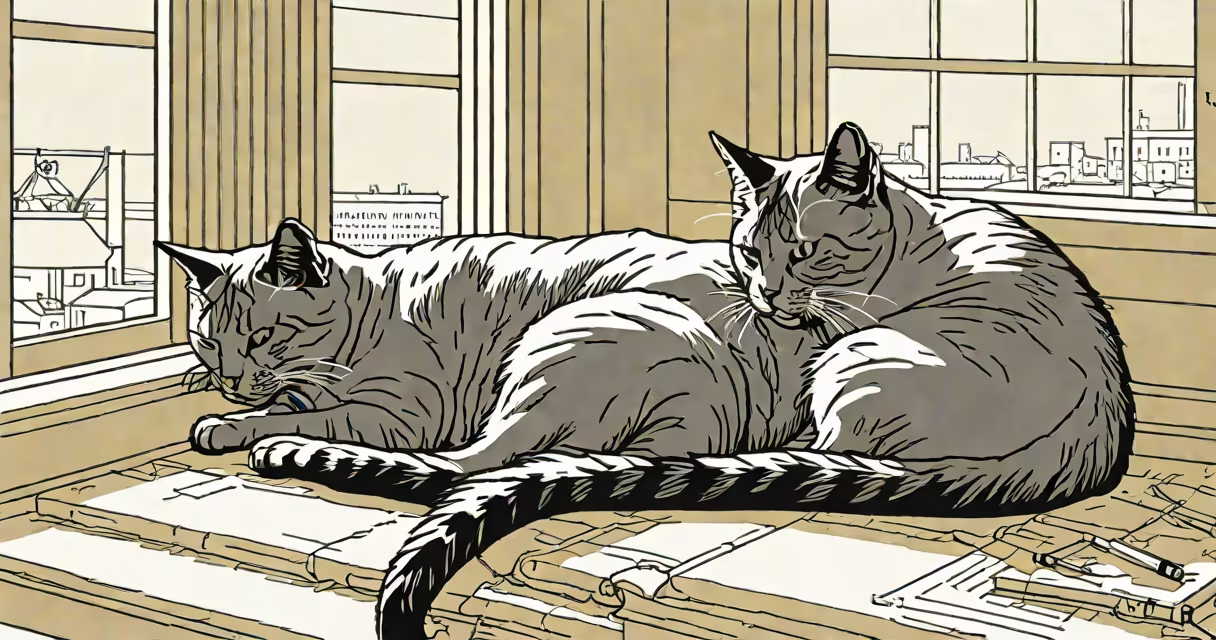
Indoor cats sleep 12 to 16 hours a day because their physiology evolved for short bursts of intense activity followed by long recovery periods. This pattern stems from ancestral hunting behaviors and energy conservation strategies. The average adult cat sleeps nearly twice as long as a human.
Cats are natural predators. In the wild, they rely on stealth and sudden speed to catch prey. These sprints require high energy, so they must rest afterward to recover. Domestic cats inherit this instinct even though they don't hunt for food. Their bodies still operate on the same biological clock: short bursts of play or exploration followed by extended downtime.
A 2020 study published in Applied Animal Behaviour Science found that domestic cats spend 48% of their waking time in light sleep or drowsy states, often with eyes half-open. This allows them to remain alert while conserving energy. Even when awake, many indoor cats exhibit "catnapping" behavior-dozing off during quiet moments like sunlight streaming through a window.
Cats follow a polyphasic sleep cycle, meaning they sleep in multiple short sessions throughout the day rather than one long stretch. A typical indoor cat may nap for 30 minutes, wake briefly to groom or drink water, then return to sleep. This differs from humans, who usually have one consolidated sleep period.
Research from the University of California, Davis Veterinary Medicine Teaching Hospital shows that cats enter REM sleep (rapid eye movement) about every 20 minutes during naps. During REM, brain activity mimics wakefulness, which supports memory consolidation and neural maintenance. Cats experience REM more frequently than humans, contributing to their frequent, brief sleep cycles.
Environmental factors influence duration. A cat in a quiet home with consistent feeding and safe access to elevated spots tends to sleep longer. Noise, unfamiliar people, or changes in routine can reduce sleep time temporarily. However, prolonged reduction may indicate stress or illness.
Not all sleep is the same. Understanding the stages helps distinguish normal rest from potential issues.
| Sleep Stage | Duration | Behavioral Clues | Function |
|---|---|---|---|
| Light Sleep (Non-REM) | 10-30 min | Ears twitch, tail flicks, eyes partially open | Restoration, environmental awareness |
| Deep Sleep (Non-REM) | 30-60 min | Body relaxed, slow breathing, limbs limp | Tissue repair, immune function |
| REM Sleep | 5-10 min | Eye movements under lids, muscle twitches, occasional vocalizations | Memory processing, emotional regulation |
During deep sleep, a cat's body temperature drops slightly. This thermoregulatory shift reduces metabolic demand. A cat sleeping on a warm radiator or near a heater conserves energy efficiently. Conversely, cold environments increase sleep duration as the body seeks warmth and energy savings.
One non-obvious fact: cats don't dream in the same way humans do. While they experience REM sleep, their dreams likely involve sensory fragments-chasing shadows, pouncing on imaginary mice-not narrative sequences. A cat may twitch its legs or make soft meows during REM, but these aren't signs of complex dreaming.
Many owners assume excessive sleep means laziness or poor health. This is incorrect. A healthy indoor cat sleeps more than a dog and more than a human. The misconception arises from comparing species with different evolutionary pressures.
However, sudden changes in sleep patterns can signal problems. If a cat that normally sleeps 14 hours suddenly sleeps 20 hours or more, especially with loss of appetite or reduced interaction, it may indicate illness. Conditions like hyperthyroidism, kidney disease, or depression can cause lethargy.
Another common error is mistaking sleep for disinterest. A cat lying still on a couch isn't necessarily bored. It may be scanning its environment for movement. Cats often sleep with one ear angled toward sound sources. This allows them to respond quickly to stimuli while remaining relaxed.
I once observed a cat named Miso, a 5-year-old domestic shorthair, who slept 18 hours a day after moving to a new apartment. His owner worried he was ill. After three days, Miso began exploring, playing with a feather toy, and eating normally. He had simply adjusted to a new environment. His sleep returned to baseline-14 hours-within a week.
Normal sleep varies by age. Kittens sleep 18-20 hours daily. Adults average 12-16 hours. Senior cats (over 12 years) may sleep 16-20 hours due to decreased mobility and slower metabolism. If a senior cat sleeps more than usual but remains responsive and eats well, it's likely within normal range.
Red flags include:
If any of these occur, consult a veterinarian. Excessive sleep can result from underlying conditions such as anemia, infections, or neurological disorders. Early diagnosis improves outcomes.
Understanding why indoor cats sleep so much prevents unnecessary worry. Their rest patterns reflect survival adaptations, not idleness. When sleep aligns with natural rhythms and the cat remains active and engaged during waking hours, it's a sign of good health.
Why do indoor cats sleep so much? Because evolution designed them to conserve energy between hunting episodes. Modern life replaces hunting with toys and meals, but the biology remains unchanged. A cat sleeping deeply on a sunny rug isn't lazy-it's fulfilling a biological imperative.