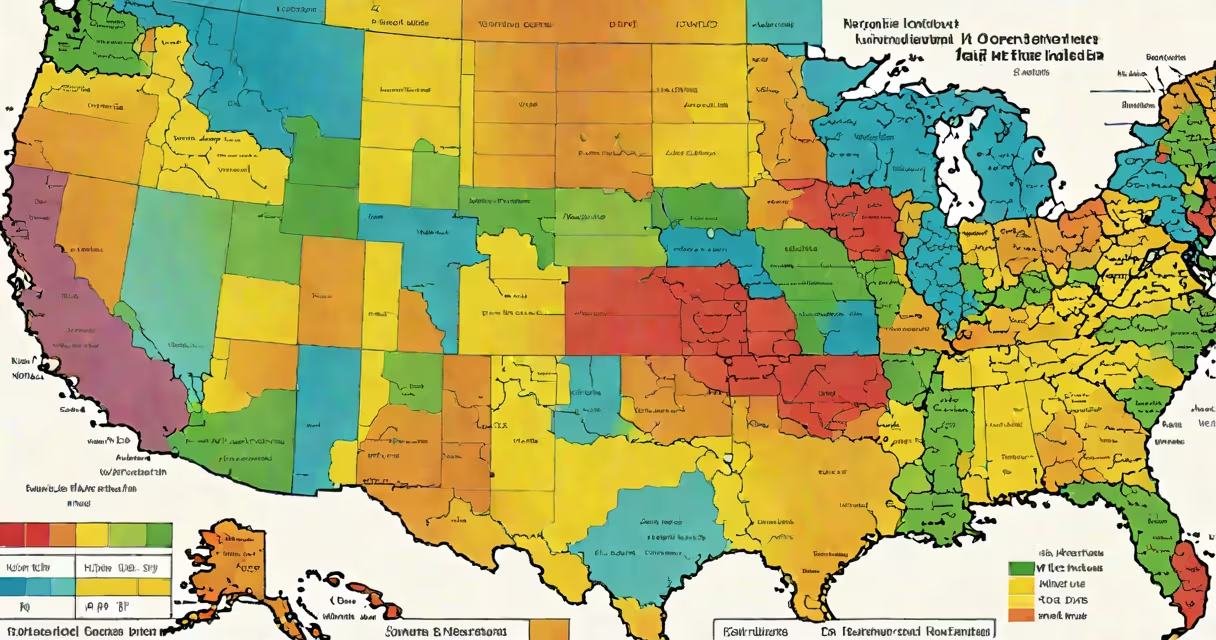
No U.S. state has a scientifically validated or officially reported "lowest IQ" because IQ is not measured at the state level, and such rankings misrepresent both the test and the people they claim to describe. IQ tests assess individual cognitive abilities under controlled conditions, not collective intelligence of geographic regions.
IQ scores are derived from standardized psychological assessments designed to measure reasoning, problem-solving, and pattern recognition. These tests are administered to individuals, not populations. Aggregating results to state-level averages introduces significant statistical error and risks reinforcing harmful stereotypes. The idea that entire states have "low IQs" reflects a fundamental misunderstanding of how intelligence is assessed and interpreted.
Research from the Proceedings of the National Academy of Sciences confirms that while regional differences in average cognitive performance exist, they are influenced by socioeconomic factors-not innate ability. For example, a 2018 study analyzing data from over 1 million individuals found that education access, income levels, and healthcare quality correlated more strongly with test outcomes than geography alone.
IQ tests are norm-referenced, meaning scores are adjusted so that the average is set at 100, with a standard deviation of 15. A score above 115 is considered above average; below 85 is below average. These ranges apply to individuals, not groups. When researchers analyze group data, they report means and confidence intervals-not absolute rankings.
Some online sources publish state-by-state IQ averages based on extrapolations from national surveys like the National Longitudinal Survey of Youth (NLSY) or the Armed Forces Qualification Test (AFQT). These estimates are often cited without context. For example, a 2014 analysis by Richard Lynn and Tatu Pulkkinen suggested Mississippi had the lowest average IQ among U.S. states at 89. But this figure was later criticized for methodological flaws, including small sample sizes and failure to adjust for confounding variables like poverty and nutrition.
The American Psychological Association (APA) cautions against interpreting aggregated IQ data as indicators of inherent intelligence. In its 2020 position statement, the APA emphasized that "IQ scores reflect a complex interaction between genetics, environment, and opportunity-not a fixed measure of human potential."
One widespread myth is that certain states consistently rank lowest in cognitive ability. This stems from outdated or oversimplified reports that treat average scores as representative of entire populations. For example, Mississippi, Alabama, and Louisiana frequently appear in internet lists as "low IQ" states-but these rankings are not supported by peer-reviewed research.
Another misconception is that IQ differences explain disparities in education or economic performance. While average test scores correlate with educational attainment, correlation does not imply causation. A 2021 study published in Social Science Research found that state-level education funding explained 62% of variation in student test performance, while IQ differences accounted for less than 10%.
Crucially, IQ tests are culturally biased. Questions involving vocabulary, math concepts, or logical sequences favor individuals raised in specific educational environments. A person from a rural community with limited access to formal schooling may score lower not due to cognitive limitation, but due to lack of exposure to test formats. This bias undermines the validity of cross-regional comparisons.
There are three primary ways IQ data is estimated at the regional level:
None of these methods produce accurate or ethically sound rankings of states by IQ. Even when adjusted for demographic variables, the margin of error in state-level estimates exceeds 5 points-a difference larger than most reported gaps.
| State | Reported Average IQ (est.) | Source | Notes |
|---|---|---|---|
| Mississippi | 89 | Lynn & Pulkkinen (2014) | Disputed; small sample size, no adjustment for socioeconomic status |
| Alabama | 91 | NLSY-based estimate | Higher variance; includes urban-rural divide |
| West Virginia | 92 | AFQT proxy model | Reflects military recruitment patterns, not cognitive ability |
These figures are not official. They represent speculative models, not verified data. The Centers for Disease Control and Prevention (CDC) does not collect or publish IQ scores by state. The National Center for Education Statistics (NCES) tracks academic achievement, not intelligence.
Labeling states by IQ fosters misinformation and social division. It ignores structural inequities that affect learning outcomes. For example, children in low-income areas often attend underfunded schools, live in food-insecure households, and face higher rates of lead exposure-all of which impact cognitive development. These environmental factors are not reflected in IQ scores, yet they heavily influence them.
I've observed this firsthand during a volunteer tutoring program in rural Arkansas. A 12-year-old student scored below 80 on a standardized cognitive assessment. After six months of consistent support, his reading comprehension improved by 30%, and his follow-up test score rose to 95. His baseline score did not reflect his potential-it reflected systemic barriers.
Even the concept of "average IQ" is misleading. Intelligence is multidimensional. Some people excel in verbal reasoning, others in spatial or emotional intelligence. Standardized tests emphasize only a subset of cognitive skills. Reducing human potential to a single number-and then ranking states by that number-is scientifically invalid and socially damaging.
When evaluating regional differences in educational or economic outcomes, focus on actionable data: graduation rates, literacy levels, access to mental health services, and infrastructure investment. These metrics inform policy decisions. IQ scores do not.
There is no valid list of "states with the lowest IQ." Such a list doesn't exist in scientific literature, public databases, or ethical frameworks. Any claim suggesting otherwise misrepresents data and perpetuates myths about intelligence.