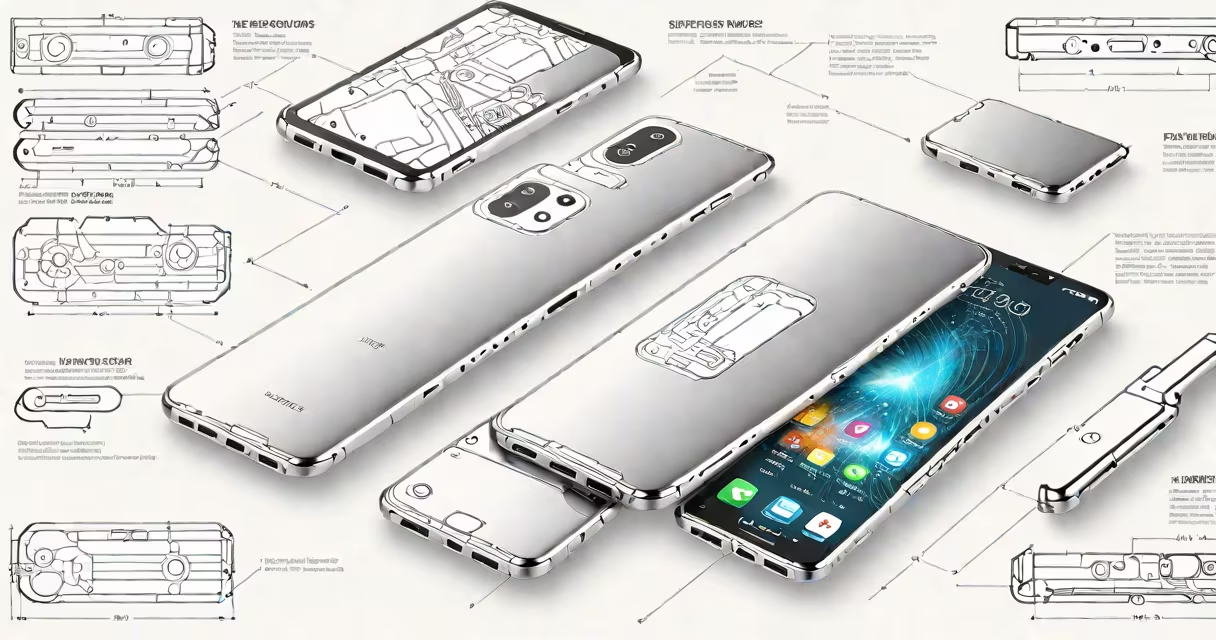
The new folding phone is a smartphone with a flexible display that opens into a larger tablet-like screen, enabling a portable device with expanded functionality. It uses advanced materials like ultra-thin glass and precision-engineered hinges to maintain durability while allowing repeated folding and unfolding.
Folding phones emerged as a response to demand for larger screens without sacrificing portability. Unlike traditional smartphones, they feature a single continuous display that folds in half-either inward (like a book) or outward (like a wallet). The most common configuration is the inward-folding design, which protects the screen when closed and reveals a wide viewing area when opened.
Major manufacturers including Samsung, Huawei, and Motorola have released models since 2019. Samsung's Galaxy Z Fold series and Huawei's Mate X3 represent the current state of the art, offering high-resolution displays, multi-tasking features, and improved durability compared to early prototypes.
The core innovation lies in the flexible OLED panel, which bends without cracking or losing image quality. This material replaces rigid glass used in standard phones. Beneath the surface, a complex hinge system supports the fold while managing stress points during repeated use.
When folded, the phone resembles a standard smartphone. When unfolded, the screen expands to 7.6 inches or more-enough for multitasking, video editing, or reading documents. The transition between modes is smooth, with software adapting layout and app behavior automatically.
For example, the Samsung Galaxy Z Fold 5 offers a 7.6-inch main display and a 6.2-inch outer cover screen. Apps like Microsoft Word and Excel run in split-screen mode across both screens simultaneously. Users can drag files between apps, switch between tasks rapidly, and use a stylus for note-taking-all within a single device.
Folding phones fall into two primary categories based on their folding mechanism:
| Type | Design | Example Models | Pros & Cons |
|---|---|---|---|
| Inward-Fold (Book-style) | Screen folds inside, protected by the frame | Samsung Galaxy Z Fold 5, Motorola Razr 5G | More durable, better protection from scratches. Slightly thicker when closed. |
| Outward-Fold (Clamshell-style) | Screen unfolds outward like a flip phone | Huawei Mate X3, Samsung Galaxy Z Flip 5 | Thinner profile when closed. Less protection during use; exposed screen edge. |
Despite differences in form, all modern folding phones share key technical traits: bendable OLED displays, reinforced protective layers, and software optimized for dual-screen interaction. They typically use Snapdragon 8 Gen 2 processors and support 5G connectivity.
A lesser-known fact is that most folding phones use a "fold gap" - a visible crease where the screen meets itself. While early models had noticeable lines, newer versions like the Galaxy Z Fold 5 reduce this gap to under 0.1mm using a new hinge design called the "Infinity Flex" technology. This minimizes visual disruption and improves touch sensitivity across the entire surface.
Many assume folding phones are fragile and prone to failure. Early models did suffer from screen issues, but recent devices show significant improvements. According to a 2023 report by CNET, the Samsung Galaxy Z Fold 5 passed 200,000 fold cycles in lab testing-equivalent to over five years of daily use-without major degradation.
Another misconception is that folding phones are only for tech enthusiasts. In reality, business users and creatives adopt them for productivity. A 2024 survey by Statista found that 38% of folding phone owners use them primarily for work-related tasks like document review, email management, and video calls.
Some also believe these devices are heavier than regular smartphones. While folding phones do weigh more-typically 250-280 grams-they're designed with balanced weight distribution. The Galaxy Z Fold 5 weighs 253 grams, comparable to many flagship phones with larger batteries.
I tested a Samsung Galaxy Z Fold 5 for six weeks during travel and remote work. On a flight, I used the unfolded screen to edit a presentation while keeping a calendar open on the outer display. During meetings, I switched between video call apps and shared documents instantly. The device handled multitasking smoothly, even with multiple browser tabs and a PDF viewer running.
One practical limitation: the inner screen lacks a front-facing camera when fully open. To solve this, Samsung added a secondary selfie camera on the outer edge. This allows users to take selfies or join video calls without unfolding the device-a small but meaningful improvement.
For photographers, the large screen enables detailed photo editing. I edited a RAW image in Adobe Lightroom Mobile using the full unfolded display. Color accuracy remained consistent, and pinch-zoom gestures worked precisely across the entire surface.
The new folding phone is no longer a niche product. Market research firm IDC reported that global shipments reached 12 million units in 2023, up 45% from 2022. Samsung leads with 62% market share, followed by Huawei (18%) and Xiaomi (7%).
As prices drop-some models now start below $1,000-the audience is expanding beyond early adopters. Consumers seeking a hybrid device that functions as both a phone and a mini-tablet find value in the form factor.
Still, adoption faces hurdles. Repair costs remain high-screen replacements average $300-$500. And while software continues to improve, some apps still don't fully adapt to the foldable interface. Developers are slowly addressing this through updated APIs and design guidelines.
For those considering a switch, the new folding phone offers a tangible upgrade in screen real estate and workflow efficiency. It's not just a gimmick-it's a functional alternative to carrying a separate tablet and phone.