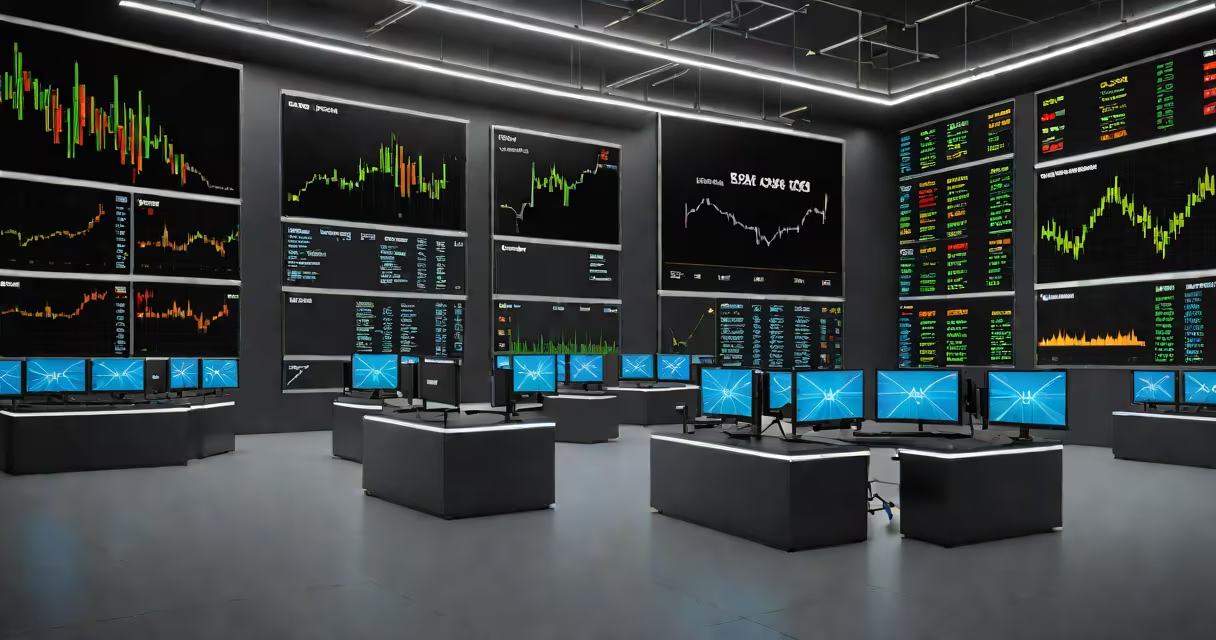
A market exchange is a regulated marketplace where buyers and sellers trade financial instruments like stocks, bonds, options, and futures under standardized rules. It acts as a centralized hub for price discovery, liquidity, and transaction execution, ensuring transparency and fairness in trading.
Market exchanges operate under strict oversight by regulatory bodies such as the U.S. Securities and Exchange Commission (SEC) and are governed by formal listing requirements. They differ from over-the-counter (OTC) markets, which lack centralization and uniform standards. The New York Stock Exchange (NYSE) and NASDAQ are prominent examples of organized exchanges that help millions of trades daily.
Every trade executed on a market exchange goes through a matching engine that pairs buy and sell orders based on price and time priority. Once matched, settlement occurs within T+2 days (two business days after the trade date), meaning funds and securities are transferred between parties. This system reduces counterparty risk and ensures accountability.
When an investor places an order to buy or sell a security, the request is routed to the exchange's electronic trading system. Orders are either placed as market orders (executed at current market price) or limit orders (executed only at a specified price or better). The exchange's matching algorithm processes these orders in real time, prioritizing those with the best price and earliest timestamp.
For example, if a trader wants to buy 100 shares of Apple Inc. (AAPL) at $180 per share, and another trader wants to sell 100 shares at $180, the system automatically matches them. The trade executes instantly, and both parties receive confirmation. This process happens thousands of times per second across major exchanges.
Exchanges also maintain a public order book-a real-time list of pending buy and sell orders. Traders use this data to assess supply and demand, anticipate price movements, and make informed decisions. High-frequency traders exploit microsecond differences in order book updates to profit from small price gaps, highlighting the speed and precision required in modern exchange systems.
There are two primary models: auction-based exchanges and dealer (or quote-driven) markets. Auction-based exchanges, like the NYSE, rely on specialists who match trades and manage order books. Dealer markets, such as NASDAQ, depend on market makers-firms that provide bid and ask prices continuously.
| Type | Structure | Examples | Key Feature |
|---|---|---|---|
| Auction-Based | Centralized matching via specialists | NYSE, LSE | Price discovery through open outcry and electronic auctions |
| Dealer-Driven | Market makers set bid/ask spreads | NASDAQ, London Stock Exchange (alternative system) | Continuous pricing; relies on liquidity providers |
Some exchanges also host derivatives markets, where contracts based on underlying assets (like commodities or indices) are traded. The Chicago Mercantile Exchange (CME) handles futures and options on interest rates, currencies, and equity indexes. These derivatives allow hedging against risk and speculation on future price changes.
The market exchange exists to reduce friction in capital allocation. By bringing together thousands of participants-individual investors, institutions, hedge funds, and corporations-it enables efficient pricing of assets and access to funding for companies. A company going public raises capital by issuing shares on an exchange, while investors gain ownership stakes in growing businesses.
For instance, when Tesla went public in 2010, it listed on NASDAQ. The initial offering raised $226 million, and the stock began trading at $17 per share. Within five years, it reached $700 per share, reflecting investor confidence and growth potential. This flow-from IPO to secondary trading-is only possible through a regulated exchange environment.
Exchanges also serve as economic barometers. Indices like the S&P 500 and Dow Jones Industrial Average track the performance of large-cap stocks and are widely used to gauge market health. When the S&P 500 drops 2%, media outlets report "the market is down," referring to broad exchange activity rather than individual stocks.
Many people assume the market exchange is synonymous with "the stock market." While related, they're distinct: the stock market is the collective term for all venues where stocks are traded-including regional exchanges, dark pools, and OTC markets. The market exchange is one subset of that larger system.
Another misconception is that exchanges are purely speculative. In reality, they support long-term investment and capital formation. According to the SEC, over 70% of U.S. equities trading occurs on regulated exchanges, not informal platforms. This ensures compliance with disclosure rules, anti-fraud measures, and fair access.
A lesser-known fact: exchanges are not neutral platforms. They generate revenue through fees charged to brokers and market participants. For example, the NYSE charges a fee per trade, which contributes to infrastructure maintenance and regulatory compliance. These fees influence trading costs and can affect retail investor returns over time.
In 2018, I monitored a live trading session during a quarterly earnings announcement for a biotech firm. The stock opened at $25.50, but within 15 minutes, after positive trial results were released, it surged to $38.20 on the NASDAQ. The rapid movement was driven by algorithmic orders flooding the exchange's order book. I watched the bid-ask spread narrow from 5 cents to less than 1 cent as liquidity increased. This demonstrated how efficiently exchanges absorb new information and adjust prices in real time.
The market exchange is not a single entity but a network of regulated institutions that enable secure, transparent trading of financial assets. Its structure supports innovation, economic growth, and investor participation. Understanding how it functions helps individuals make better decisions about investing, whether buying a single stock or managing a diversified portfolio.