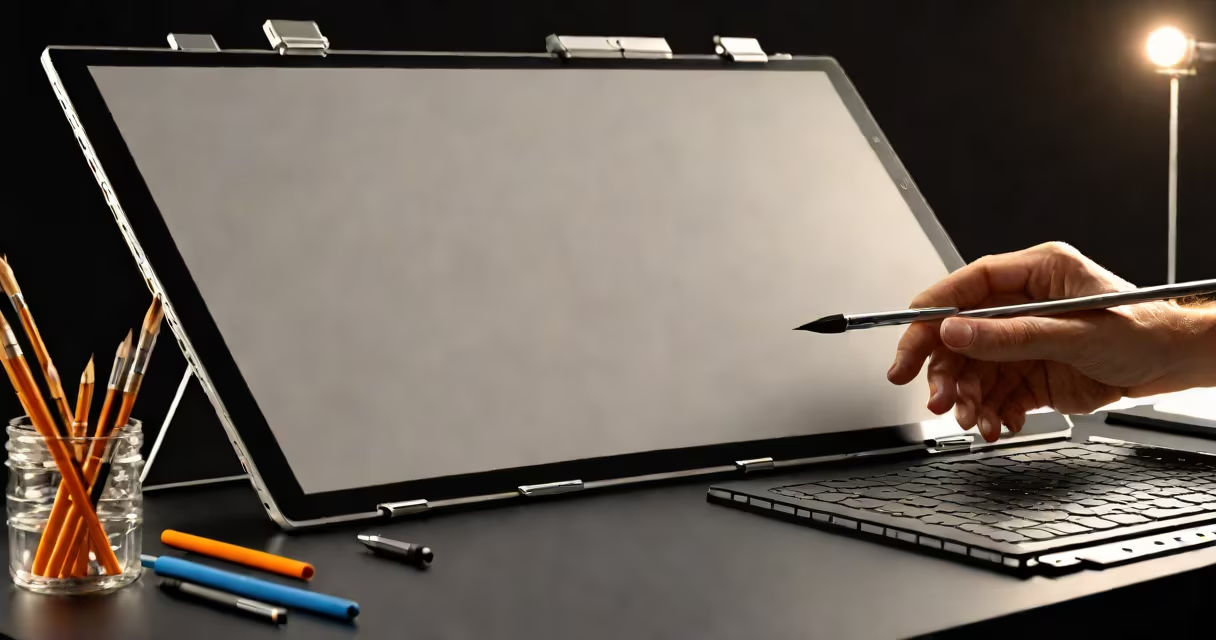
The best drawing tablet for artists delivers precise pressure sensitivity, responsive stylus input, and a display that accurately renders color and contrast-critical for digital painting, illustration, and concept work. Devices like the Wacom Cintiq Pro 24 and Apple iPad Pro with Apple Pencil lead in performance, but the ideal choice depends on workflow, budget, and software preference.
Drawing tablets convert physical pen movements into digital strokes on a screen or surface. Pressure sensitivity allows artists to vary line thickness and opacity based on how hard they press. The tablet's sensor detects tilt, speed, and direction, enabling natural brush behavior.
Styluses differ. Active pens (like the Apple Pencil or Wacom Pro Pen 3) have internal batteries and support advanced features such as tilt recognition and customizable buttons. Passive pens rely on electromagnetic resonance and lack these capabilities.
For example, the Wacom Cintiq Pro 24 uses a 24-inch LCD display with 16-bit pressure sensitivity and supports 2048 levels of pressure. This allows subtle gradients in shading and fine control in detailed artwork.
There are two primary categories: display tablets and non-display tablets. Display tablets feature a built-in screen, letting artists draw directly on the surface. Non-display tablets require a separate monitor and function as a drawing surface.
| Type | Best For | Examples | Key Feature |
|---|---|---|---|
| Display Tablet | Full creative workflow, digital painting | Wacom Cintiq Pro 24, iPad Pro with Apple Pencil | Direct-to-screen drawing, high refresh rate |
| Non-Display Tablet | Sketching, animation, budget users | Wacom Intuos Pro, Huion H610Pro | Lower cost, portable, works with any computer |
Display tablets offer better immersion. When using the iPad Pro with Procreate, artists report a tactile experience nearly indistinguishable from traditional sketching. The 120Hz refresh rate reduces lag, making strokes feel immediate.
Professional illustrators, concept artists, and animators use drawing tablets daily. A 2023 survey by Adobe Creative Cloud found that 78% of digital artists use a tablet for at least 80% of their work. The tools reduce hand fatigue and improve precision compared to mouse-based workflows.
For example, a character designer at a major animation studio uses the Wacom Cintiq Pro 24 to create storyboards. The device's 16-bit depth and 1000 nits brightness ensure accurate color representation during client reviews.
Many artists choose the iPad Pro because it runs Procreate, a useful app with changing brushes and layer management. The combination of hardware and software creates a smooth experience unmatched by most Windows-based tablets.
Some assume all drawing tablets are the same. That's false. A $50 tablet may support only 1024 pressure levels, while a $1,000 model offers 2048 levels and tilt detection. The difference impacts how smoothly lines blend and how expressive the artwork feels.
Another misconception is that higher resolution always equals better performance. A 4K display on a non-display tablet doesn't improve drawing accuracy-it only enhances visual clarity on-screen. For actual drawing, pressure sensitivity and latency matter more.
A key insight: the best tablet isn't the most expensive. An artist I observed at a local studio used a Wacom Intuos 5 for years. She preferred its simplicity and reliability over newer models with flashy features. Her workflow didn't require a screen-she used her laptop's monitor and valued portability and low maintenance.
For professionals needing a full-screen experience, the Wacom Cintiq Pro 24 delivers industry-standard performance. It supports 16-bit pressure, 120Hz refresh rate, and integrates with Adobe Photoshop and Clip Studio Paint. Its 24-inch display provides ample space for complex compositions.
For artists who prefer mobile flexibility and a touch-friendly interface, the Apple iPad Pro (12.9-inch, M2 chip) paired with the Apple Pencil (2nd generation) excels. It runs Procreate, Affinity Designer, and other native apps with minimal lag. The 120Hz ProMotion display ensures smooth animation and precise line control.
For those on a budget or needing a compact setup, the Huion H610Pro offers 8192 pressure levels and a 10x6 inch active area. It connects via USB-C and works with Windows, macOS, and Linux. While not a display tablet, it pairs well with a secondary monitor for efficient workflow.
When choosing between options, consider software compatibility. Wacom tablets integrate deeply with Adobe Creative Set. iPad users gain access to a curated system of art apps. Non-Wacom tablets often require driver installation and may not support all features out of the box.
The best drawing tablet for artists isn't defined by specs alone. It's about matching tool to workflow. A comic book artist working on tight deadlines may prioritize speed and responsiveness over raw resolution. A fine art painter might value color accuracy and brush texture simulation.
The best drawing tablet for artists is the one that fits your process, software, and physical space. Test a few models if possible. Even a 30-minute demo can reveal whether a tablet feels natural under the hand-or causes strain over time.