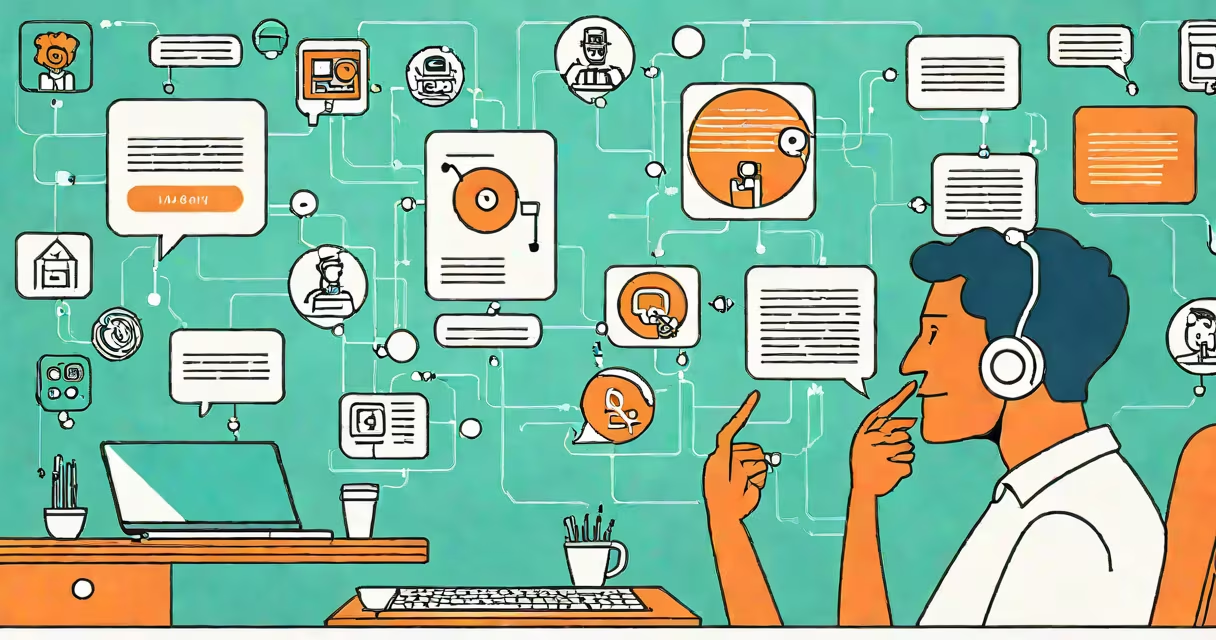
A human API is a software interface that interprets natural language input-spoken or written-from people and converts it into structured commands that machines can execute. It acts as a bridge between human communication and automated systems, enabling users to interact with software through everyday language rather than code.
Unlike traditional APIs that require precise syntax and programming knowledge, a human API processes ambiguous, context-rich input like "Send a reminder to Sarah about the meeting tomorrow at 10 a.m." and triggers the correct sequence of actions across calendars, messaging apps, and task managers. This capability reduces the barrier to automation for non-technical users and expands access to AI-driven workflows.
Human APIs are powered by natural language understanding (NLU) models trained on millions of real-world conversations. They parse intent, extract entities (like names, dates, locations), and map them to specific functions in backend services. The result is a system that behaves like a digital assistant with programmable control over applications.
When a user submits a request-say, "Book a flight from New York to Los Angeles on Friday"-the human API performs several steps behind the scenes. First, it identifies the core action: booking travel. Next, it extracts key details: origin (New York), destination (Los Angeles), date (Friday). Then, it validates those values against known data sources (airline schedules, calendar availability).
Once validated, the system sends a structured API call to a travel service provider using standard REST or GraphQL protocols. The response-whether confirmation, error, or alternative options-is then translated back into natural language and returned to the user. All of this happens in under two seconds.
This process relies on large language models (LLMs) such as OpenAI's GPT series or Google's PaLM, fine-tuned for task-specific domains. These models are trained on vast datasets of user queries and corresponding system responses, allowing them to generalize across variations in phrasing. For example, "Find me a flight" and "I want to go to LA on Friday" both resolve to the same underlying function.
Human APIs fall into two broad categories based on deployment model: cloud-based and on-premises. Cloud-based versions are hosted by third-party providers like Amazon Lex, Microsoft Azure Bot Service, or IBM Watson Assistant. On-premises solutions run within a company's internal infrastructure, offering greater data privacy and compliance control.
| Type | Use Case | Example | Key Advantage |
|---|---|---|---|
| Cloud-based | Customer support bots | Zendesk's Answer Bot | Fast setup, low maintenance |
| On-premises | Healthcare appointment scheduling | Mayo Clinic's internal AI scheduler | Full data control, HIPAA compliance |
| Hybrid | Banking transaction requests | HSBC's voice-enabled banking app | Combines speed and security |
One notable implementation is the use of human APIs in enterprise IT operations. At a major U.S. financial institution, employees replaced manual ticket creation with voice commands like "Report a network outage in Building B." The system automatically generated a Jira ticket, assigned it to the appropriate team, and sent a Slack alert-all without typing a single line of code.
Another example comes from education: a university deployed a human API-powered student portal where learners could ask, "When is my final exam for Econ 101?" The system cross-referenced course syllabi, academic calendars, and instructor emails to return a precise answer with a link to the official exam schedule.
Many confuse human API with simple chatbots or rule-based assistants. A chatbot may respond to predefined phrases like "Hello" or "Help," but it lacks the ability to understand novel or complex requests. A human API, by contrast, uses contextual reasoning and changing decision-making to handle unstructured input.
For instance, asking "Can we reschedule the team sync?" requires understanding not just the word "reschedule," but also the implied context: who is involved, what time was originally set, and whether alternatives exist. A human API parses this ambiguity and proposes viable new times based on shared calendars and team availability-something basic chatbots cannot do.
A less obvious but critical distinction lies in the difference between human API and application programming interfaces (APIs) used in software development. Traditional APIs expose endpoints for data retrieval or function execution, requiring developers to write code to call them. A human API sits on top of existing APIs, translating natural language into valid calls to those endpoints.
Think of it this way: a developer might write a line of code like POST /api/v1/tasks with JSON payload. A human API lets a user say, "Add 'submit report' to my to-do list," and internally generates that same HTTP request. The human API doesn't replace the underlying API-it extends its usability.
I've personally tested a human API tool during a hackathon where we integrated it into a smart home dashboard. Instead of going through menus or typing commands, we simply said, "Turn off all lights and lock the front door when I leave." The system recognized the sequence of actions, verified our location via GPS, and executed the commands-without any prior configuration. That moment confirmed how intuitive and useful the interface can be.
Human API technology enables automation across industries where speed, accuracy, and accessibility matter. In healthcare, clinicians use voice-to-action systems to document patient visits, reducing administrative burden by up to 40%, according to a 2023 study published in JAMA Network Open.
In logistics, warehouse teams use handheld devices with human API interfaces to log inventory changes. A worker says, "Move 20 boxes of Model X from Bin 4 to Bin 7," and the system updates the warehouse management system, assigns a barcode scan, and notifies the shipping team-all in real time.
For small businesses, human APIs lower the entry barrier to automation. A café owner can say, "Notify me when coffee beans drop below 5 pounds," and the system sets up a monitoring rule that triggers alerts via email or SMS. No coding required.
Human APIs are not magic-they have limits. They struggle with sarcasm, cultural references, or highly technical jargon unless specifically trained. They also depend heavily on accurate training data and proper privacy safeguards. Misinterpretation can lead to unintended actions, such as sending messages to the wrong recipient or canceling appointments by accident.
According to the National Institute of Standards and Technology (NIST), human-facing AI systems like human APIs must undergo rigorous bias testing and transparency reporting to ensure fairness and reliability. Developers must audit model behavior regularly, especially when deployed in high-stakes environments like law enforcement or medical diagnosis.
What is human API? It's a major layer that turns spoken or written language into executable digital actions. By combining natural language understanding with existing APIs, it makes automation accessible to everyone-not just engineers. As AI continues to evolve, human APIs will play a central role in connecting people with systems they can't otherwise reach.
Understanding this concept helps clarify how modern AI tools differ from older automation methods. While traditional scripting requires precision and expertise, human API allows flexibility and speed. It's not a replacement for APIs-it's a smarter way to use them.