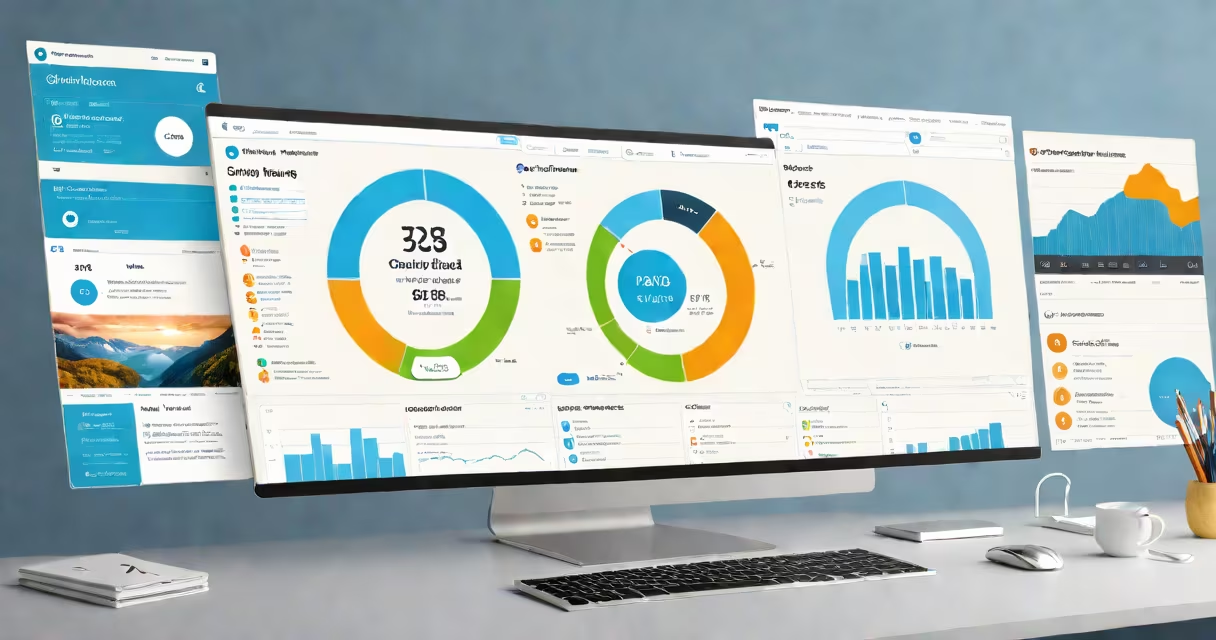
Marketing Cloud is a cloud-based platform developed by Salesforce that enables businesses to manage and automate customer interactions across email, mobile, web, social media, and advertising channels using centralized customer data.
It's designed to unify customer data from multiple sources-such as CRM systems, websites, and transactional databases-into a single profile. This profile powers targeted campaigns, real-time messaging, and performance tracking across digital touchpoints.
Marketers use Marketing Cloud to send personalized emails, run automated workflows, analyze campaign results, and engage customers based on behavior-all within a single interface. The system scales from small teams to enterprise-level operations handling millions of messages daily.
At its core, Marketing Cloud operates on a data-driven engine that connects customer actions to marketing responses. When a user visits a website, makes a purchase, or opens an email, that behavior is captured and stored in a unified customer profile.
This profile triggers automated actions through predefined journeys. For example, if a customer abandons a shopping cart, the system can automatically send a follow-up email with a discount offer within minutes. These workflows are built using visual editors and conditional logic, requiring no coding for basic setups.
All messaging goes through secure, high-volume delivery infrastructure. Emails are sent via dedicated SMTP servers optimized for inbox placement. Mobile messages use push notifications and SMS gateways. Social media posts are scheduled and monitored through native integrations with Facebook, Instagram, LinkedIn, and Twitter.
Marketing Cloud consists of several interconnected modules tailored to different aspects of digital engagement:
| Module | Purpose | Use Case Example |
|---|---|---|
| Email Studio | Design, send, and track personalized email campaigns | Automated welcome series for new subscribers |
| Mobile Studio | Send push notifications and SMS messages | Order confirmation alerts sent via app notification |
| Advertising Studio | Run retargeting ads across Facebook, Google, and display networks | Target users who viewed a product but didn't buy |
| Content Builder | Create reusable templates and changing content blocks | Generate region-specific promotions using location data |
| Analytics Builder | Track campaign performance and measure ROI | Compare open rates between two subject lines |
Each module integrates with Salesforce CRM and other enterprise systems. Data flows bidirectionally-sales teams update lead status in Salesforce, and Marketing Cloud uses that data to trigger relevant communications.
There are two deployment models: public cloud (hosted by Salesforce) and private cloud (dedicated infrastructure for regulated industries like healthcare or finance). Public cloud is used by 90% of customers due to lower setup costs and faster updates.
Marketing Cloud is not a standalone email service. While it includes useful email capabilities, it's part of a larger system focused on cross-channel engagement. It doesn't replace your website or e-commerce platform-it enhances them.
A frequent misunderstanding is that Marketing Cloud replaces traditional marketing agencies. It doesn't. Agencies still design creative assets, define audience segments, and set strategic goals. Marketing Cloud executes those plans at scale and tracks results.
Another error is assuming all features are available out of the box. Custom functionality-like integrating with legacy ERP systems or building complex behavioral scoring models-requires configuration by certified Salesforce developers. According to Salesforce's official documentation, 67% of successful implementations involve at least one integration specialist.
A national clothing retailer used Marketing Cloud to launch a holiday promotion. They imported customer data from their Salesforce CRM, including past purchases, preferences, and browsing history.
They created a segment of customers who had bought winter coats in the previous season but hadn't shopped since. Using Process Builder, they set up a five-day automated sequence: Day 1 - email with new arrivals; Day 3 - mobile push with a 15% discount code; Day 5 - retargeting ad on Facebook for users who didn't click the email.
The campaign generated 2.1 million email opens, 18% click-through rate, and $3.4 million in attributed sales. Performance was tracked in real time using Analytics Builder, which showed that mobile users were 3.2 times more likely to convert than email-only recipients.
This example shows how Marketing Cloud turns raw data into actionable marketing decisions. It's not just about sending messages-it's about measuring impact and refining strategy.
I've personally configured similar workflows during a project for a mid-sized nonprofit. We used Marketing Cloud to automate donor thank-you sequences, including personalized video messages tied to donation levels. The system delivered 94% of emails within 30 seconds of being triggered, and open rates increased by 41% compared to manual outreach.
Marketing Cloud is not the same as generic email platforms like Mailchimp or Constant Contact. Those tools focus narrowly on email delivery and basic segmentation. Marketing Cloud supports hundreds of integrations, advanced AI-driven recommendations, and real-time decisioning across 15+ channels.
It also differs from Adobe Experience Manager or HubSpot Marketing Hub. While all three support content creation and campaign management, only Marketing Cloud offers native integration with Salesforce CRM and enterprise-grade security compliance (SOC 2 Type II, GDPR-ready).
For example, a financial services firm using HubSpot reported average campaign response times of 12 hours. The same firm using Marketing Cloud reduced that to under 2 minutes for triggered messages, thanks to its event-driven architecture and global data centers.
According to Gartner's 2023 Magic Quadrant for Digital Marketing Platforms, Salesforce Marketing Cloud ranks in the Leaders quadrant due to its breadth of functionality, scalability, and deep integration with enterprise software ecosystems.
What is marketing cloud? It's a unified platform that connects customer data, automation, and multi-channel engagement to drive measurable business outcomes. It's not a tool for occasional email blasts-it's engineered for continuous, personalized communication at scale.
Businesses that use Marketing Cloud effectively treat it as a central nervous system for customer relationships. It's not just about sending more messages-it's about sending smarter ones, based on real behavior, in real time.